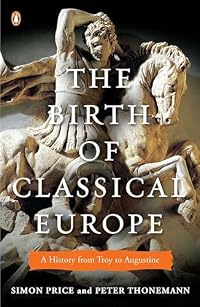
The Birth of Classical Europe: A History from Troy to Augustine
by Simon Price, Peter Thonemann
The Penguin History of Europe (1)
On This Page
Description
To an extraordinary extent we continue to live in the shadow of the classical world. At every level, from languages to calendars to political systems, we are the descendants of a "classical Europe," using frames of reference created by ancient Mediterranean cultures. As this consistently fresh and surprising new audio book makes clear, however, this was no less true for the inhabitants of those classical civilizations themselves, whose myths, history, and buildings were an elaborate show more engagement with an already old and revered past - one filled with great leaders and writers, emigrations and battles. Indeed, much of the reason we know so much about the classical past is because of the obsessive importance it held for so many generations of Greeks and Romans, who interpreted and reinterpreted their changing casts of heroes and villains. Figures such as Alexander the Great and Augustus Caesar loom large in our imaginations today, but they themselves were fascinated by what had preceded them. A stunning work of research and imagination, The Birth of Classical Europe is an authoritative history, covering two millennia of human experience and casting new light on the world that in many ways still defines our own. In their thoughtful look at the twin engines of memory and culture, Simon Price and Peter Thonemann show how our own changing values and interests have shaped our feelings about an era that is by some measures very remote but by others startlingly close. show lessTags
Recommendations








Member Reviews
After reading two of the Penguin History of Europe volumes, which were bad and quite bad, why did I pick up this one? Honestly, because they're well designed and I love series. Luckily, this was much better than the other two. It's not in depth at all, but that's fine; that's the type of thing I want from books like this. It's well written, which is hardly a given these days even for supposedly accessible history writing. And it has a cogent argument: those who look to ancient Greece or Rome for some sort of fixed starting point of history or Europeanness or tradition or whatever are engaged on a fool's errand. Price and Thonemann show that the pre-classical civilizations, and the Greeks and Romans, were always looking backwards to show more justify their actions or existence. People still do it today: x is good/valuable/right because it's what our forefathers did. Well, that's nonsense. As if that wasn't good enough, P & T also manage to split the difference between "There are no facts, only interpretations" and "Only facts matter, interpretations are meaningless" by making sure they explain the facts as well as how those facts were interpreted at the time and since. Their section on pre-classical civilizations was particularly interesting, as were the smattering of pages about the Celts and other north of the alps types. My only caveat is that this might be a tough read if you don't know something about the period already; lots of names whiz by. show less
The Birth of Classical Europe’s wide-angle-lens view of classical influence in European history looks out in all directions, making the book something more than simply a general history of some 2,500 years in and around the Mediterranean Sea. The book is written to be comprehensive, rather than controversial, but one of its most important themes lends a depth of clarity to its ambitious subject that is usually absent in general overviews: the theme of cultural memory and identity:
This book offers (among other things) a historical study of memory, which does not draw a simple line between the ‘true’ and the ‘false’ memory claims of the past. All history is an act of remembering, an attempt by the historian to preserve the show more memory of the past by putting it on record . . . But the historian cannot (or should not) claim to be the simple guardian of the objective truth. History is, at least in part, a constructed artifact, the product of intellectual, social and political pressures.
In other words, it doesn’t really matter if the Romans were not, literally, descended directly from Aeneas of Troy. It does matter that they believed themselves to be, for that belief informed their national character.
Price and Thonemann keep this consideration of cultural memory and identity to the fore as they discuss a historical timeline for the rise of classical civilization that has already been well established. Their style is readable and conversational, but their continued focus on memory, on how the ancients regarded their own past, brings a kind of illumination to periods and events that even classical scholars would find useful and intriguing. Read full review. show less
This book offers (among other things) a historical study of memory, which does not draw a simple line between the ‘true’ and the ‘false’ memory claims of the past. All history is an act of remembering, an attempt by the historian to preserve the show more memory of the past by putting it on record . . . But the historian cannot (or should not) claim to be the simple guardian of the objective truth. History is, at least in part, a constructed artifact, the product of intellectual, social and political pressures.
In other words, it doesn’t really matter if the Romans were not, literally, descended directly from Aeneas of Troy. It does matter that they believed themselves to be, for that belief informed their national character.
Price and Thonemann keep this consideration of cultural memory and identity to the fore as they discuss a historical timeline for the rise of classical civilization that has already been well established. Their style is readable and conversational, but their continued focus on memory, on how the ancients regarded their own past, brings a kind of illumination to periods and events that even classical scholars would find useful and intriguing. Read full review. show less
The Birth of Classical Europe: A History from Troy to Augustine is a fantastic overview of Mediterranean and broader European history. One advantage of reading modern books on history is you have the latest thoughts coming from recent archaeology, technological development, discoveries about languages and migrations, etc.
I have read Freeman's Egypt, Greece, and Rome (my review) so this book was a good refresher for events but did a better job helping me understand the overall historical contexts of the Mediterranean and Asia Minor (Anatolia) during the time period covered. Whereas Freeman tended to categorize his chapters by looking at art, war, technology, and religion separately, Price and Thonemann weave them together as a whole. You show more can't understand what we know about, say, the Punic Wars without looking at who recorded the stories and the context they were writing in. Price and Thonemann also look more at what modern archaeology tells us about the lives and development. There are also several inset boxes that explain the significance of an event or writing in modern history-- whether it be what influenced Machiavelli or Dante's writings, Shakespeare, the U.S.'s Founding Fathers, or Nazi Germany's inspirations.
We start in the areas of Mycenae, whose inhabitants also settled in Crete, blending with a native culture that was growing and continue with the development of Classical Greece, then through the later Greek periods. Not too much time is spent on Philip and Alexander's Macedonian conquests. We then look at the rise of Rome while also looking at the civilizations that existed in mainland Europe (Gaul) and Britain, Carthage (North Africa), Persia, and Syria. The book concludes by looking at Christianity in the early Roman empire, and the increasing divide between East and West (Greek-speakers vs. Latin speakers). It concludes with a look at St. Augustine, which having just read Confessions I found helpful to put him in a greater context. Augustine is truly a post-Roman, a Latin speaker living in a Roman colony, highly educated in the classics and trying to reconcile those classics and Roman history with biblical history. If you want a general history of Europe and the Mediterranean with plenty of peeks at details without going too deep, then this is your book.
I greatly enjoyed it and give it 5 stars. show less
I have read Freeman's Egypt, Greece, and Rome (my review) so this book was a good refresher for events but did a better job helping me understand the overall historical contexts of the Mediterranean and Asia Minor (Anatolia) during the time period covered. Whereas Freeman tended to categorize his chapters by looking at art, war, technology, and religion separately, Price and Thonemann weave them together as a whole. You show more can't understand what we know about, say, the Punic Wars without looking at who recorded the stories and the context they were writing in. Price and Thonemann also look more at what modern archaeology tells us about the lives and development. There are also several inset boxes that explain the significance of an event or writing in modern history-- whether it be what influenced Machiavelli or Dante's writings, Shakespeare, the U.S.'s Founding Fathers, or Nazi Germany's inspirations.
We start in the areas of Mycenae, whose inhabitants also settled in Crete, blending with a native culture that was growing and continue with the development of Classical Greece, then through the later Greek periods. Not too much time is spent on Philip and Alexander's Macedonian conquests. We then look at the rise of Rome while also looking at the civilizations that existed in mainland Europe (Gaul) and Britain, Carthage (North Africa), Persia, and Syria. The book concludes by looking at Christianity in the early Roman empire, and the increasing divide between East and West (Greek-speakers vs. Latin speakers). It concludes with a look at St. Augustine, which having just read Confessions I found helpful to put him in a greater context. Augustine is truly a post-Roman, a Latin speaker living in a Roman colony, highly educated in the classics and trying to reconcile those classics and Roman history with biblical history. If you want a general history of Europe and the Mediterranean with plenty of peeks at details without going too deep, then this is your book.
I greatly enjoyed it and give it 5 stars. show less
Perhaps unsurprisingly, given the title, this book largely ignores any of the early history of Europe that is not directly related to that of Rome or Greece. This is disappointing. However, 'the Birth of Classical Europe' provides a succinct and enjoyable history of the foundation of civilisation in the Mediterranean, the rise of the Greek city states and the war with Persia, Alexander the Great and the emergence of Rome.
In my opinion, the authors place too much emphasis on how the peoples of the region defined their own identities and this is made more frustrating when some significant events are given very scant coverage indeed, for example the Roman destruction of Carthage is covered in half a page. There is also very little mention show more of the nearby Egyptians.
In summary, a good read but you'll have to look elsewhere if pre-Roman British and Northern European history interests you too. show less
In my opinion, the authors place too much emphasis on how the peoples of the region defined their own identities and this is made more frustrating when some significant events are given very scant coverage indeed, for example the Roman destruction of Carthage is covered in half a page. There is also very little mention show more of the nearby Egyptians.
In summary, a good read but you'll have to look elsewhere if pre-Roman British and Northern European history interests you too. show less
The two authors of this historical overview give you a hop-scotch approach to this period. Best for readers who already have the big picture on these classical times/personalities, but a rewarding read for those who are up to speed. Especially enlightening re: its take on the central role of Troy in the narratives of the societies that would, eventually, lay the foundations of Western culture.
Interesting.
I can't recommend this book too highly ~ I found it completely enjoyable, enormously informative as well as extremely readable. The back cover of the Penguin paperback edition says 'We still live in the shadow of the classical world' ~ I'd rather say we still live in the light of that world. In the same way that we look back to the Classical era to throw some light on our modern world, the Greeks and Romans harked back to times 'whose myths, history and buildings were an elaborate engagement with an already old and revered past'. Although Tacitus said 'Omnia, [...] quae nunc vetustissima creduntur, nova fuere' (All the things we now believe ancient were once new: Tac., Annals, 11:24) it's also true the ancient world still has resonance show more and is very much alive today: much we deem 'new' is old.
Price and Thonemann's chronological narrative is well-constructed, taking us from the so-called Dark Ages of the early Aegean civilisations of the Minoans, Mycenaeans and Trojans to the age of Augustine ~ from the mid-Second millennium BC to AD425. The sheer scope of the undertaking, the broad sweep of history, is underpinned by lucid clarity in the writing, meticulous research and a schema which can be easily understood by lay reader and Classics student alike, the general ideas firmly rooted in circumstances and events.
I like the inset boxes within the text, which explain or explore in depth or give more information on peripheral issues, e.g., Evans and Knossos, Black Athena, Hellenism in Asia Minor, Flaubert's 'Salammbo'...
Under the aegis of 'memory', the three themes of the work are communal identity and the spatial, conceptual and changing ideas of 'Europe' as a geographical entity and at the same time an historical and cultural construct.
Sadly, although Simon Price has recently died, the writers also provided a helpful measure of size (p.9) utilising the normal archaeological unit of the hectare (perhaps unfamiliar to non-specialist readers?) in easily-visualised equivalents, viz., a British football pitch is roughly one hectare, an American one half a hectare. If you wish to think in terms of acres, double the number of hectares (or, to be more precise, multiply by 2.5). They also tell us Windsor Castle occupies just over 10 hectares or 26 acres. This kind of small but telling detail, even if only a rule of thumb for ancient settlements, is useful.
Myths are also debunked: Rome did NOT plough salt into the soil of fallen Carthage to make it infertile ~ that particular canard, which has a curious longevity, was invented by an historian writing in 1930. Carthage was dismantled after its defeat in 146BC, its population sold into slavery. In the previous year Corinth had also revolted, and the Romans sacked it the same way they did Carthage ~ it was 'devoted' to the gods of the underworld.
The funniest thing I came across in the book was J. Caesar's writing on the Hercynian forest and the hunting of elk. Elks could not bend their legs, so they slept leaning against trees. Hunters covertly weakened the trunks so, when resting elks subsequently pushed over the trees, they could thus capture the fallen animals! I laughed out loud.
The style has an easy fluency, and there are sidelights on received opinions and assumptions, and lots of challenges to things like post-event 'alterations' of history, as well as small gobbets of information missed out by many Classical Studies courses, e.g., the Alexandrian scholars' selection of what was 'canonical' and what was not, and how the Romans referred to the authors selected by Aristophanes of Byzantium as 'classici' ('of the first class') from which we derive our concept of the 'Classical'. I'm fond of this sort of trivia.
This is a really seriously good book. I'm impressed with it. Tho' the lack of footnotes / endnotes is unusual in a volume of this type, the authors did at least insert an index. It's so well-ordered one can follow it with ease. Clarity in perception and in writing is evident ~ the one is not always mirrored in t'other, especially where Classicists are concerned!
Definitely five + 5 stars! show less
Price and Thonemann's chronological narrative is well-constructed, taking us from the so-called Dark Ages of the early Aegean civilisations of the Minoans, Mycenaeans and Trojans to the age of Augustine ~ from the mid-Second millennium BC to AD425. The sheer scope of the undertaking, the broad sweep of history, is underpinned by lucid clarity in the writing, meticulous research and a schema which can be easily understood by lay reader and Classics student alike, the general ideas firmly rooted in circumstances and events.
I like the inset boxes within the text, which explain or explore in depth or give more information on peripheral issues, e.g., Evans and Knossos, Black Athena, Hellenism in Asia Minor, Flaubert's 'Salammbo'...
Under the aegis of 'memory', the three themes of the work are communal identity and the spatial, conceptual and changing ideas of 'Europe' as a geographical entity and at the same time an historical and cultural construct.
Sadly, although Simon Price has recently died, the writers also provided a helpful measure of size (p.9) utilising the normal archaeological unit of the hectare (perhaps unfamiliar to non-specialist readers?) in easily-visualised equivalents, viz., a British football pitch is roughly one hectare, an American one half a hectare. If you wish to think in terms of acres, double the number of hectares (or, to be more precise, multiply by 2.5). They also tell us Windsor Castle occupies just over 10 hectares or 26 acres. This kind of small but telling detail, even if only a rule of thumb for ancient settlements, is useful.
Myths are also debunked: Rome did NOT plough salt into the soil of fallen Carthage to make it infertile ~ that particular canard, which has a curious longevity, was invented by an historian writing in 1930. Carthage was dismantled after its defeat in 146BC, its population sold into slavery. In the previous year Corinth had also revolted, and the Romans sacked it the same way they did Carthage ~ it was 'devoted' to the gods of the underworld.
The funniest thing I came across in the book was J. Caesar's writing on the Hercynian forest and the hunting of elk. Elks could not bend their legs, so they slept leaning against trees. Hunters covertly weakened the trunks so, when resting elks subsequently pushed over the trees, they could thus capture the fallen animals! I laughed out loud.
The style has an easy fluency, and there are sidelights on received opinions and assumptions, and lots of challenges to things like post-event 'alterations' of history, as well as small gobbets of information missed out by many Classical Studies courses, e.g., the Alexandrian scholars' selection of what was 'canonical' and what was not, and how the Romans referred to the authors selected by Aristophanes of Byzantium as 'classici' ('of the first class') from which we derive our concept of the 'Classical'. I'm fond of this sort of trivia.
This is a really seriously good book. I'm impressed with it. Tho' the lack of footnotes / endnotes is unusual in a volume of this type, the authors did at least insert an index. It's so well-ordered one can follow it with ease. Clarity in perception and in writing is evident ~ the one is not always mirrored in t'other, especially where Classicists are concerned!
Definitely five + 5 stars! show less
Jul 30, 2011Italian
Members
- Recently Added By
Author Information

6+ Works 1,076 Members

14+ Works 751 Members
Peter Thonemann opens up the history and culture of the vast Hellenistic world, and introduces the adventurers who dared to dream of empire after Alexander.
Series

Common Knowledge
- Canonical title
- The Birth of Classical Europe: A History from Troy to Augustine
- Original publication date
- 2010
- Important places
- Troy; Athens, Greece; Rome, Italy; Jerusalem; Constantinople; Knossos, Crete, Greece (show all 9); Autun, Bourgogne-Franche-Comté, France; Carthage, Tunis, Tunisia; Europe
- Important events
- Fall of Troy; Foundation of Rome
- Original language
- English
Classifications
Statistics
- Members
- 571
- Popularity
- 51,441
- Reviews
- 8
- Rating
- (3.76)
- Languages
- Dutch, English, Italian
- Media
- Paper, Audiobook, Ebook
- ISBNs
- 12
- ASINs
- 8