On This Page
Description
"Far in the future, humankind has evacuated the earth in order to preserve it. Humans now reside in a gigantic structure that forms a ring around the earth, 35 kilometers up in the sky. The society of the ring is highly stratified: the higher the floor, the greater the status. Mitsu, the lowly son of a window washer, has just graduated junior high. When his father disappears and is assumed dead, Mitsu must take on his father's occupation. As he struggles with the transition to working life, show more Mitsu's job treats him to an outsider's view into the living-room dioramas of the Saturn Apartments"--Cover, P. [4]. show lessTags
Recommendations


























Member Reviews
Why I read it: I like to get more scifi in my manga, as well as seinen. And Ikki (the Japannese mag this originally ran in) stuff tends to be sort of off-beat, which intrigues me. Well loved by critics. Still wasn't high on my reading list, but it happened to be at the library...
Pros: Interesting world with nice world building that reveals details slowly. A good amount was explored through this volume, while I still got the feeling there were plenty more aspects of the world to be explored in the future. The main character not only entering into an new profession but beginning to work alongside the former coworkers of his deceased father (who died on the job) make a nice setup for good personal drama.
Cons: The unfairness of the class show more system is much less delicately (than other aspects of the world) and much more frequently hit over your head. This wouldn't be a problem if it were something the manga were going to engage with fully and realistically, but the characters' attitudes toward it seem to mostly range from cheerful "Well, what are you going to do? *shrug*" to just vaguely melancholic. It's an attitude some might have, sure, but there's definitely some skirting of the uglier side of social injustice going on here.
Conclusion: I find that a lot of slice of life manga--with their goal of avoiding sensationalizing everything--actually go the opposite way and make life look calmer and sweeter and more lobotomized than it really is. There's an audience for (or certain reading mood) this same as there is for sensationalized stories, but I'm not really it. I also hold that if that's what this manga wanted to be, maybe it shouldn't have introduced/hit us over the head so much with the darker threads like the main character's dead father or the unfair class system. As is, while certain aspects of the manga are realiistic and interesting, the characters come off to me as emotionally unrealistic, and I can't really get into it. show less
Pros: Interesting world with nice world building that reveals details slowly. A good amount was explored through this volume, while I still got the feeling there were plenty more aspects of the world to be explored in the future. The main character not only entering into an new profession but beginning to work alongside the former coworkers of his deceased father (who died on the job) make a nice setup for good personal drama.
Cons: The unfairness of the class show more system is much less delicately (than other aspects of the world) and much more frequently hit over your head. This wouldn't be a problem if it were something the manga were going to engage with fully and realistically, but the characters' attitudes toward it seem to mostly range from cheerful "Well, what are you going to do? *shrug*" to just vaguely melancholic. It's an attitude some might have, sure, but there's definitely some skirting of the uglier side of social injustice going on here.
Conclusion: I find that a lot of slice of life manga--with their goal of avoiding sensationalizing everything--actually go the opposite way and make life look calmer and sweeter and more lobotomized than it really is. There's an audience for (or certain reading mood) this same as there is for sensationalized stories, but I'm not really it. I also hold that if that's what this manga wanted to be, maybe it shouldn't have introduced/hit us over the head so much with the darker threads like the main character's dead father or the unfair class system. As is, while certain aspects of the manga are realiistic and interesting, the characters come off to me as emotionally unrealistic, and I can't really get into it. show less
I’ve been aware of Hisae Iwaoka’s near future slice-of-life manga series Saturn Apartments for a while now. Considering my proclivity for science fiction, it is somewhat surprising that I took so long to get around to reading it, especially since I’ve heard very good things about the series. But when Saturn Apartments was the only manga to make the top ten list of the American Library Association’s Great Graphic Novels for Teens in 2011, I couldn’t ignore it any longer. The first collected volume of Saturn Apartments was originally published in Japan in 2006. The English edition of the book was published by Viz Media’s lovely Signature imprint in 2010. I have enjoyed just about every manga released by Signature, increasing show more the odds even more that I would like Saturn Apartments.
In the near future, the entire earth has been set aside as a nature preserve. The human population has completely removed itself from the planet, now living inside a ring encircling the Earth 35,000 meters above the surface. Most people live in the lower levels of the complex, the middle levels are primarily devoted to public works, while the elite, rich, and powerful inhabit the upper levels. Mitsu lives in the lower levels. A recent junior high school graduate, he has chose to become a window washer like his father before him. Cleaning the outside of the ring is a dangerous and demanding occupation. In fact, Mitsu’ father was lost in an accident while working a job. No one seems to know exactly what happened on that day, but the event affected the entire community.
Iwaoka’s artwork is quite distinctive and I became rather fond of it. I wouldn’t call the art pretty, some might even call it ugly, but it is cute and lovely in its own way. The characters have large heads with small but expressive facial features. While everyone has very similar, stocky body types, it is easy to tell the characters apart. It’s also nice to see such a wide range of ages done in Iwaoka’s style, from toddlers to older adults. The world-building in Saturn Apartments is also very well done--something that the artwork helps emphasize and capture. The differences between those living in the crowded and dirty lower levels and those living in the pristine and luxurious upper levels are made clear simply by looking at their setting. The backgrounds are wonderfully detailed without being too cluttered, really adding to the sense of place. The Saturn Apartments and its environments are just as important to the story as the characters.
I wasn’t wowed or blown away by the first volume of Saturn Apartments, but I did enjoy it. So far the series has a quiet charm and has more depth to it than I first realized. There is a sadness and loneliness to the story that is effective but not overwhelming. Humanity has been literally separated from its origins, making individuals’ struggles to establish and maintain meaningful connections and relationships more vital than ever. Saturn Apartments takes a closer look at these relationships--it's about people. Particularly important, and who ties much of the first volume together, is Mitsu’s father, a character that only appears in flashbacks and as part of other people’s memories. It is obvious that he has impacted the lives of others and his disappearance greatly affected those around him. Mitsu, who feels abandoned, needs to learn about his father and through others is able to begin to better understand parts of his life. I am looking forward to following Mitsu further in the next volume of Saturn Apartments.
Experiments in Manga show less
In the near future, the entire earth has been set aside as a nature preserve. The human population has completely removed itself from the planet, now living inside a ring encircling the Earth 35,000 meters above the surface. Most people live in the lower levels of the complex, the middle levels are primarily devoted to public works, while the elite, rich, and powerful inhabit the upper levels. Mitsu lives in the lower levels. A recent junior high school graduate, he has chose to become a window washer like his father before him. Cleaning the outside of the ring is a dangerous and demanding occupation. In fact, Mitsu’ father was lost in an accident while working a job. No one seems to know exactly what happened on that day, but the event affected the entire community.
Iwaoka’s artwork is quite distinctive and I became rather fond of it. I wouldn’t call the art pretty, some might even call it ugly, but it is cute and lovely in its own way. The characters have large heads with small but expressive facial features. While everyone has very similar, stocky body types, it is easy to tell the characters apart. It’s also nice to see such a wide range of ages done in Iwaoka’s style, from toddlers to older adults. The world-building in Saturn Apartments is also very well done--something that the artwork helps emphasize and capture. The differences between those living in the crowded and dirty lower levels and those living in the pristine and luxurious upper levels are made clear simply by looking at their setting. The backgrounds are wonderfully detailed without being too cluttered, really adding to the sense of place. The Saturn Apartments and its environments are just as important to the story as the characters.
I wasn’t wowed or blown away by the first volume of Saturn Apartments, but I did enjoy it. So far the series has a quiet charm and has more depth to it than I first realized. There is a sadness and loneliness to the story that is effective but not overwhelming. Humanity has been literally separated from its origins, making individuals’ struggles to establish and maintain meaningful connections and relationships more vital than ever. Saturn Apartments takes a closer look at these relationships--it's about people. Particularly important, and who ties much of the first volume together, is Mitsu’s father, a character that only appears in flashbacks and as part of other people’s memories. It is obvious that he has impacted the lives of others and his disappearance greatly affected those around him. Mitsu, who feels abandoned, needs to learn about his father and through others is able to begin to better understand parts of his life. I am looking forward to following Mitsu further in the next volume of Saturn Apartments.
Experiments in Manga show less
Saturn Apartments Volume 1 by Hisae Iwaoka is about a window washer living with the rest of humanity on a giant ring built around the Earth. The environment was destroyed on Earth but instead of putting everyone on massive ships, à la Wall-E, they now live in orbit above it.
Those who can afford to pay for it, have a window to the outside. The best views are those of the planet. They're also the most dangerous to wash. Mitsu is one of those washers, taking up where his father left off, after he was tragically killed years earlier.
As this is the first in the manga series, there are lots of questions posed. What happened to Earth? What's it like down there now? What really happened to Mitsu's father. What's happening to the ring everyone show more lives on? show less
Those who can afford to pay for it, have a window to the outside. The best views are those of the planet. They're also the most dangerous to wash. Mitsu is one of those washers, taking up where his father left off, after he was tragically killed years earlier.
As this is the first in the manga series, there are lots of questions posed. What happened to Earth? What's it like down there now? What really happened to Mitsu's father. What's happening to the ring everyone show more lives on? show less
Mitsu graduates school and begins working as a window cleaner on the outside of the ring surrounding earth where everyone lives now. There are three levels, the top being the most wealthy and living the best lives, the lowest being the bottom of the barrel where people frequently suffer from not getting any natural sunlight. Mitsu is following in his father's footsteps. His dad disappeared on the job one day and now most everyone is trying to help Mitsu succeed.
Clearly this is a dystopia and I am very curious as to whether the story will go deeper into the dystopia or keep following Mitsu as he learns more about his father and those around him. If it follows the dystopia, I am kind of over it. If we follow Mitsu and he doesn't get show more involved in the government, I could be into it. I am sick of dystopia's. show less
Clearly this is a dystopia and I am very curious as to whether the story will go deeper into the dystopia or keep following Mitsu as he learns more about his father and those around him. If it follows the dystopia, I am kind of over it. If we follow Mitsu and he doesn't get show more involved in the government, I could be into it. I am sick of dystopia's. show less
It was a pleasant read. I quite enjoyed the artwork, and the story was thoughtful and interesting, but didn't quite deliver on some those ideas. Perhaps these will develop in later volumes; I'd be happy to read more and see where it goes.
Story: 6 / 10
Characters: 5
Setting: 8
Art: 7
Characters: 5
Setting: 8
Art: 7
Beautiful.
Members
- Recently Added By
Published Reviews
Hisae Iwaoka's Saturn Apartments takes place in a ring-shaped apartment complex orbits the earth, 35 kilometers above the surface—high enough that the air is thin and the earth is a distant ball, but not quite in outer space. Inside, the building is divided into levels that correspond with the levels of society: Wealthy people live in airy, naturally lit apartments in the top level; the show more middle level is dedicated to commerce and agriculture; and the working classes live a dark, cramped existence on the lower level. The difference is not just aesthetic: The lack of natural light causes immune system deficiencies in the lower level, making the inhabitants weak and shortening their lives. This seems to be the only place where people live; the planet earth has been declared a nature preserve and is off limits to humans.
The main characters in this manga are the people who maintain the outer shell of the apartment complex. Most are window washers, who stare down into the spacious apartments of the rich, and one is an inspector, who tramps about, with her dog, looking for flaws in the outer skin of the structure.
Mitsu, the main character, is a second-generation window washer. His father, Aki, disappeared while washing windows on the lower side of the structure, an area where the windows are seldom washed—partly because it is more dangerous there (gravity still exerts its pull this close to the earth) and partly because the lower-level denizens can't afford luxuries like clean windows. Everyone assumes that Aki fell to his death, but Mitsu is not so sure, and the tantalizing possibility remains that he might be still alive on the earth's surface.
On his first day on the job, Mitsu almost meets the same fate as his father. A young couple ask the window washers to clean their windows for their wedding day. Everyone refuses, citing Aki's accident, but Mitsu stands up and says they should find a way—and his co-workers give him the job. Working with his father's old partner, Jin, he finds the spot where Aki's rope broke—apparently an accident caused by a bit of protruding metal. They fix it and move on, but Mitsu lingers a bit too long, trying to get the window just right for the newlywed couple, and ends up being battered by a windstorm. Jin just barely manages to pull him in.
From there, the series moves in a stately pace through a series of short stories. In some ways, it's a workplace story: Many scenes are set in the window washers' workroom, where they gossip and argue, and Mitsu socializes with his co-workers and their families as well. Other stories play on the role of the window washer as the outsider looking in. Mitsu, being young and earnest, quickly gets emotionally involved with his clients and often moves through the barriers, physical and mental, that separate them.
At the same time, there is a wisp of a larger story floating through these short stories. The young couple from the first episode reappear and become a larger part of the story. Sohta, the husband, once dreamed of doing research, but because he is from the lower levels, he is relegated to cleaning tanks and other humiliating jobs. He channels his energy into designing a vehicle that would descend to the earth, work that must be done on the sly. This piece of the story hints at something that is rarely mentioned: The peacekeepers who maintain the rigid discipline and class structure of the ring apartments.
That class structure is a recurring theme in the stories. Mitsu's co-workers are a collection of stock blue-collar characters: Jin hides a kind heart under a gruff exterior, Kageyama is a gentle giant, Makoto is young and rebellious. All three are macho at work but tender-hearted when they are with their families, and in the fourth volume in particular, they are forced to face up to the physical hazards of their work.
The denizens of the upper level are the opposite. Many of them appear to be the idle rich, sitting passively in their sunlit lofts, although a few acknowledge that they work outside the home. One man is a waste collector, tearing down slums and recycling the materials to build new dwellings, a profession that is presented first as exploitation and then as urban renewal. The rich, of course, are no happier than the laborers, and while Mitsu usually is fairly passive when interacting with his co-workers, who have seniority over him, he is more active in solving the problems of his clients.
While the Saturn Apartments are physically stratified, the levels are not impermeable. Prejudice keeps people in the lower levels from getting permanent berths above, and the rich tend to shun the imagined squalor of the lower levels, but the window washers move freely between the different worlds. Class differences are mentioned often, and two of the stories explicitly address class change—one of a woman who moves up, one of a man who moves down. It's a fascinatingly nuanced world, and Iwaoka seems to be capable of weaving an endless number of stories out of its varied threads.
He is also capable of creating an amazingly detailed and varied visual world. The window washers stand on the top of the ring as if they were at the North Pole, surrounded by the emptiness of space. Sometimes he pulls back and shows them as tiny specks, tethered by ropes, atop the vast complex. Other times we see them from the clients' perspective, looking at them from below as they work on their hands and knees. The sophisticated lofts of the upper levels are huge empty spaces with mezzanines, bookcases, even landscaping arranged around the sides—one features a huge fishtank. Down below, the quarters are more crowded and cluttered but no less interesting, and the levels are connected both by elevators and a series of stairways and catwalks. It's a complicated world, but the reader never gets lost in it.
Iwaoka's overarching story is unfolding at a leisurely pace, but each volume of Saturn Apartments has so much going on that it's impossible to become bored. Mitsu's growth from tenderfoot to experienced window washer, Sohta's quest to design something that will bring him the respect he thinks he deserves, the window washers' lives and loves, all make for a fascinating, textured manga that could go on forever. In fact, I hope it does.
You can read the first chapter of each volume of Saturn Apartments, and most of the fourth volume, at Viz's SigIKKI website. show less
The main characters in this manga are the people who maintain the outer shell of the apartment complex. Most are window washers, who stare down into the spacious apartments of the rich, and one is an inspector, who tramps about, with her dog, looking for flaws in the outer skin of the structure.
Mitsu, the main character, is a second-generation window washer. His father, Aki, disappeared while washing windows on the lower side of the structure, an area where the windows are seldom washed—partly because it is more dangerous there (gravity still exerts its pull this close to the earth) and partly because the lower-level denizens can't afford luxuries like clean windows. Everyone assumes that Aki fell to his death, but Mitsu is not so sure, and the tantalizing possibility remains that he might be still alive on the earth's surface.
On his first day on the job, Mitsu almost meets the same fate as his father. A young couple ask the window washers to clean their windows for their wedding day. Everyone refuses, citing Aki's accident, but Mitsu stands up and says they should find a way—and his co-workers give him the job. Working with his father's old partner, Jin, he finds the spot where Aki's rope broke—apparently an accident caused by a bit of protruding metal. They fix it and move on, but Mitsu lingers a bit too long, trying to get the window just right for the newlywed couple, and ends up being battered by a windstorm. Jin just barely manages to pull him in.
From there, the series moves in a stately pace through a series of short stories. In some ways, it's a workplace story: Many scenes are set in the window washers' workroom, where they gossip and argue, and Mitsu socializes with his co-workers and their families as well. Other stories play on the role of the window washer as the outsider looking in. Mitsu, being young and earnest, quickly gets emotionally involved with his clients and often moves through the barriers, physical and mental, that separate them.
At the same time, there is a wisp of a larger story floating through these short stories. The young couple from the first episode reappear and become a larger part of the story. Sohta, the husband, once dreamed of doing research, but because he is from the lower levels, he is relegated to cleaning tanks and other humiliating jobs. He channels his energy into designing a vehicle that would descend to the earth, work that must be done on the sly. This piece of the story hints at something that is rarely mentioned: The peacekeepers who maintain the rigid discipline and class structure of the ring apartments.
That class structure is a recurring theme in the stories. Mitsu's co-workers are a collection of stock blue-collar characters: Jin hides a kind heart under a gruff exterior, Kageyama is a gentle giant, Makoto is young and rebellious. All three are macho at work but tender-hearted when they are with their families, and in the fourth volume in particular, they are forced to face up to the physical hazards of their work.
The denizens of the upper level are the opposite. Many of them appear to be the idle rich, sitting passively in their sunlit lofts, although a few acknowledge that they work outside the home. One man is a waste collector, tearing down slums and recycling the materials to build new dwellings, a profession that is presented first as exploitation and then as urban renewal. The rich, of course, are no happier than the laborers, and while Mitsu usually is fairly passive when interacting with his co-workers, who have seniority over him, he is more active in solving the problems of his clients.
While the Saturn Apartments are physically stratified, the levels are not impermeable. Prejudice keeps people in the lower levels from getting permanent berths above, and the rich tend to shun the imagined squalor of the lower levels, but the window washers move freely between the different worlds. Class differences are mentioned often, and two of the stories explicitly address class change—one of a woman who moves up, one of a man who moves down. It's a fascinatingly nuanced world, and Iwaoka seems to be capable of weaving an endless number of stories out of its varied threads.
He is also capable of creating an amazingly detailed and varied visual world. The window washers stand on the top of the ring as if they were at the North Pole, surrounded by the emptiness of space. Sometimes he pulls back and shows them as tiny specks, tethered by ropes, atop the vast complex. Other times we see them from the clients' perspective, looking at them from below as they work on their hands and knees. The sophisticated lofts of the upper levels are huge empty spaces with mezzanines, bookcases, even landscaping arranged around the sides—one features a huge fishtank. Down below, the quarters are more crowded and cluttered but no less interesting, and the levels are connected both by elevators and a series of stairways and catwalks. It's a complicated world, but the reader never gets lost in it.
Iwaoka's overarching story is unfolding at a leisurely pace, but each volume of Saturn Apartments has so much going on that it's impossible to become bored. Mitsu's growth from tenderfoot to experienced window washer, Sohta's quest to design something that will bring him the respect he thinks he deserves, the window washers' lives and loves, all make for a fascinating, textured manga that could go on forever. In fact, I hope it does.
You can read the first chapter of each volume of Saturn Apartments, and most of the fourth volume, at Viz's SigIKKI website. show less
added by susieimage
Every once in a while you read a manga that just grabs you in some way. There’s a certain draw to these rare titles, and it’s a combination of many components that make up the greater whole. Characters, plot, artwork, and setting all craft the tone of a book, and in the case of Saturn Apartments, that tone is peculiar and addicting.
Created by Hisae Iwaoka, Saturn Apartments volume one was show more originally released in Japan in 2006. VIZ has licensed the series for an American release and it found itself in the Signature lineup. Personally I’ve found that titles from VIZ Signature tend to be more unique and interesting then mainstream manga, and that’s exactly the case with this one.
Saturn Apartments takes place far into the future where man has moved from the Earth to the stars. There is an orbital ring which surrounds the planet, and the world below has remained off limits for a number of years. Earth is basically a giant nature preserve and it’s forbidden to travel to the surface. The view from above is certainly pretty, however the windows on this orbital station can get mighty dirty. That’s where window cleaners come in.
That’s right, Saturn Apartments is a manga about window cleaners in space. In particular the series follows a young upstart named Mitsu, who has just graduated and is determined to take over his father’s career as a cleaner. You see, Mitsu’s dad recently passed away while on the job. Ever since then the people around him have taken care of him, rooted him on, and looked over his shoulder. He has a large surrogate family in the lower level, and it’s this assistance and support that has helped him become the headstrong hard-worker he is today.
Though Mitsu lives in the lower levels of the orbital ring, he attended school in the middle level, and now that he’s a cleaner he does jobs for the upper level. You see, the apartment complex is broken up into the three stages that follow a class structure, so to speak. The lower levels are the poor classes while the upper is the richest, though I’m sure you already figured that one out. Each of the levels was constructed accordingly, and, due to financial hardships, the lower levels aren’t able to get their windows clean. They have to use artificial light which tends to lead to health complications and the whatnot.
As the book continues Mitsu gets in good with the Guild his father used to work for. He’s quickly put on the job and finds himself outside wiping windows for clients and seeing Earth in all its glory. He eventually discovers something about his father’s death that he didn’t realize before, and, beyond that, he gets to know the rest of the Guild members. Some of them are supporters of his; others are friends of his father; and there are some who just plain hate his guts. Mitsu has to deal with all this while his life is overshadowed by the death of his old man.
Through the course of this first volume Mitsu goes on a few cleaning assignments, including one where the guy wants water placed over the window to simulate being under the ocean. There’s a solid bit of reasoning behind it, but it’s not revealed until later in the storyline. There’s also an inspector brought into play later in the book, and the character seems to be of importance to the story. I suppose we’ll find out more in the next installment.
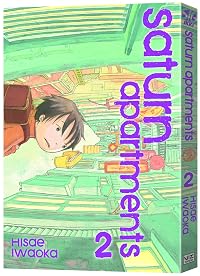
Aesthetically the book stands out, thanks largely in part to Iwaoka’s unique art style. Everything is smallish (almost chibi style) and people in particular look shrunken compared to their environment. That’s probably a deliberate statement on living in the apartments. The lower levels are more compact while the upper levels are more open, leaving readers to assume the upper class leads emptier lives. There’s some incredible detail here, and the backgrounds all have nice definition and depth.
Saturn Apartments is a fascinating read that is richly layered. The characters are the standout element of this book, however, and the development of both main and secondary characters is simply amazing. Mitsu is a deep character, and he feels right at home in the world. It seems as though the apartments were created around him, and that’s really a good thing. This gives readers the sense of connection with the character and he really defines the tone of the series. If you’re looking for a manga that is unlike any other, Saturn Apartments is a sure ticket. show less
Created by Hisae Iwaoka, Saturn Apartments volume one was show more originally released in Japan in 2006. VIZ has licensed the series for an American release and it found itself in the Signature lineup. Personally I’ve found that titles from VIZ Signature tend to be more unique and interesting then mainstream manga, and that’s exactly the case with this one.
Saturn Apartments takes place far into the future where man has moved from the Earth to the stars. There is an orbital ring which surrounds the planet, and the world below has remained off limits for a number of years. Earth is basically a giant nature preserve and it’s forbidden to travel to the surface. The view from above is certainly pretty, however the windows on this orbital station can get mighty dirty. That’s where window cleaners come in.
That’s right, Saturn Apartments is a manga about window cleaners in space. In particular the series follows a young upstart named Mitsu, who has just graduated and is determined to take over his father’s career as a cleaner. You see, Mitsu’s dad recently passed away while on the job. Ever since then the people around him have taken care of him, rooted him on, and looked over his shoulder. He has a large surrogate family in the lower level, and it’s this assistance and support that has helped him become the headstrong hard-worker he is today.
Though Mitsu lives in the lower levels of the orbital ring, he attended school in the middle level, and now that he’s a cleaner he does jobs for the upper level. You see, the apartment complex is broken up into the three stages that follow a class structure, so to speak. The lower levels are the poor classes while the upper is the richest, though I’m sure you already figured that one out. Each of the levels was constructed accordingly, and, due to financial hardships, the lower levels aren’t able to get their windows clean. They have to use artificial light which tends to lead to health complications and the whatnot.
As the book continues Mitsu gets in good with the Guild his father used to work for. He’s quickly put on the job and finds himself outside wiping windows for clients and seeing Earth in all its glory. He eventually discovers something about his father’s death that he didn’t realize before, and, beyond that, he gets to know the rest of the Guild members. Some of them are supporters of his; others are friends of his father; and there are some who just plain hate his guts. Mitsu has to deal with all this while his life is overshadowed by the death of his old man.
Through the course of this first volume Mitsu goes on a few cleaning assignments, including one where the guy wants water placed over the window to simulate being under the ocean. There’s a solid bit of reasoning behind it, but it’s not revealed until later in the storyline. There’s also an inspector brought into play later in the book, and the character seems to be of importance to the story. I suppose we’ll find out more in the next installment.
Aesthetically the book stands out, thanks largely in part to Iwaoka’s unique art style. Everything is smallish (almost chibi style) and people in particular look shrunken compared to their environment. That’s probably a deliberate statement on living in the apartments. The lower levels are more compact while the upper levels are more open, leaving readers to assume the upper class leads emptier lives. There’s some incredible detail here, and the backgrounds all have nice definition and depth.
Saturn Apartments is a fascinating read that is richly layered. The characters are the standout element of this book, however, and the development of both main and secondary characters is simply amazing. Mitsu is a deep character, and he feels right at home in the world. It seems as though the apartments were created around him, and that’s really a good thing. This gives readers the sense of connection with the character and he really defines the tone of the series. If you’re looking for a manga that is unlike any other, Saturn Apartments is a sure ticket. show less
added by susieimage
Lists

Best Science Fiction Originally Published in a Language Other Than English
449 works; 34 members

Recommend the 20 best books you've read in the last five years
2,168 works; 606 members
Author Information

26 Works 699 Members
Some Editions
Awards and Honors
Notable Lists
Series

Common Knowledge
- Canonical title
- Saturn Apartments, Volume 1
Classifications
- Genres
- Graphic Novels & Comics, Teen
- DDC/MDS
- 741.5952 — Arts & recreation Drawing & decorative arts Drawing Comic books, graphic novels, fotonovelas, cartoons, caricatures, comic strips History, geographic treatment, biography Asian Japanese
- LCC
- PN6790 .J33 .I92 — Language and Literature Literature (General) Literature (General) Collections of general literature Comic books, strips, etc.
- BISAC
Statistics
- Members
- 189
- Popularity
- 173,135
- Reviews
- 11
- Rating
- (3.57)
- Languages
- English, French, Italian, Portuguese
- Media
- Paper, Ebook
- ISBNs
- 7
- ASINs
- 3