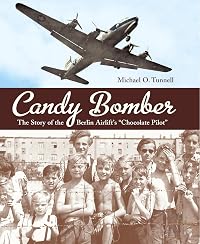
Candy Bomber: The Story of the Berlin Airlift's "Chocolate Pilot"
by Michael O. Tunnell
On This Page
Description
"World War II was over, and Berlin was in ruins. US Air Force Lieutenant Gail Halvorsen knew the children of the city were suffering. They were hungry and afraid. The young pilot wanted to help, but what could one man in one plane do?"--dust jacket flap.Tags
Recommendations




Member Reviews
Here's an aspect of post WW2 that I never heard about, food and supply drops on Berlin, but especially candy drops for the children. Lt. Gail Halvorsen comes up with the idea of dropping candy from his C-54 after meeting several hungry children in Berlin. Candy is a scarce commodity in wartime and especially now with the Soviets trying to keep food deliveries from taking place. The idea takes off like gangbusters. What's wonderful about his story is not just the generosity but that Lt. Halvorsen is still very active, still flying, and still in touch with the people whose lives he touched over 50 years ago. Great non-fiction for kids and not just because of the idea of candy.
I was familiar with the story of the Berlin Airlift of 1948-49 – the effort by the Allied powers of World War II to use aircraft to circumvent a 16-month ground blockade of West Berlin by the Soviet Union. But until reading "The Candy Bomber," I was unfamiliar with the wonderful story of “Operation Little Vittles.”
On one of his first trips to Berlin, U.S. Air Force Lt. Gail Halvorsen, a pilot charged with flying food and other supplies to West Berlin, met some sad and hungry children along a fence at a Berlin airfield. To lift their spirits, Halvorsen decided on future trips to use parachutes made of handkerchiefs to drop chocolate and gum to the city’s children.
In time, other Americans began donating candy and handkerchiefs to show more the Candy Bomber’s cause, and the children of Berlin wrote him sometimes poignant, sometimes funny letters, giving him detailed maps and directions to their house in the hope he would drop some special treat their way.
Author Michael O. Tunnell gets the story of the Candy Bomber directly from Gail Halvorsen himself, still living in Utah at the age of 94. The book is illustrated with wonderful children's drawings, photos, and letters from Halvorsen’s personal collection, including his heartwarming correspondence with one German girl, whom Halvorsen would finally meet years later while traveling to Berlin for an Airlift anniversary.
A sweet story for children 8 and up, history classes studying the Cold War and post-WWII period, and anyone with a weakness for the triumph of ingenuity and the human spirit. show less
On one of his first trips to Berlin, U.S. Air Force Lt. Gail Halvorsen, a pilot charged with flying food and other supplies to West Berlin, met some sad and hungry children along a fence at a Berlin airfield. To lift their spirits, Halvorsen decided on future trips to use parachutes made of handkerchiefs to drop chocolate and gum to the city’s children.
In time, other Americans began donating candy and handkerchiefs to show more the Candy Bomber’s cause, and the children of Berlin wrote him sometimes poignant, sometimes funny letters, giving him detailed maps and directions to their house in the hope he would drop some special treat their way.
Author Michael O. Tunnell gets the story of the Candy Bomber directly from Gail Halvorsen himself, still living in Utah at the age of 94. The book is illustrated with wonderful children's drawings, photos, and letters from Halvorsen’s personal collection, including his heartwarming correspondence with one German girl, whom Halvorsen would finally meet years later while traveling to Berlin for an Airlift anniversary.
A sweet story for children 8 and up, history classes studying the Cold War and post-WWII period, and anyone with a weakness for the triumph of ingenuity and the human spirit. show less
I'm a big fan of learning about history from the stories of individuals and this book is a great way of learning about the Berlin Airlift. It's also a humorous and touching story about small kindnesses leading to great acts of generosity between former enemies. The first chapter (which gives the historical background) is a bit dry, but I'd say that the rest of the book could be enjoyed even by young children. (It doesn't hurt that the story is largely about Lt. Halvorsen's interactions with children.)
Highly recommended.
Highly recommended.
While I never though I enjoyed history, Candy Bomber really changed my perspective. The book was well written, entertaining, and informative. I read the book in one brief sitting; I could not put it down! This book opened my eyes to the fact that I may enjoy other Social Studies nonfiction books. From this story I learned of events that followed World War II, something that I never knew much about. The Candy Bomber was a real person who showered the people of West Berlin with candies and sweets, something they hadn't seen much of since before the war. The story was moving and inspirational. It made me really think about how I treat others.
I liked Candy Bomber. How could I not like a book about a man who was a flying Santa to children in a war torn land? What I can't quite figure out is why I didn't like it MORE. I think that this book did exactly what Michael Tunnell had in mind; it chronicled the ins and outs of "Operation Little Vittles," and even threw in some heartwarming post-war anecdotes about the primary pilot, Lt. Gail Halvorsen. I loved Gail. I think it all just felt a little to Pollyanna to be honest. Of course I understand that Halvorsen wouldn't see it that way. He was privy to an up-close view of the devastation that I can only read about.
So what caused the niggling sense of dissatisfaction that kept creeping in between the page turns of this ostensibly show more uplifting factual account of "Onkel Wackelflugel"?
I think what bother me is the pristineness of this book. It's not what the book says; it's what it doesn't say. I understand that Tunnell was creating a slice of life, one life in particular, but that slice feels so disconnected from the state of the U.S.A. and the rest of the world at the time. I know it sounds awful and nosey, but I kept wanting to know more about other aspects of Gail Halvorsen's life. Specifically, I wonder about his attitudes toward the many disenfranchised children in America at the time. What are his opinions about race and the brewing Civil Rights movement in Post WWII America? It's just all so . . . nice, in a time when things decidedly weren't nice. Of course, to be fair to Halvorsen (who I'm sure I would probably like quite a bit), he served the need in front of him, where he was stationed at the time. And I admire that. I also admire the creative lengths to which he went in order to deliver "hope in the form of a chocolate bar."
And I WOULD use this book with students. I would like for them riff off the theme of "hope in the form of." Hope really does take many forms, and sometimes the smallest acts of kindness, like dropping two sticks of Doublemint into the waiting hands of waifs, mean the most. Like Halvorsen said, those small acts can lead to really big things. But even if they don't, their meaning is not lost when the kindness is recognized. Isn't it interesting how in vulnerable times, these small acts can have the greatest impact? I love the heart of Gail Halvorsen in this respect. Am warmed by the fact that he couldn't sleep after his first encounter with the West Berlin children. It's reminiscent of Leo Hart's heart. I think these two would have found common ground.
Halvorsen's story does shine on its own but also as part of the larger effort to repair post WWII relations with Germany. The whole Berlin airlift effort represents larger "package of hope." The U.S. had learned, at least for that moment in history, that heavy post-war burdens did nothing to prevent (and perhaps even fostered) another uprising that cost a sea of lives.
All in all, I find more to praise than to criticize, and Tommell can't be blamed for me wanting information that was clearly outside the scope of his authorial intent. So be it. show less
So what caused the niggling sense of dissatisfaction that kept creeping in between the page turns of this ostensibly show more uplifting factual account of "Onkel Wackelflugel"?
I think what bother me is the pristineness of this book. It's not what the book says; it's what it doesn't say. I understand that Tunnell was creating a slice of life, one life in particular, but that slice feels so disconnected from the state of the U.S.A. and the rest of the world at the time. I know it sounds awful and nosey, but I kept wanting to know more about other aspects of Gail Halvorsen's life. Specifically, I wonder about his attitudes toward the many disenfranchised children in America at the time. What are his opinions about race and the brewing Civil Rights movement in Post WWII America? It's just all so . . . nice, in a time when things decidedly weren't nice. Of course, to be fair to Halvorsen (who I'm sure I would probably like quite a bit), he served the need in front of him, where he was stationed at the time. And I admire that. I also admire the creative lengths to which he went in order to deliver "hope in the form of a chocolate bar."
And I WOULD use this book with students. I would like for them riff off the theme of "hope in the form of." Hope really does take many forms, and sometimes the smallest acts of kindness, like dropping two sticks of Doublemint into the waiting hands of waifs, mean the most. Like Halvorsen said, those small acts can lead to really big things. But even if they don't, their meaning is not lost when the kindness is recognized. Isn't it interesting how in vulnerable times, these small acts can have the greatest impact? I love the heart of Gail Halvorsen in this respect. Am warmed by the fact that he couldn't sleep after his first encounter with the West Berlin children. It's reminiscent of Leo Hart's heart. I think these two would have found common ground.
Halvorsen's story does shine on its own but also as part of the larger effort to repair post WWII relations with Germany. The whole Berlin airlift effort represents larger "package of hope." The U.S. had learned, at least for that moment in history, that heavy post-war burdens did nothing to prevent (and perhaps even fostered) another uprising that cost a sea of lives.
All in all, I find more to praise than to criticize, and Tommell can't be blamed for me wanting information that was clearly outside the scope of his authorial intent. So be it. show less
"This book is special to me because it tells about the people of Berlin who valued freedom over food. The Russians promised them food if they agreed to live under Soviet rule, but they refused. They wanted to be free, even if that meant going hungry."
The Candy Bomber was absolutely captivating, full of amazing pictures, detailed maps of the airlift routes, letters/drawings from children of Berlin, and even world maps of how the countries were divided up between the allies. The pictures really kept me flying through this book, but the meticulous attention to detail and grand imagery did as well. Although Lt. Gail Halvorsen's experiences are very real and this is a work of nonfiction, I almost felt as if I was reading a novel about a show more fictional pilot heading up these spectacularly kind and giving candy drops for starving children. I believe I felt like this simply because I never learned much about the aftermath of World War II in school. I was taught all about Hitler and the war, but never much about what happened afterwards. This would be a great way to further student knowledge after learning about WWII. Much like my love for some of the other nonfiction books I have read thus far, I love the many different aspects that Michael O. Tunnell touches and elaborates upon. In addition, this would be such a great title to use in the classroom because it has just enough of Halvorsen's biographical information to tie in with the historical context. Even so, my absolute favorite part of this book was the inspiring story of the Berlin children who would rather starve than lose their new found freedoms. On page 21, Halvorsen recalls, "These young kids [gave] me the most meaningful lesson in freedom I ever had." This could also be easily used in concurrence with an English class in order to explore the meaning of freedom in relation to other texts and also to look at just how much people are willing to sacrifice and go without in order to be free. I can think of a great writing prompt to begin a discussion with on this piece, for high school or middle school students. show less
The Candy Bomber was absolutely captivating, full of amazing pictures, detailed maps of the airlift routes, letters/drawings from children of Berlin, and even world maps of how the countries were divided up between the allies. The pictures really kept me flying through this book, but the meticulous attention to detail and grand imagery did as well. Although Lt. Gail Halvorsen's experiences are very real and this is a work of nonfiction, I almost felt as if I was reading a novel about a show more fictional pilot heading up these spectacularly kind and giving candy drops for starving children. I believe I felt like this simply because I never learned much about the aftermath of World War II in school. I was taught all about Hitler and the war, but never much about what happened afterwards. This would be a great way to further student knowledge after learning about WWII. Much like my love for some of the other nonfiction books I have read thus far, I love the many different aspects that Michael O. Tunnell touches and elaborates upon. In addition, this would be such a great title to use in the classroom because it has just enough of Halvorsen's biographical information to tie in with the historical context. Even so, my absolute favorite part of this book was the inspiring story of the Berlin children who would rather starve than lose their new found freedoms. On page 21, Halvorsen recalls, "These young kids [gave] me the most meaningful lesson in freedom I ever had." This could also be easily used in concurrence with an English class in order to explore the meaning of freedom in relation to other texts and also to look at just how much people are willing to sacrifice and go without in order to be free. I can think of a great writing prompt to begin a discussion with on this piece, for high school or middle school students. show less
The Candy Bomber is a heartfelt historical extended photographic essay which recounts the story of Air Force Pilot Gail Halvorsen during the Berlin Airlift. This event is fairly often glossed over, or even relegated to a sentence or two in middle and high school text books. So much of the focus of secondary school studies of WWII has traditionally painted a fairly black and white “Allies good, Nazis bad” picture of the war and its aftermath, and I feel this likely leads many curricula to leave out the humanitarian crisis that West Berlin faced in the post war years.
The history of the Berlin Airlift and the story of Lt. Halvorsen are crucial to an understanding of the human toll of war on all sides. These types of stories of show more cooperation and caring in the face of trying times are too often given little attention in primary and secondary history books in favor of more cataclysmic or less nuanced events.
The Candy Bomber shows how one pilot started a movement to bring a little joy into the lives of the children of West Berlin by dropping them much craved sweets. This all happens with the larger political backdrop of the massive food and supply drops all over the city, obviously, but the tale of “Uncle Wiggle Wings” brings a happy and almost sickeningly optimistic perspective to the whole affair. But that is precisely what the author sought to do – to paint a positive, warm picture of people helping other people following a dark period in history and surrounded by the looming shadow of further conflict.
This book is well researched and sourced, and, at the same time, full of almost too much heart. While the author is a literature professor, he went to reputable historical sources for his background material, and he even obtained valuable primary source material from interviews with Halvorsen himself (who he met with at his home in Utah). The story is well written, and the photos are rich and well-chosen. This is another text I will be including in my classroom library. show less
The history of the Berlin Airlift and the story of Lt. Halvorsen are crucial to an understanding of the human toll of war on all sides. These types of stories of show more cooperation and caring in the face of trying times are too often given little attention in primary and secondary history books in favor of more cataclysmic or less nuanced events.
The Candy Bomber shows how one pilot started a movement to bring a little joy into the lives of the children of West Berlin by dropping them much craved sweets. This all happens with the larger political backdrop of the massive food and supply drops all over the city, obviously, but the tale of “Uncle Wiggle Wings” brings a happy and almost sickeningly optimistic perspective to the whole affair. But that is precisely what the author sought to do – to paint a positive, warm picture of people helping other people following a dark period in history and surrounded by the looming shadow of further conflict.
This book is well researched and sourced, and, at the same time, full of almost too much heart. While the author is a literature professor, he went to reputable historical sources for his background material, and he even obtained valuable primary source material from interviews with Halvorsen himself (who he met with at his home in Utah). The story is well written, and the photos are rich and well-chosen. This is another text I will be including in my classroom library. show less
Members
- Recently Added By
Published Reviews
ThingScore 94
Lists

Mensa for Kids Excellence in Reading Award Program (Nonfiction)
54 works; 4 members

Book Review Roundup
254 works; 2 members
Author Information

18+ Works 2,541 Members
Michael O. Tunnell is a professor of children's literature and the author of Mailing May, The Children of Topaz, Wishing Moon, and other books. He lives in Orem, Utah.
Awards and Honors
Awards
Common Knowledge
- Canonical title
- Candy Bomber: The Story of the Berlin Airlift's "Chocolate Pilot"
- Original publication date
- 2010
- People/Characters
- Gail Halvorsen; Eugene T. Williams, "Willy"
- Important places
- Tempelhof airport, Berlin, Germany; East Berlin, Germany
- Important events
- Berlin Airlift (1948 | 1949)
- Dedication
- To Gail
-- M. O. T. - First words
- When I was a boy I would watch silver airplanes fly high in the sky, going to faraway places with strange-sounding names. (Prologue, Gail S. Halvorson, The Chocolate Pilot
Nine-year-old Peter Zimmerman searched the sky for airplanes. - Last words
- (Click to show. Warning: May contain spoilers.)Today Germany is one again a unified country, and East and West Berlin have come together as a single city.
Classifications
- Genres
- Nonfiction, Tween, Kids
- DDC/MDS
- 943.1550874 — History & geography History of Europe Central Europe: Germany, Austria, Switzerland, Czech, Poland, Hungary Northeastern Germany Brandenburg and Berlin Berlin Historical periods 1866- 1945-1990 : Period of East Germany
- LCC
- DD881 .T845 — History of Europe, Asia, Africa and Oceania Germany History of Germany Local history and description Berlin
- BISAC
Statistics
- Members
- 665
- Popularity
- 43,321
- Reviews
- 170
- Rating
- (4.25)
- Languages
- English
- Media
- Paper, Ebook
- ISBNs
- 9
- ASINs
- 2