

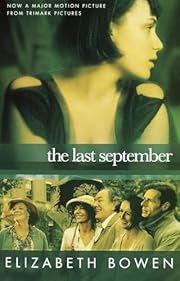
Click on a thumbnail to go to Google Books.
|
Loading... The Last September (1929)by Elizabeth Bowen
  
No current Talk conversations about this book.   ) ) Tytania | Apr 8, 2022 | Tytania | Apr 8, 2022 |   ) charlie68 | Dec 17, 2019 | ) charlie68 | Dec 17, 2019 | The premise was good, but I didn't connect to any of the characters to the point where I could barely care to take the time to keep them straight in my mind. I wouldn't start here if you're interested in reading Bowen's works. (  ) japaul22 | Jul 5, 2019 | ) japaul22 | Jul 5, 2019 | Kristel Hart's review Sep 22, 2016 · edit liked it Read from September 08 to 22, 2016 ** spoiler alert ** Story set in Ireland during the time period of the Irish War of Independence written bye Elizabeth Bowen and published in 1929. The Irish War of Independence was a guerrilla war fought from 1919 to 1921 between the IRA and the British security forces in Ireland. The characters consist of people from the Irish mansion at Danielstown and the British soldiers (subalterns). To me, it was about what life would be like for a young person growing up in uncertain times at the age when young people are interested in each other, about the awkwardness of feeling you are mature when you really aren't. But it is also about how how people don't really say what they really mean. Over all, the story is more a study of character and less plot driven. It was often very boring and slow to read. It was easy to put the book down and do something else. The last part of the book was a bit better. It is the story of the coming of age of Lois and the ending of an age of the Irish mansion land owners. So here's what wiki and the cover: Themes: Sterility: life is pretty much dead, there are no children Big House: often talks about 20 windows facing out, empty, blank. Tensions between love and freedom, tradition and Motifs: Unfinished sentence (so many, so many, so many) The cover of the book hints that this is a combination of social comedy and private tragedy, so we know that "something bad is coming". ( ) Kristelh | Sep 22, 2016 | ) jeffome | Mar 16, 2015 | no reviews | add a review
Belongs to Publisher SeriesIs abridged in
The Last September is Elizabeth Bowen's portrait of a young woman's coming of age in a brutalized time and place, where the ordinariness of life floats like music over the impending doom of history. In 1920, at their country home in County Cork, Sir Richard Naylor and his wife, Lady Myra, and their friends maintain a skeptical attitude toward the events going on around them, but behind the facade of tennis parties and army camp dances, all know that the end is approaching--the end of British rule in the south of Ireland and the demise of a way of life that had survived for centuries. Their niece, Lois Farquar, attempts to live her own life and gain her own freedoms from the very class that her elders are vainly defending. The Last September depicts the tensions between love and the longing for freedom, between tradition and the terrifying prospect of independence, both political and spiritual. "Brilliant.... A successful combination of social comedy and private tragedy."--The Times Literary Supplement (London) No library descriptions found. |
Current DiscussionsNonePopular covers
 Google Books — Loading... Google Books — Loading...GenresMelvil Decimal System (DDC)823.912Literature English English fiction Modern Period 1901-1999 1901-1945LC ClassificationRatingAverage: (3.57) (3.57)
Is this you?Become a LibraryThing Author. |
|||||||||||||||||||||||||||||||||||||||||||||||||||||||||||||||||||||||||||||||||||||||||||||||||||||||||||||||||||||||||



 Wikipedia in English (1)


 2
2