This site uses cookies to deliver our services, improve performance, for analytics, and (if not signed in) for advertising. By using LibraryThing you acknowledge that you have read and understand our Terms of Service and Privacy Policy. Your use of the site and services is subject to these policies and terms.
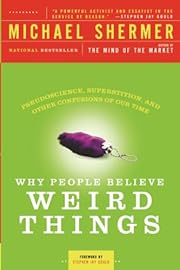
The co-founder of "Skeptic" magazine explains why people are so willing to believe in mind reading, alien abductions, ghosts, and other manifestations of pseudoscience, and discusses how such wrong thinking can lead to very real danger.
peter_vandenbrande: Stikvallei toont de blik van een journalist op het fenomeen waarbij feiten worden vermengd tot verhalen. "Why People..." bekijkt het analytisch vanuit wetenschappelijke bril.
To be honest, I don't think this book lived up to its title. "Vague writings on weird things people believe", or "Why these people are wrong" was the more common theme. Some interesting content, but very little of what I expected - ie social theory re: how 'weird things' catch on. There are three chapters entirely devoted to debunking weird things, which, again, is interesting, but not what I was expecting. Some fascinating footnotes, though. ( )
Brings up important ideas about epistemology, does a good job of describing methodologies that can tackle pseudoscience in a persuasive fashion. It does not give me a lot of optimism about the ordinary person's ability to follow such a program. We rely on other experts to evaluate pseudoscience. When our experts and leaders are motivate to reason to support pseudoscience, we are stuck again with lots of people being willing to believe weird things.
Technically, the book shows its history of being a bunch of long magazine articles, it has below average cohesion, some chapters were much stronger than others, some had odd overlap.
One flaw I found in this book and the entire genre is that they tackle ideas that are way out there- like a cat pushing small objects off the edge of a table. It is very satisfying, but what is amazing is that people believe bunk, not that it can be debunked to a more objective observer, sometimes easily. So people at the end of the book can feel good about themselves because they don't believe in aliens or fictional alternative histories, yet have unexamined beliefs about more mundane things like their seeming centrist political opinions and we cling to these ideas with the ferocity of a ufologists belief in UFOs. ( )
Started to reread this. But the author asserts rather than proves, especially annoying in a book that purports to teach that one needs reliable proof to believe something. On page 27 one finds the following sentence. "Shouldn't we know by now that the laws of science prove that ghosts cannot exist?" I followed up by reading every other reference to ghosts in the index. On 28-29 the author compares ghosts to mental abstractions such as the law of gravity. I didn't find this especially convincing since it only addressed the false proposition that the law of gravity didn't exist before Newton named it. Page 33 continues this false dichotomy with an assertion that ghosts have never been confirmed to any extent. But to make this statement one should explain what would constitute confirmation. For example, if I am trying to prove that Vitamin D is essential to mammalian life, I need to assert something like "the rate of illness in the experimental group will be significantly higher than that in the control group." Or, if I am trying to establish that an endangered species has made a comeback, I could specify what evidence: den sites, evidence of feeding, excrement, actual sightings or photographs from trail cameras, dead specimens in the excrement or stomach contents of prey animals, I would expect to find. On page 55 the author notes that mundane explanations for odd noises should be ruled out before concluding that the noises are evidence of ghosts. Well, I don't know of any reputable paranormal investigator who doesn't do just that. Is there a highway or train track nearby that would explain noises or lights? is there an ill-fitting window to explain cold spots? is there a likelihood of a person faking evidence? But what, pray tell, is the scientific law that rules out the existence of unknown types of energy or substances? If we grant that radio waves existed before we developed radios what makes it _impossible_ for ghosts to exist in the absence of an ectoplasmeter? I suppose there may be such a law, but the author expects us to take it on faith. Ironic.
This book includes a wide-ranging series of topics that touch on individuals’ and groups’ unusual beliefs. The summaries address issues such as philosophy of science, social-cognitive psychology, and popular psychology, but with several hard-to-classify outliers. My interest in the topics varied, and I could seldom read more than a few pages at a time before turning to something else. ( )
"It seems to me what is called for is an exquisite balance between two conflicting needs: the most skeptical scrutiny of all hypotheses that are served up to us and at the same time a great openness to new ideas. If you are only skeptical, then no new ideas make it through to you. You never learn anything new. You become a crotchety old person convinced that nonsense is ruling the world. (There is, of course, much data to support you.) On the other hand, if you are open to the point of gullibility and have not an ounce of skeptical sense in you, then you cannot distinguish useful ideas from the worthless ones. If all ideas have equal validity then you are lost, because then, it seems to me, no ideas have any validity at all." — Carl Sagan, "The Burden of Skepticism," Pasadena lecture, 1987
Dedication
To the memory of Carl Sagan, 1934–1996, colleague and inspiration, whose lecture on "The Burden of Skepticism" ten years ago gave me a beacon when I was intellectually and professionally adrift, and ultimately inspired the birth of the Skeptics Society, Skeptic magazine, and this book, as well as my commitment to skepticism and the liberating possibilities of science.
First words
The bane of hypocrisy is not its visibility to others, it is its invisibility to the practitioner. (Introduction to the Paperback Edition)
On Monday, October 2, 1995, for the first time in its ten-year history, the Oprah Winfrey Show offered a psychic as the featured guest.
Quotations
Last words
It is a different source of hope, but it is hope nonetheless: hope that human intelligence, combined with compassion, can solve our myriad problems and enhance the quality of each life; hope that historical progress continues on its march toward greater freedoms and acceptance for all humans; and hope that reason and science as well as love and empathy can help us understand our universe, our world, and ourselves.
The co-founder of "Skeptic" magazine explains why people are so willing to believe in mind reading, alien abductions, ghosts, and other manifestations of pseudoscience, and discusses how such wrong thinking can lead to very real danger.




 )
)

 )
) )
) Google Books — Loading...


 Wikipedia in English (14)


 4
4