

Click on a thumbnail to go to Google Books.
|
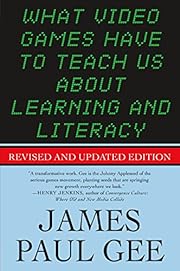
Loading... What Video Games Have to Teach Us About Learning and Literacyby James Paul Gee
   None No current Talk conversations about this book.  Cheryl_in_CC_NV | Jun 5, 2016 | Cheryl_in_CC_NV | Jun 5, 2016 |    ) breadhat | Jul 23, 2013 | ) jtfairbro | Sep 29, 2009 | ) breadhat | Jul 23, 2013 | ) jtfairbro | Sep 29, 2009 | Gee presents a convincing argument that learning is essentially social, rather than mental, in nature; and that video and computer games - in contrast to skill-and-drill teaching oriented towards standardized testing - incorporate good learning principles that are relevant to today's world. ( ) wendellg | Jun 19, 2007 | For instance, the book seems sharper to me when it discusses a skill like-- nonlinear exploration preceding movement towards a goal --a skill that Gee convincingly argues that video games develop, as well as one that has an obvious relevance in the classroom. To an educator (like myself) who teaches students who were raised on video games, this information is useful, and it gives me ideas on how I might tailor my assignments accordingly. By contrast, we have something like learning the rules of a "semiotic domain" or "affinity group." Gee is right to say that gamers learn "to see themselves as the kind of person who can learn, use, and value [a] new semiotic domain" (in this case the "semiotic domain" of the gaming subculture). I also think that Gee is correct to say that a science teacher, for instance, is asking students to do similar work with reference to the semiotic domain of "science," and that students who have learned how to integrate themselves into a domain through gaming might be at a light advantage here. But it seems at this point like we're no longer dealing with "what video games have to teach us," and more dealing with a broader concept of subcultural orientation: certainly a student who belongs to the "affinity group" of, say, Honda aficionados would have had an identical experience and an identical advantage. Other than this minor quibble (and some other quibbles about the way Gee thinks about narrative in video games) the book is an engaging read, one that I'd readily recommend to those interested on the topic. ( )1  jbushnell | Feb 28, 2007 | jbushnell | Feb 28, 2007 | no reviews | add a review
A controversial look at the positive things that can be learned from video games by a well known professor of education. James Paul Gee begins his new book with "I want to talk about video games-yes, even violent video games-and say some positive things about them." With this simple but explosive beginning, one of America's most well-respected professors of education looks seriously at the good that can come from playing video games. Gee is interested in the cognitive development that can occur when someone is trying to escape a maze, find a hidden treasure and, even, blasting away an enemy with a high-powered rifle. Talking about his own video-gaming experience learning and using games as diverse as Lara Croft and Arcanum, Gee looks at major specific cognitive activities: How individuals develop a sense of identity; How one grasps meaning; How one evaluates and follows a command; How one picks a role model; How one perceives the world. This is a ground-breaking book that takes up a new electronic method of education and shows the positive upside it has for learning. A controversial look at the positive things that can be learned from video games. No library descriptions found. |
Current DiscussionsNonePopular covers
 Google Books — Loading... Google Books — Loading...GenresMelvil Decimal System (DDC)794.8019The arts Recreational and performing arts Indoor games of skill; board games Electronic and video games Video Game HistoryLC ClassificationRatingAverage: (3.95)
Is this you?Become a LibraryThing Author. |
|||||||||||||||||||||||||||||||||||||||||||||||||||||||||||||||||||||||||||||||||||||||||||||||||||||||||||||||||||||||



 Wikipedia in English (3)


 1
1
One thing that is still relevant, interesting, and true, is this:
Shooting is an easy form of social interaction (!) to program.?á As realistic forms of conversation become more computationally possible (a very hard task), I predict that shooting will be less important and talking more important in many games, even shooter games.""