

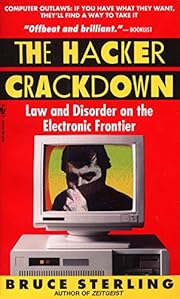
Click on a thumbnail to go to Google Books.
|
Loading... The Hacker Crackdown: Law And Disorder On The Electronic Frontier (1992)by Bruce Sterling
  
None No current Talk conversations about this book.   ) ) zeh | Jun 3, 2023 | zeh | Jun 3, 2023 |  bloftin2 | May 4, 2023 | bloftin2 | May 4, 2023 | This is a classic non-fiction about late eighties and very early nineties hacking from both sides of the law, but what is most most interesting is not that it's written by a classic cyberpunk author, but that it's written in such a way as to awe and amaze us readers even this late in the internet game... before there was truly a real Internet. BBS's and phreaking was is its own kind of world, as was trashing and other kinds of social engineering. Not that we don't have our modern equivalents with our threads and skype.... and trashing and social engineering. :) Ah well, some things never change. :) But these days, the kinds of overreactions have really changed into all new kinds of overreactions. :) Still, it was kinda amazing to see just how crazy the computer world was back then. SOMEONE COPIED AN ELECTRONIC FILE! And each copy was worth 80K! (To who? No idea. It was about how the emergency 911 calls got routed through the telecom system. No one intended to do crap with it, but of course it became a big hoo-haw. With time in jail.) Seriously. It's like dark age stuff, and we're talking 1990. And then there was the phone outages that were AT&T's own fault, and yet they tried to blame everything on hackers who had absolutely nothing to do with it, and let's not forget the scares and the craze about just how evil these people are! You know, that 14 year old who is bragging to all his mates because he got into someone's system and he's treating it as a game without consequences? Yeah! That EVIL PERSON. Of course, there are real criminals out there but they're all identity theft people and credit swindlers, but most of them are just individuals who's gotten very specialized with very specific features of a computer. These aren't coders or creative types or explorers. These are just people trying to steal your wallet, and those people are a menace. It's really interesting to read about both sides of the coin and to see what horrible and stupid mistakes both sides made. Steve Jackson Games being the most prominent example, of course. Paladium Books! Obviously they're in deep. And the Secret Service never gave them their computers back. How embarrassing. This is equal parts a blast from the past and it's an exploration about how idiotic people are in real life. It's kinda freaky. :) I wouldn't be surprised if this book remains popular twenty years from now as a classic frontier novel. :) ( ) bradleyhorner | Jun 1, 2020 | It's been years since I picked the book up, but it immediately sucked me in. I don't know of another book about technology that is still as relevant as this one. It's worth your time to read. (  ) Lyndatrue | Apr 14, 2018 | ) Lyndatrue | Apr 14, 2018 |  ) ballfresno | Apr 4, 2013 | ) ballfresno | Apr 4, 2013 | no reviews | add a review
References to this work on external resources.
|
Current DiscussionsNonePopular covers
 Google Books — Loading... Google Books — Loading...GenresMelvil Decimal System (DDC)005Information Computer Science; Knowledge and Systems Computer programming, programs, data, securityLC ClassificationRatingAverage: (3.76)
Is this you?Become a LibraryThing Author. |
|||||||||||||||||||||||||||||||||||||||||||||||||||||||||||||||||||||||||||||||||||||||||||||||||||||||||||||||||||||||



 Wikipedia in English (17)


 1
1