Hide this

Results from Google Books

Click on a thumbnail to go to Google Books.

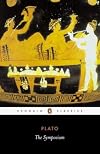
The Symposium by Plato
Loading...

The Symposium

by Plato

Other authors: See the other authors section.

MembersReviewsPopularityAverage ratingMentions
3,448251,433 (3.98)53
Loading...

Sign up for LibraryThing to find out whether you'll like this book.

English (19)  Spanish (3)  French (1)  Italian (1)  Greek (1)  All languages (25)
Showing 1-5 of 19 (next | show all)
I was unprepared for how funny this book is. A group of friends extremely hung over from the previous night's partying decide that tonight, instead of going all out to get drunk again, they would send away the flute girl, drink in moderation and each would make a speech on the topic of love. Socrates makes the most profound speech but no sooner has be finished when the party is crashed by another band of drunken revellers and the extremely inebriated Alcibiades joins the party. Requested to add his speech on love, he claims unfairness on account of his state and instead of making a speech in praise of love, he speaks in praise of Socrates. ( )
  marq | Mar 3, 2013 |
Edition: First Edition // Descr: 64 p. 20.5 cm. // Series: The Library of Liberal Arts Number 7 Call No. { } Translated by Benjamin Lowett With an Introduction by Fulton H. Anderson Oskar Piest General Editor of The Library of Liberal Arts Series Contains Selected Bibliography. // John E. Rexine Library Donation //
  ColgateClassics | Oct 26, 2012 |
Rating: 2* of five, all for Aristophanes's way trippy remix of Genesis

While perusing a review of [Death in Venice] (dreadful tale, yet another fag-must-die-rather-than-love piece of normative propaganda) written by my GoodReads good friend Stephen, he expressed a desire to read The Symposium before he eventually re-reads this crapulous homophobic maundering deathless work of art. As I have read The Symposium with less than stellar results, I warned him off. Well, see below for what happened next.

Stephen wrote: "Damn...can you do a quick cliff notes summary or maybe a video lecture? I would much rather take advantage of your previous suffering than have to duplicate it."

THE SYMPOSIUM

So this boring poet dude wins some big-ass prize and has a few buds over for a binge. They're all lying around together on couches, which is as promising a start to a story as I can think of, when the boys decide to stay sober (boo!) and debate the Nature of Luuuv.

Phaedrus (subject of a previous Socratic dialogue by Plato) gives a nice little speech, dry as a popcorn fart, about how Love is the oldest of the gods and Achilles was younger than Patroclus, and Alcestis died of love for her husband, and some other stuff I don't remember because I was drifting off, so got up to see if I would stay awake better on the patio. It was a little nippy that day.

So next up is the lawyer. I know, right? Ask a lawyer to talk about love! Like asking a priest to talk about honor, or a politician to talk about common decency! So he pontificates about pederasty for a while, which made me uncomfortable, so I got up to get some coffee. I may have stopped by the brandy bottle on the way back out, I can't recall.

So after the lawyer tells when *exactly* it's okay to pork a teenager, the doctor chimes in that luuuuuv is the drug, it's everything, man, the whole uuuuuuuniiiiiveeeeeeeeeerse is luuuuv. Who knew they had hippies in those days? I needed more brandy, I mean coffee!, and the text of my ancient Penguin paperback was getting smaller and smaller for some reason, so I went to look for the brandy get the magnifying glass so I could see the footnotes.

Then comes Aristophanes. Now seriously, this is a good bit. Aristophanes, in Plato's world, tells us why we feel whole, complete, when we're with our true love: Once upon a time, we were all two-bodied and two-souled beings, all male, all female, or hermaphroditic. When these conjoined twins fell into disfavor, Zeus cleaved them apart, and for all eternity to come, those souls will wander the earth seeking the other half torn from us.

Now being Aristophanes, Plato plays it for laughs, but this is really the heart of the piece. Plato quite clearly thought this one through, in terms of what makes us humans want and need love. It's a bizarre version of Genesis, don'cha think?

So there I was glazed over with brandy-fog admiration for the imagination of this ancient Greek boybanger, and I was about to give up and pass out take my contemplations indoors when the wind, riffling the pages a bit, caused me to light on an interesting line. I continued with the host's speech.

Now really...is there anything on this wide green earth more boring than listening to a poet bloviate? Especially about luuuuv? Blah blah noble blah blah youthful yakkity blah brave *snore*

Then it's Socrates's turn, and I was hoping Plato gave him some good zingers to make up for the tedium of the preceding sixteen years of my life. I mean, the previous speech. It was a little bit hard to hold the magnifying glass, for some reason, and it kept getting in the way of the brandy bottle. I mean, coffee thermos! COFFEE THERMOS.

I'm not all the way sure what Plato had Socrates say, but it wasn't riveting lemme tell ya what. I woke up, I mean came to, ummm that is I resumed full attention when the major studmuffin and hawttie Alcibiades comes in, late and drunk (!), and proceeds to pour out his unrequited lust for (older, uglier) Socrates. He really gets into the nitty-gritty here, talking about worming his way into the old dude's bed and *still* Socrastupid won't play hide the salami.

Various noises of incredulity and derision were heard to come from my mouth, I feel sure, though I was a little muzzy by that time, and it is about this point that the brandy bottle COFFEE THERMOS slid to the ground and needed picking up. As I leaned to do so, I remember thinking how lovely and soft the bricks looked.

When I woke up under the glass table top, the goddamned magnifying glass had set what remains of the hair on top of my head on fire.

The moral of the story is, reading The Symposium should never be undertaken while outdoors. ( )
  richardderus | May 22, 2012 |
A thought-provoking and intense yet short read, The Symposium was still far from what I had first anticipated. I had expected the philosophical nature of the piece, however, placing that upon the intricacies of love and homosexuality was shocking and delightful. I wouldn't expect less from Plato, one of the greatest human minds, and am always fascinated by his work. The Symposium is no exception. ( )
  bleached | May 8, 2012 |
{N.B. This partly a review of Plato's "Symposium", and partly an evaluation of its author, in general, whose works I have sampled somewhat broadly. Part of the reason for this is because trying to talk about Plato and his "books", or rather, dialogues, can be trying at best, when it comes to cataloguing and organization.)

I'm not trying to insult anyone, and I hope I don't pop anyone's fragile nerves or anything, but I'm going to say it.

This book. Is not good. This is a *crappy* book.

For one thing, Plato should seriously have spent some time with some girls before writing this sort of thing. (And no, slave girls don't count.) I mean, this is "about Love" in (very theoretical) theory, but this has got to be one of the most unromantic things I've ever read in my life. I mean, Dante could be a possible exception, he might just be worse, but I'm not even sure about that. And I'm pretty sure that even Paul of Tarsus did a better job on love in his letters than Plato does here, and that's just...

*shakes head* Think about how Paul of Tarsus does as a romantic, and then think about what it means to do worse than him in that department. And then, I don't know, just slink on down the wall, in sadness and in shame. I really don't even have the words for it, you know? Seriously tho, do you?

*
I mean, what does one say about someone who claims to be a philosopher, a keeper of wisdom, and yet basically assigns women NO ROLE in **Love**? ! ! ! That's right, here is a man who claims that women have no proper place, not in politics or the army or something like that, but in Real Love. ! ! ! How does one find words for this sort of disgusting, repulsive, shitty way of looking at things? ? ? It really makes less sense than Hitler; it's basically the Nazi theory of love, or something. It's very shitty, I'll say that much. Very shitty indeed. I'm not sure what words could be found to make sense of it--what sort of vile, what sort of filth, what sort of vulgar, what sort of UNHOLY, what sort of ANTI-RELIGIOUS BULLSHIT is this, exactly? I have to tell you, I look at some of this stuff, and I'm just not sure it's better than Hitler. And Hitler was more like a wild beast than a man, but this seems like not just unhuman, but anti-human, and not just anti-human, but an attempt to negate humanity, if the great gods would allow such to be.

To me, it's at least as scary as reading about any death-camp, I'll tell you that.

I mean, what use does Plato have for women--at all? At all? Unless, of course, they are (purported) representatives of the mysteries, who, ***according to Socrates according to Plato*** are prepared to sell religion down the shit-hole to this false philosopher, and stab pregnant Juno in the belly and turn the Moon into a puddle of blood in the sky, and bring all pain to all gods and all men, and all so some shitty bully can do what he likes with secrets he cannot understand, nor understand how much he does not understand. It's like saying, hey, why not make HITLER our RABBI? ? ? C'mon, if Plato says, we do! ! !
*

And, I mean, it just sucks in general. I don't see how this is good philosophy, and I don't see how this is good prose, and I don't see how this is good anything. It's even hard to follow who's saying what, especially at the beginning, and I know it's all supposed to be really really hot (Parmenides said that Glaucon said that Dude said that Socrates said that Plato said that I said that Parmenides said) but it's really really not...maybe he should have just written something about salt instead--maybe he could have handled that.

Also, there's the issue that, perversely, the thing has a tendency to go from bad to worse, the "bad" philosophers at the beginning have the best philosophy, or, at least, say the fewest number of reprehensible things, but as we 'progress' from the "bad" philosophers to the "good" ones, the degeneration becomes acute, so that the lies and harmful crap both multiplies and becomes worse and worse. And already with the second speaker, we are told, in an off-hand sort of way, that an all-masculine goddess is of course superior to a goddess that is at all feminine, and so he doesn't talk much about women, and, with regard to men, he mostly speaks of them to justifty various meaningless and stupid punishments inflicted on them for no real reason. So, while the first speaker was somewhat sensible, and the second quite crazy, and the ones after him more and more inane and feverishly naziish, and obviously this is progress. And just to top it all off, at the end some random fucker comes in in a fucking drunken stupor like street trash and starts going on about ancient battles and how Socrates was a great man because he killed men in battle, as if it wasn't fucking anti-love enough already.

And if you honestly have to start explaining to me (how you've heard people say that) the technical style is good in the ancient original, please consider. Please consider how small are the straws you grasp at.

Really though. Sentence structure? No, really? Oh, ok. And it didn't even translate into our poor benighted pauper's English. Ah, well. Might as well just give up, then. Back to the caves, boys.

The thing about Plato is, he can kinda seem good *for awhile*, until one day you *wake up* and realize that you haven't learned *anything* by reading him. By reading Plato, you learn *about Plato*. And that's it. That's all.

At least with Aristotle, you can pick up one of his books, and at least figure out what it's supposed to be about. Like, Nicomachean Ethics, oh, good, ethics. (And, for me, at least, the way Aristotle writes about ethics is somewhat of a different category than someone like Epictetus writing about ethics, but that's a little beside the point and it's not so bad either way.)

But with Plato, it's like, hey--Gorgias. It's about, well, we talked to this guy named Gorgias, and, gawd, he has *such* a nice house. Hey, Gorgias, you've got a nice crib here, bro. Oh, thank you, Socrates. And on and on, like it's never gonna end. Hey, wierdo, did I ever tell you about the time I taught the little slave boy how to draw a triangle right? No, Socrates, but I would *gladly* sit here all day and hear about how you taught him to piss properly, if only it was you who did it. And on and on and on, and for what?

And even when you can find some word for it, like, oh, this one is about Piety and this one is about Justice, (and this one is about Being Smarter than Jack Shit, hahaha, I'm an emperor now!!) and this one is about Drinking With Your Friends. Well, consider Aristotle again for a moment. Aristotle writes a book about ethics--is ethics a part of philosophy? Yes. But if Plato writes something about Drinking With Your Friends? Which type of philosophy is that, I'd like to know?

{And, for that matter, why is Plato considered the Fountainhead of All Knowledge And Wisdom, when it's actually true that you need Epictetus or someone like him to prepare you for the work of philosophy, and give you the right mindset for it--and life in general, at least from the philosophical point of view--and if you need that, way before, long before, you need or can handle the speculative Birds like Plato, why is Plato always put first? Does he really have to be given a Free Pass *Every Single Time* just because he spoken good Classical, good Aristocratic, Classic, Provincial, Pre-Alexander-the-Great Greek? It is really *necessary* or *helpful* to take everyone else, everyone who spoke post-classical, post-provincial, more cosmopolitan and wordly language (Alexander says--hey guys! meet Persia! meet Egypt! meet the world, guys! c'mon! see new places!) and automatically give them *all* a dozen demerits and tell the lot of 'em to come back next week or not at all?

Or are we just so sure that it makes sense to teach it all in chronological order, without any thought as to the different topics of philosophy, and which ought to come first, and which second or third, and what we want to happen to the student *now* *inside*, rather than what did happen back when the Pillars of Western Civilization were being mind-mapped out by a bunch of guys who'd never even heard of the "West", much less planned it, and who actually don't have all that much in common with us and who might not necessarily be our very best friends in the whole wide world if they were to be time-travelled into our midst?

I mean, don't get me wrong, study them if you can learn from them, just like Celts would have been open to the study of Greek ideas if they thought the ideas were sound, even though they shared little common culture, and just like Pythagoras and his buddies would be open to studying with Persians or Egyptians or anyone if they could teach them things worth knowing.

To be honest, alot of the claptrap about the West boils down to this: Sir Winston and the Archbishop go into the other room and lock the door. Raised voices are heard. Tea-cups rattle. The women look nervous and the servants look stoic. Some of the students go out to play tennis, while others talk quietly with the women about Epictetus or the upcoming soccer game against Scotland. Then, suddenly, the door is unlocked, and out comes Sir Winston and the Archbishop, who inform the others that the students may indeed go on learning about these Bad Pagan Ideas, so long as they understand that it must go within the Four Walls of The West, that is, they may learn about the pagan customs of Christianized lands, in ways that their elders may find appropriate, but, so help me, lads, none of you will speak a word about Egypt or the East, unless you want to take your chances fighting with Rudyard Kipling in India. And, you better be grateful, and, you ought to know, that if you talk too much about Epictetus instead of doing your Plato like a good boy, well, if you're that much of a damn fool, you ought to know that you're not much better than the servants and the women. And, so help me, if any of you want to talk about Celts and Goths and other barbarians, you can bloody well go fight in the trenches with Tolkien and talk about his fairy tales with him, but you may not then touch even the hem of the Clarendon Press of Oxford University.

In short, Plato is the Father of Snobs, and most of his students form the Form of Fakers.}

And, of course, sometimes Plato has these interesting speculations, and rather interesting themes or unexpected topics, about, say, reincarnation and the Forms and stuff, but are we really supposed to worship this guy just because he had random ideas that he didn't express clearly or well, and which are so religious and spiritual that priests would really be better at explaining anyway? And, if Aristotle can write about every topic there is in philosophy without needing to freak out about the Forms, why does Plato need to invent his own little language just to confuse people?

But really, you start wanting to learn about Plato because you *actually* want to learn about *Socrates*, but then you realize Plato is lying to you, and you're only *really* learning about *Plato's Socrates*, his fucking handpuppet. And then you waste more time reading to try to figure out how much is he's lying to you and in which ones, which "dialogues", and then you read these books written by these (grown-up?) guys who seem to spend most of their lives counting words in Ancient Greek late at night so they can file them into these little fucking charts so they can classify them into categories of Socratic, middle, late, and Late-Night on Tuesday. It's like learning about the History of Socrates, instead of learning about philosophy.

It's the sort of thing that makes you want to think bad thoughts, once you realize what it really is. Remember when you realized that Marx was actually a big, fat, stupid moron who'd been lying to you the whole time? Well, this is like that. It's like, all of a sudden, you emerge from a dark cave, and you see the sun for the first time, and you think, why haven't I ever seen things clearly before. And then you remember, and realize, that all these bad things have happened to you because you let a false philosopher deceive you.

And, basically, I really think Plato was bad. I think he was a bad person. And I'm glad that, since we don't live in his fantasy city, and since in our country you can read whatever book you buy, we're free to read Plato, even though his ideas are hurtful, but we can talk freely about him despite all that.

I do think he was bad tho. I have a feeling that he was a megalomaniac. Maybe something happened to him, inside, when Socrates got executed, and maybe it took awhile to blossom. Or maybe it wasn't really because of that at all. Either way, you can't envy Aristotle for having to adjust his thoughts and ideas to avoid and basically negate the evil side of Plato's thought, without becoming too polemical or hurtful himself.

But basically, let's just be glad that there were plenty of other Greeks who were a little greater than this one.

Yeah, better than Plato, because Plato is Evil.

(4/10) ( )
  Tullius22 | Jan 31, 2012 |
Showing 1-5 of 19 (next | show all)
no reviews | add a review

» Add other authors (137 possible)

Author nameRoleType of authorWork?Status
Platoprimary authorall editionsconfirmed
Hamilton, WalterTranslatorsecondary authorsome editionsconfirmed
Waterfield, RobinTranslatorsecondary authorsome editionsconfirmed
You must log in to edit Common Knowledge data.
For more help see the Common Knowledge help page.
Series (with order)
Canonical title
Original title
Information from the Catalan Common Knowledge. Edit to localize it to the English one.
Alternative titles
Original publication date
People/Characters
Important places
Information from the Dutch Common Knowledge. Edit to localize it to the English one.
Important events
Related movies
Awards and honors
Epigraph
Dedication
First words
Quotations
Information from the Norwegian Common Knowledge. Edit to localize it to the English one.
Den ed er jo ingen ed hvor Afrodite hører med, heter det jo.
Last words
Disambiguation notice
Publisher's editors
Blurbers
Publisher series

References to this work on external resources.

Wikipedia in English (4)

Book description
Haiku summary

Amazon.com Product Description (ISBN 0140449272, Paperback)

Translated with an Introduction and Notes by Christopher Gill.

(retrieved from Amazon Sat, 08 Jan 2011 03:26:06 -0500)

(see all 8 descriptions)

"Counter Plato, Allan Bloom wrote, is "the most erotic of philosophers," and his Symposium is one of the greatest works on the nature of love ever written. This new edition brings together the English translation of the renowned Plato scholar and translator, Seth Benardete, with two illuminating commentaries on it: Benardete's "On Plato's Symposium" and Allan Bloom's provocative essay, "The Ladder of Love." In the Symposium, Plato recounts a drinking party following an evening meal, where the guests include the poet Aristophanes, the drunken Alcibiades, and, of course, the wise Socrates. The revelers give their views on the timeless topics of love and desire, all the while addressing many of the major themes of Platonic philosophy: the relationship of philosophy and poetry, the good, and the beautiful." http://catdir.loc.gov/catdir/description/uchi051/00032593.html.… (more)

» see all 3 descriptions

Quick Links

Popular covers

Rating

Average: (3.98)
0.5
1 2
1.5 4
2 24
2.5 7
3 64
3.5 29
4 130
4.5 24
5 131

Audible.com

An edition of this book was published by Audible.com.

See editions

Penguin Australia

Two editions of this book were published by Penguin Australia.

Editions: 0140449272, 0141023848

Yale University Press

An edition of this book was published by Yale University Press.

» Publisher information page

Is this you?

Become a LibraryThing Author.


Help/FAQs | About | Privacy/Terms | Blog | Contact | LibraryThing.com | APIs | WikiThing | Common Knowledge | Legacy Libraries | 81,938,074 books!