
Jean Froissart
Author of Chronicles [ed. Geoffrey Brereton]
About the Author
Image credit: Courtesy of the NYPL Digital Gallery (image use requires permission from the New York Public Library)
Works by Jean Froissart
Chroniques : Livre III (du Voyage en Béarn à la campagne de Gascogne) et Livre IV (années 1389-1400) (2004) — Author — 6 copies
Froissart krónikája : válogatás 5 copies
The World's Great Classics Chronicles of England, France, Spain, and the Adjoining Countries, Vol II, Revised edition (1901) 4 copies
The Hundred Years War 4 copies
The World's Great Classics Chronicles of England, France, Spain and the Adjoining Countries, Vol I, Revised edition (1901) 3 copies
The chronicles of Froissart translated by John Bourchier, Lord Berners ... reduced into one volume (1895) — Author — 3 copies, 1 review
Chronicles of England, France, Spain, and the Adjoining Countries - Revised Edition, Volume I (2010) 3 copies
Illuminated illustrations of Froissart / Selected from the ms. in the British museum. (2021) 3 copies
The first volume of Sir Johan Froyssart of the Chronycles of Englande, Fraunce, Spayne (1523) 2 copies, 1 review
Jean Froissart: An Anthology of Narrative and Lyric Poetry (Garland Library of Medieval Literature) (1994) 2 copies
Illuminated Illustrations Of Froissart: Selected From The Ms. In The Biblioth'eque Royale, Paris, And From Other Sources (2012) 1 copy
Sir John Froissart's Chronicles of England, France, Spain and the Adjoining Countries, Tr. by T. Johnes. [&c.].... (2012) 1 copy
Au bon vieux temps;: Episodes from the Chronicles of Froissart, (The "Modern studies" series) 1 copy
Stories from Froissart 1 copy
Border Warfare 1 copy
Crecy and Poitiers 1 copy
Histoire et chronique 1 copy
Les chroniques de Sire Jean Froissart ... / nouvellement revues et augmentés d'après les manuscrits ... par J. A. C. Buchon 1 copy, 1 review
Sir John Froissart’s Chronicles of England, France, Spain and the Adjoining Countries, Vol. 5 (2013) 1 copy
Froissarts cronycles 1 copy
Froissart's Cronycles 1 copy
Chroniques (extraits) 1 copy
Associated Works
Extraits des chroniqueurs français; Villehardouin, Joinville, Froissart, Commines — Contributor — 2 copies, 1 review
The princess's story book — Contributor — 1 copy
Tagged
Common Knowledge
- Birthdate
- 1333 (circa)
- Date of death
- 1404 (circa)
- Gender
- male
- Occupations
- chronicler
historian
writer
author
poet
chaplain - Short biography
- Jean Froissart was one of the most important chroniclers of his era in France and England. At about age 24, he became a court poet and historian as the protégé of Philippa of Hainault, queen consort of Edward III of England. He was also able to travel widely in Europe gathering material for his writings. He's considered a leading sources of information on the Hundred Years' War.
- Nationality
- France
- Birthplace
- Valenciennes, France
- Places of residence
- Valenciennes, France (birth)
London, England, UK - Associated Place (for map)
- France
Members
Discussions
Froissart Chronicles – LIMITED EDITIONS CLUB 1959 in George Macy devotees (May 2023)
Reviews

This is an absorbing commentary on the major political and military events in France, England, Scotland and briefly Spain during the Fourteenth Century. Jean Froissart transcribes description from court acquaintances and, as well, writes of his own participation in these historical tales.
He makes some major geographical blunders, but the historical sense and engaging style give these excerpts life and maintain interest.
The old knightly values permeate the lives of the aristocracy; bravery, show more mercy, Christian values, remain the standard of behaviour.
There is a lengthy section devoted to the coup d'etat that toppled Richard II. This was a set Shakespeare play for study at school when I was sixteen (probably because it is relatively short). I remained confused as to who was who until Froissart, and his chronicle on the affair, swept like a new comet into my ken and all became as clear to me as the blue Pacific. show less
He makes some major geographical blunders, but the historical sense and engaging style give these excerpts life and maintain interest.
The old knightly values permeate the lives of the aristocracy; bravery, show more mercy, Christian values, remain the standard of behaviour.
There is a lengthy section devoted to the coup d'etat that toppled Richard II. This was a set Shakespeare play for study at school when I was sixteen (probably because it is relatively short). I remained confused as to who was who until Froissart, and his chronicle on the affair, swept like a new comet into my ken and all became as clear to me as the blue Pacific. show less
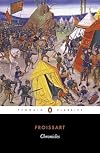
This penguin classic edition was translated by Geoffrey Brereton and contains selections from the four books of chronicles written in the 14th century by Jean Froissart, who was at various times attached to the courts of Edward III, Richard II, and the Count of Foix. The chronicles were contemporaneous documents that recorded some of the major events of 14th century France and England. Froissart was writing for the educated classes of his time and so his accounts of events had to be show more realistic. They are in fact more than that as he has his own inimitable style that makes his narratives flow and the events described come alive on the page. He has been described as a forerunner of modern day journalists and I can certainly see why people hold this view.
His narrative accounts of the battles of Poitiers, Crecy, the siege of Calais and the peasants revolt of 1381 have been used extensively by modern day historians. In Froissart's hands they give a real feel for the age in which he was writing. There is plenty of information about how people lived and how they reacted. When he writes more provincially when he was attached to the Count of Foix we get some marvellous medieval tales of haunting, shape changing and sorcery. There is much here for the modern reader, I was enthralled by the descriptions of tournaments, coronations and marriages. His descriptions of the battlefield are at times frighteningly realistic and shot through with medieval lore
I learned much about the period from this book, but at the same time it is very entertaining. Froissart says that the French had come to the battlefield of Poitiers "splendidly provided like men who felt certain in advance of victory. They were routed and there was gold, silver plate, precious jewels, ornamental chests, and splendid cloaks pilfered from the aftermath. At other times the reader is hurled back into the realms of the 14th century when in a narrative description of Edward II's attempted escape from his pursuers we get Froissart saying
"Their plan was to escape to Wales.... but their sins weighed so heavily against them that God would not permit it."
We are told this about one of the brigand leaders that roamed France when King John was a prisoner in England
"This Sir Eustace performed many fine feats of arms and no one could stand up to him, for he was young and deeply in love and full of enterprise."
The English doctor who nursed King Charles VI back from an attack of "madness" goes back to England with a substantial reward but Friossart says of him:
"His only pleasure in life had been to amass great piles of florins. There were days when he hardly spent a penny of his own, but went round getting free meals and drinks wherever he could. All doctors suffer from such weaknesses" show less
His narrative accounts of the battles of Poitiers, Crecy, the siege of Calais and the peasants revolt of 1381 have been used extensively by modern day historians. In Froissart's hands they give a real feel for the age in which he was writing. There is plenty of information about how people lived and how they reacted. When he writes more provincially when he was attached to the Count of Foix we get some marvellous medieval tales of haunting, shape changing and sorcery. There is much here for the modern reader, I was enthralled by the descriptions of tournaments, coronations and marriages. His descriptions of the battlefield are at times frighteningly realistic and shot through with medieval lore
I learned much about the period from this book, but at the same time it is very entertaining. Froissart says that the French had come to the battlefield of Poitiers "splendidly provided like men who felt certain in advance of victory. They were routed and there was gold, silver plate, precious jewels, ornamental chests, and splendid cloaks pilfered from the aftermath. At other times the reader is hurled back into the realms of the 14th century when in a narrative description of Edward II's attempted escape from his pursuers we get Froissart saying
"Their plan was to escape to Wales.... but their sins weighed so heavily against them that God would not permit it."
We are told this about one of the brigand leaders that roamed France when King John was a prisoner in England
"This Sir Eustace performed many fine feats of arms and no one could stand up to him, for he was young and deeply in love and full of enterprise."
The English doctor who nursed King Charles VI back from an attack of "madness" goes back to England with a substantial reward but Friossart says of him:
"His only pleasure in life had been to amass great piles of florins. There were days when he hardly spent a penny of his own, but went round getting free meals and drinks wherever he could. All doctors suffer from such weaknesses" show less

This is the most modern of the selections of Froissart that I have read, and Mr. Brereton has made a serious effort to present at least one example of the vast range of topics covered by the work. I can read this as a historical novel, or as a serious source, though academic historians really prefer almost any other source for making serious points. It's a good read, but the Thomas Johnes translatin, though much longer gives a good flavour of the piece. I tried the Lord Berners translation show more from the 1530's but the writing is flatter than Malory, and the spelling has not been regularized as the Penguin Malory is. But for wandering in a medieval experience, muttering out the words one by one, the Berners is wonderful. This Penguin selection is the best way into Froissart, and if you go on to the longer translations you'll be grateful you stared with this one. show less
Chronicle and Romance Froissart, Malory, Holinshed (The Harvard Classics Series) by Charles William Eliot

I only read the selection of Froissart's Chronicle, after reading the exquisite historical fiction book [b:The Ill-Made Knight|13550502|The Ill-Made Knight|Christian Cameron|https://d.gr-assets.com/books/1377004653s/13550502.jpg|19117307] I was very curious to approach the work of Froissart about medieval warfare. Very interesting and highly educative, the language of this edition is a bit archaic and remembering all the names of the characters a nightmarish task, but it is, in my opinion, a show more must-read to better understand the workings, the culture and the men behind the events of the earlier stages of the Hundred Years War. show less
Lists
You May Also Like


Associated Authors
Statistics
- Works
- 75
- Also by
- 8
- Members
- 1,504
- Popularity
- #17,082
- Rating
- 3.8
- Reviews
- 17
- ISBNs
- 94
- Languages
- 6
- Favorited
- 6
