

Valeria Petrone
Author of The Boy and the Tigers (Little Golden Book)
Works by Valeria Petrone
Associated Works
Tagged
Common Knowledge
There is no Common Knowledge data for this author yet. You can help.
Members
Reviews
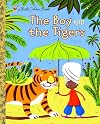
This edition, the Little Golden Book, ill. by Valeria Petrone, is just fine. It fixes the setting, by giving the characters respectful Indian names and characteristics. And reveals that there's really not anything wrong with the story itself. Still, my preferred edition is The Story of Little Babaji as illustrated by Fred Marcellino.
A nice retelling of Little Black S*mbo which has been adapted so as to not use racial slurs and racist depictions.
Fun fact, when I worked as an Amazon Prime/Whole Foods shopper our orders were assigned four or five character words which were generated by some Amazon algorithm. On at least two occasions the order ticket machine spat out "s*mbo" for an order name (which would be plastered on every grocery bag in that order.) A coworker reported it to WF management but of course they had no show more control over the device/word bank and I assume it's still spittin' out occasional slurs to this day. And this is why, yes, computers can be biased and racist and reflect whatever other social blind spots we allow to persist. show less
Fun fact, when I worked as an Amazon Prime/Whole Foods shopper our orders were assigned four or five character words which were generated by some Amazon algorithm. On at least two occasions the order ticket machine spat out "s*mbo" for an order name (which would be plastered on every grocery bag in that order.) A coworker reported it to WF management but of course they had no show more control over the device/word bank and I assume it's still spittin' out occasional slurs to this day. And this is why, yes, computers can be biased and racist and reflect whatever other social blind spots we allow to persist. show less
"Once upon a time there was a little boy, and his name was Little Rajani. And his mother was called Ramita. And his father was called Kapaali." Except for the names Bannerman's charming folktale like text remains unchanged. Gone are her stereotypical caricatures and names, leaving a cheerful and reassuring children's story set in India.
You May Also Like
Associated Authors
Statistics
- Works
- 13
- Also by
- 11
- Members
- 157
- Popularity
- #133,742
- Rating
- 3.4
- Reviews
- 3
- ISBNs
- 13
- Languages
- 4