
Susan J. Ritchie
Author of Children of the Same God: The Historical Relationship Between Unitarianism, Judaism, and Islam
Works by Susan J. Ritchie
Tagged
Common Knowledge
- Canonical name
- Ritchie, Susan J.
Members
Reviews
Children of the Same God: The Historical Relationship Between Unitarianism, Judaism, and Islam by Susan J. Ritchie
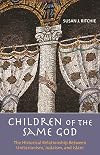
This is a thin volume that took me less than two and a half hours to read. I picked it up because I'm taking a class on the Qur'an, and I wanted to dig deeper into the similarities I'm seeing between Qur'anic and Unitarian Universalist theology. This wasn't quite the book I expected, although the subtitle should have clued me in before I opened the cover that this would be about the historical rather than theological relationship between three faith traditions.
Moreover, in this book, Ritchie show more doesn't address the historical relationship between the three faith traditions in a general way but from a distinctly Unitarian Universalist perspective, which isn't a problem, but it left it more narrow in scope than I expected. I did appreciate the the call to let go of some of our reserve and to open ourselves up to "staggering and reeling," especially as I've experienced some of this in my experience of reading the Qur'an and hearing it recited, but it seemed strange paired with what I read as a caution against cultural misappropriation. Not that I'm favor of cultural misappropriation, but there seemed to be a warning about how not to engage with Judaism and Islam but no corresponding suggestions for how to go about doing this in a culturally sensitive way. How can we exercise restraint so we don't risk cultural insensitivity and simultaneously let ourselves open to profound religious experience? How can Unitarian Universalism become truly multi-religious without simply falling back on interpreting other religions as "UU even though they don't know it yet"?
Ritchie did provide some interesting context for the development of Unitarianism in Europe and how that development intersected with the rise of Islam as introduced by the Ottoman Empire, but I would have liked to have read more about her process of discerning the authenticity and relevance of different documents. In the end, this seems like neither a rigorously historical nor theological take on the intersection of these three faith traditions, but it does provide an intriguing overview and a different context than I'd encountered before. It might be interesting to read a book on the same subject written by an author from the Muslim tradition. show less
Moreover, in this book, Ritchie show more doesn't address the historical relationship between the three faith traditions in a general way but from a distinctly Unitarian Universalist perspective, which isn't a problem, but it left it more narrow in scope than I expected. I did appreciate the the call to let go of some of our reserve and to open ourselves up to "staggering and reeling," especially as I've experienced some of this in my experience of reading the Qur'an and hearing it recited, but it seemed strange paired with what I read as a caution against cultural misappropriation. Not that I'm favor of cultural misappropriation, but there seemed to be a warning about how not to engage with Judaism and Islam but no corresponding suggestions for how to go about doing this in a culturally sensitive way. How can we exercise restraint so we don't risk cultural insensitivity and simultaneously let ourselves open to profound religious experience? How can Unitarian Universalism become truly multi-religious without simply falling back on interpreting other religions as "UU even though they don't know it yet"?
Ritchie did provide some interesting context for the development of Unitarianism in Europe and how that development intersected with the rise of Islam as introduced by the Ottoman Empire, but I would have liked to have read more about her process of discerning the authenticity and relevance of different documents. In the end, this seems like neither a rigorously historical nor theological take on the intersection of these three faith traditions, but it does provide an intriguing overview and a different context than I'd encountered before. It might be interesting to read a book on the same subject written by an author from the Muslim tradition. show less
Children of the Same God: The Historical Relationship Between Unitarianism, Judaism, and Islam by Susan J. Ritchie
A top scholar in her field, Susan J. Ritchie makes the groundbreaking historical argument that long before Unitarianism and Universalism merged in the United States, Unitarianism itself was inherently multi-religious. She demonstrates how Unitarians in Eastern Europe claimed a strong affinity with Jews and Muslims from the very beginning. - - from book cover
Statistics
- Works
- 3
- Members
- 49
- Popularity
- #320,874
- Rating
- 3.0
- Reviews
- 2
- ISBNs
- 1