
Art Thibert
Author of Huntress: Year One
Works by Art Thibert
Black & White No.03 Grey 1 copy
Black & White No.01 Black 1 copy
Black & White No.02 White 1 copy
X-Men #12 1 copy
Black & White #1-3 1 copy
Associated Works
Supergirl and the Legion of Super-Heroes: Strange Visitor from Another Century (2006) — Illustrator — 96 copies, 2 reviews
L. Ron Hubbard Presents Writers of the Future, Volume 2 (1986) — Illustrator, some editions — 82 copies
Supergirl and the Legion of Super-Heroes: Adult Education (2007) — Illustrator — 75 copies, 2 reviews
Heroes: The World's Greatest Super Hero Creators Honor The World's Greatest Heroes 9-11-2001 (2001) — Inker — 25 copies, 1 review
Avengers (1997) #80 — Cover artist — 4 copies
Batman The Widening Gyre #1 Cover A — Illustrator — 4 copies
Legion of Super-Heroes [2005] #13 — Illustrator — 3 copies
The Transformers 114: Wanted: Galvatron — Dead or Alive! (part 2: First Blood!) (1987) — Illustrator — 1 copy, 1 review
The Transformers 113: Wanted: Galvatron — Dead or Alive! (part 1) (1987) — Illustrator — 1 copy, 1 review
Tagged
Common Knowledge
Members
Reviews
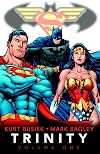
Despite its reputation for being the CBS of comic book houses; establishmentarian, fusty, dotty, etc.; DC continues to push the envelope of creativity to produce new and fresh stories for even their most venerable properties. Trinity focuses not only on the DC universe's Big Three characters; Superman, Wonder Woman, and Batman, but writer Kurt Busiek (Astro City, among many other excellent jobs) ties their common and disparate characteristics together to form a story of cosmic juxtaposition show more that again tests the limits of the plausible.The dialogue is sufficiently tuned to each character's personality, even reaching outside the borders of the main three and into the rosters of the Justice League and others. The storyline encompasses several threads that penetrate the myriad worlds of the DC "manifest cosmos," from Gotham and Keystone to the anti-matter universe, touching high and low supporting characters, and an especially clever plot twist near the end of the first volume.But, and pardon my ignorance, when did they make the new Firestorm black? show less

Probably the worst comic book I have ever read. You see the three "Trinity" on the cover, maybe the reason you purchased this book? They do not even appear in the nearly 300 pages that follow, complete false advertising if ever I saw it. The story runs around in circles and rehashes the same plot points so repetitively that it's as if the writers were trying to be as slow and dreary as possible. A cavalcade of characters other than the Big Three run around spouting the most horrific show more mumbo-jumbo about alternate realities and destinies in a mind-numbing blather that tries to add substance to this horribly overwrought and excessively long story. Including book 1 and this edition, I have no faith that a third collection would wrap the story up satisfactorily, let alone paying almost $100 for the entire miserable experience. show less

Access a version of the below that includes illustrations on my blog.
Retcons are a weird thing, but they're a constant of the superhero comic book world. Helena Bertinelli was introduced as the Huntress in the 1989-90 ongoing series The Huntress, a dark, sort of moody noir series that stood on its own, though she did meet Batman once and was also a member of the Justice League International's American branch (since she lived in New York City). She faded away, but in 1992, Chuck Dixon brought show more her back for a two-issue story in Detective Comics, and then a key role in Robin III: Cry of the Huntress (1992-93), and finally her own miniseries (1994). Each of these tweaked her origin a little bit: soon she was from Gotham, not New York, and the exact details of how her family had been murdered fluctuated with each new story. Her origin got a wholesale retelling in 2000 with Batman/Huntress: Cry for Blood (the only one of these I haven't actually read), and then another one in 2008 with this series, Huntress: Year One.
As you read new versions, it's sometimes hard to judge them on their own merits. The original Huntress series by Joey Cavalieri and Joe Staton isn't perfect, but it is distinctive, with dark, moody artwork and a heroine who's not always attractive, physically or elsewise. Though later takes on the Huntress would be darker and more violent, and though the plots of the ongoing sometimes got silly, there's a real sense of the series trying something not because it's tried and true, but because it's new and distinctive. The 1990s would take "dark and gritty" in bad directions sometimes, but I enjoyed what The Huntress seemed to be striving towards, even if it didn't always hit it.
So, my problems with Huntress: Year One aren't really its own fault. Its Huntress is a different character than the one created by Cavalieri and Staton, and she has a somewhat different history. I'm not sure what I think of her being raised in Sicily, or having a lost love: I liked the damaged, lonely warrior of the original series that didn't have anyone to support her. But the story Madison Ivory and Cliff Richards tell here is not bad, just different, and on its own merits, it's pretty good-- if nothing exceptional.
Instead of the gritty urban vigilante aspects of the character, this really focuses on mafia princess components, as Helena untangles a conspiracy to deprive her of her inheritance, and much worse, that runs from Sicily to the Vatican to Gotham, and leads to her meeting Batman, Batgirl, Barbara Gordon, Bruce Wayne, and Catwoman, among others. Like a lot of conspiracy stories, some of it went over my head, and there's a lot of characters to keep track of, but Ivory keeps things pretty interesting, and I enjoyed the clean linework of Cliff Richards, Art Thibert, and Norm Rapmund, especially their regal, statuesque Helena.
But I just couldn't shake the versions I'd read before from my head. Usually, I feel like I'm better at this. Oh, well.
Batman "Year One" Stories: « Previous in sequence | Next in sequence » show less
Retcons are a weird thing, but they're a constant of the superhero comic book world. Helena Bertinelli was introduced as the Huntress in the 1989-90 ongoing series The Huntress, a dark, sort of moody noir series that stood on its own, though she did meet Batman once and was also a member of the Justice League International's American branch (since she lived in New York City). She faded away, but in 1992, Chuck Dixon brought show more her back for a two-issue story in Detective Comics, and then a key role in Robin III: Cry of the Huntress (1992-93), and finally her own miniseries (1994). Each of these tweaked her origin a little bit: soon she was from Gotham, not New York, and the exact details of how her family had been murdered fluctuated with each new story. Her origin got a wholesale retelling in 2000 with Batman/Huntress: Cry for Blood (the only one of these I haven't actually read), and then another one in 2008 with this series, Huntress: Year One.
As you read new versions, it's sometimes hard to judge them on their own merits. The original Huntress series by Joey Cavalieri and Joe Staton isn't perfect, but it is distinctive, with dark, moody artwork and a heroine who's not always attractive, physically or elsewise. Though later takes on the Huntress would be darker and more violent, and though the plots of the ongoing sometimes got silly, there's a real sense of the series trying something not because it's tried and true, but because it's new and distinctive. The 1990s would take "dark and gritty" in bad directions sometimes, but I enjoyed what The Huntress seemed to be striving towards, even if it didn't always hit it.
So, my problems with Huntress: Year One aren't really its own fault. Its Huntress is a different character than the one created by Cavalieri and Staton, and she has a somewhat different history. I'm not sure what I think of her being raised in Sicily, or having a lost love: I liked the damaged, lonely warrior of the original series that didn't have anyone to support her. But the story Madison Ivory and Cliff Richards tell here is not bad, just different, and on its own merits, it's pretty good-- if nothing exceptional.
Instead of the gritty urban vigilante aspects of the character, this really focuses on mafia princess components, as Helena untangles a conspiracy to deprive her of her inheritance, and much worse, that runs from Sicily to the Vatican to Gotham, and leads to her meeting Batman, Batgirl, Barbara Gordon, Bruce Wayne, and Catwoman, among others. Like a lot of conspiracy stories, some of it went over my head, and there's a lot of characters to keep track of, but Ivory keeps things pretty interesting, and I enjoyed the clean linework of Cliff Richards, Art Thibert, and Norm Rapmund, especially their regal, statuesque Helena.
But I just couldn't shake the versions I'd read before from my head. Usually, I feel like I'm better at this. Oh, well.
Batman "Year One" Stories: « Previous in sequence | Next in sequence » show less
While the book is epic in scale, it just felt too long. Its meandering first and second acts could have used some tightening. The finale was amazing, especially the last battle, and the reveal of Enigma being an alternate version of The Riddler was something I didn’t see coming.
The symbolism of the Trinity was great. I especially loved the way they explored various symbols of the three together and how they complement each other. The alternate Trinity, meanwhile, wasn’t as cool.
The symbolism of the Trinity was great. I especially loved the way they explored various symbols of the three together and how they complement each other. The alternate Trinity, meanwhile, wasn’t as cool.
Lists
You May Also Like
Associated Authors
Statistics
- Works
- 12
- Also by
- 41
- Members
- 275
- Popularity
- #84,338
- Rating
- 3.6
- Reviews
- 11
- ISBNs
- 8
- Languages
- 1