
Dan Wakefield (1932–2024)
Author of The Story of Your Life: Writing A Spiritual Autobiography
About the Author
Image credit: Tony Valainis
Works by Dan Wakefield
The Hijacking of Jesus: How the Religious Right Distorts Christianity and Promotes Prejudice and Hate (2006) 67 copies, 1 review
Vuelta a Empezar 1 copy
Espiritualmente Incorreto. Encontrando Deus Nos Lugares Mais Inusitados (Em Portuguese do Brasil) (2006) 1 copy
New York in the '50s 1 copy
New Age, New Opportunities 1 copy
Live or die 1 copy
Ricominciare da capo 1 copy
Espiritualmente incorreto 1 copy
Associated Works
If This Isn't Nice, What Is?: Advice for the Young (2014) — Introduction, some editions — 447 copies, 21 reviews
Rediscoveries II: Important Writers Select Their Favorite Works of Neglected Fiction (1988) — Contributor — 31 copies, 1 review
Tagged
Common Knowledge
- Birthdate
- 1932-05-21
- Date of death
- 2024-03-13
- Gender
- male
- Education
- Shortridge High School
Columbia University (BA|English|1955) - Occupations
- novelist
journalist
screenwriter - Organizations
- Authors Guild of America
Writers Guild of America East
National Writers Union
Florida International University
The Nation
The Atlantic Monthly - Awards and honors
- Bernard DeVoto Fellowship to Bread Loaf Writers Conference (1958)
Neiman Fellowship in Journalism at Harvard University (1963-64)
National Foundation for the Arts Award for Short Story (1966)
Rockefeller Foundation Grant in Writing (1968) - Agent
- Janklow and Nesbit
- Nationality
- USA
- Birthplace
- Indianapolis, Indiana, USA
- Places of residence
- Broad Ripple, Indianapolis, Indiana, USA
New York, New York, USA - Associated Place (for map)
- Indiana, USA
Members
Reviews

I guess if you grew up in Indianapolis, as I did, this book is a must read. He gets the anomie of young people there right. I was a decade or two later than he was, and left in my early 20s, as do the main characters in this book. I was also a Unitarian, so I was liberated from the religious nonsense around me, only vaguely aware of it. I was, to my shame, also only vaguely aware of the racism and anti-semitism of the time and place. It was lessened in the Unitarian church, and not spoken of show more openly in my family or circle. I was also only vaguely aware of the depth of sexism that surrounded me. I became more aware of it as I went through college and in later years.
This book reminded me of On The Road. The first time I read Kerouac's book I didn't even notice the sexism. The second time I read it, I hated it for the sexism. The third time, years later, I saw the sexism and still thought it was a great book. As I read Going All the Way, I hated the sexism and did not think it was a great book, but do think it has its moments. Some of his descriptions of the confined feeling of being in Indianapolis, young, not sure how to get out on ones own, and at the mercy of the conventions of the time and place, are devastating.
The two main characters bear a vague resemblance to Kerouac's fictional self and Neal Cassidy, except they are stuck in Indianapolis, where a man who grew a beard may as well go out naked or peddle Communist literature, and certainly could not swim in a pool without somehow contaminating it. (Much as pools were segregated by race.)
I also note that the two main characters are drinking most of the time. Not lightly, but seriously. So most of the time they are driving, they are drunk. That they crash a car at one point is hardly surprising. It reminds me that the only places one could afford to be in as a young person in Indianapolis were bars, and I was not old enough to go to them when I was there. Restaurants were few and too expensive, there were no coffeeshops. (In college, we sometimes resorted to standing on the elevated porch around the War Memorial building and gazing with disgust at the park north of it, which was decorated by the American Legion with military vehicles and militaristic symbols. It wasn't much, but it got you out of the house.)
I found it perplexing that the main characters had gone to college and served two years in the military and still cared so much about their high school reputations and those of others, but I think this is probably realistic.
In the edition I have, Wakefield apologized to men and woman reading his book for his depiction of girls and women, though I imagine it was accurate among boys and men he knew at the time. I heard a recent interview with the man, who at 88 has also grown considerably concerning his attitudes about race--a change that probably began when he reported on the Medger Evers trial for the Nation magazine, and which has moved forward considerably in the past couple of years (2020, 2021).
This edition also has an introduction by Kurt Vonnegut, with whom Wakefield was friends. Vonnegut, whose family was nominally Unitarian, is more like the Indianapolis context in which I grew up, and gave me hope, growing up that one could be OK after growing up in Indianapolis.
So Wakefield left, returning only much later. The two main characters in Going All the Way left, Vonnegut left, and I left, Indianapolis. I suppose it is safer now for unconventionality and broader thoughts, and that it was not the only place that was so awful in America in the 1950s, but I could not navigate it as a young person, and do not plan a return. show less
This book reminded me of On The Road. The first time I read Kerouac's book I didn't even notice the sexism. The second time I read it, I hated it for the sexism. The third time, years later, I saw the sexism and still thought it was a great book. As I read Going All the Way, I hated the sexism and did not think it was a great book, but do think it has its moments. Some of his descriptions of the confined feeling of being in Indianapolis, young, not sure how to get out on ones own, and at the mercy of the conventions of the time and place, are devastating.
The two main characters bear a vague resemblance to Kerouac's fictional self and Neal Cassidy, except they are stuck in Indianapolis, where a man who grew a beard may as well go out naked or peddle Communist literature, and certainly could not swim in a pool without somehow contaminating it. (Much as pools were segregated by race.)
I also note that the two main characters are drinking most of the time. Not lightly, but seriously. So most of the time they are driving, they are drunk. That they crash a car at one point is hardly surprising. It reminds me that the only places one could afford to be in as a young person in Indianapolis were bars, and I was not old enough to go to them when I was there. Restaurants were few and too expensive, there were no coffeeshops. (In college, we sometimes resorted to standing on the elevated porch around the War Memorial building and gazing with disgust at the park north of it, which was decorated by the American Legion with military vehicles and militaristic symbols. It wasn't much, but it got you out of the house.)
I found it perplexing that the main characters had gone to college and served two years in the military and still cared so much about their high school reputations and those of others, but I think this is probably realistic.
In the edition I have, Wakefield apologized to men and woman reading his book for his depiction of girls and women, though I imagine it was accurate among boys and men he knew at the time. I heard a recent interview with the man, who at 88 has also grown considerably concerning his attitudes about race--a change that probably began when he reported on the Medger Evers trial for the Nation magazine, and which has moved forward considerably in the past couple of years (2020, 2021).
This edition also has an introduction by Kurt Vonnegut, with whom Wakefield was friends. Vonnegut, whose family was nominally Unitarian, is more like the Indianapolis context in which I grew up, and gave me hope, growing up that one could be OK after growing up in Indianapolis.
So Wakefield left, returning only much later. The two main characters in Going All the Way left, Vonnegut left, and I left, Indianapolis. I suppose it is safer now for unconventionality and broader thoughts, and that it was not the only place that was so awful in America in the 1950s, but I could not navigate it as a young person, and do not plan a return. show less

Imagine a past you must have known, even if you weren't there. Birney, Illinois. Population 4,742 -- Moose and Odd Fellows -- Welcome! It is December 7,1941. Ten year-old Artie Garber is our guide. His brother Roy is the hero and Roy's girl Shirley is the love interest. Artie's mother and father are midwestern parents of the best kind. Roy goes to war; Artie is charged with keeping an eye on Shirley. He and his friends watch the skies for German planes, and the streets for spies. Shirley show more falls for another guy. Artie tries to intervene, and understand. Roy comes home from the war. Life is no longer a small-town basketball game. It is a simple story (perhaps) of awakening and loss and growth. The scenes, the sounds and images, the ambiance of Birney, are at once lost in time and with us today, over 50 years later, for here is a nearly perfect work of art. show less
The Hijacking of Jesus: How the Religious Right Distorts Christianity and Promotes Prejudice and Hate by Dan Wakefield
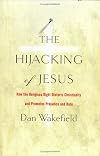
This is a much-needed book on what some people call the "religious left," which has more to do with feeding the poor, attaining civil rights and justice, providing shelter and medicine for the homeless and sick - things Jesus asked us to do - rather than what the "religious right" is all about, which is gaining power through politics, wedging issues to divide denominations, spending millions of dollars on minority-discriminating agendas, etc. - things Jesus would not want us to do.
This show more important book hits the road running and doesn't slow or stop until you finish. Immediately, I wanted to look up more books on following Christ rather than Fundamentalism. After reading this, I became sad for the many people who have been sucked into the religious right's mentality of anger and hate. They have single-handedly put a distaste of Christianity and religion in the minds of millions of liberals, who haven't been exposed to what Christianity is really supposed to be about. I hope, through resources like this, the religious right's demented and perverted version of Christianity will diminish so that Christ can actually shine through the many compassionate Christians of the world. show less
This show more important book hits the road running and doesn't slow or stop until you finish. Immediately, I wanted to look up more books on following Christ rather than Fundamentalism. After reading this, I became sad for the many people who have been sucked into the religious right's mentality of anger and hate. They have single-handedly put a distaste of Christianity and religion in the minds of millions of liberals, who haven't been exposed to what Christianity is really supposed to be about. I hope, through resources like this, the religious right's demented and perverted version of Christianity will diminish so that Christ can actually shine through the many compassionate Christians of the world. show less
Supernation at peace and war; being certain observations, depositions, testimonies, and graffiti gathered on a one-man fact-and-fantasy-finding tour of the most powerful nation in the world by Dan Wakefield
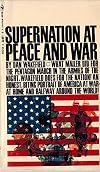
The main title's to be taken literally: Dan Wakefield is describing a nation that's simultaneously at war and at peace. His method for doing this was interviews, mainly with folks who were active in--well, almost anything. Interview subjects included Vice President Humphrey, Ray Mungo (before he wrote about becoming "famous"), members of the Detroit teachers union, anti-communist activist Don Lobsinger, and many others. The book investigates and discusses a number of subjects, but the main show more subject was the Vietnam war.
I first read this book when it was new--first an excerpt in The Atlantic, then the paperback edition soon after it was available. I loved it back then, and remembered it as kind of like Steinbeck's Travels with Charley or William Least Heat Moon's Blue Highways.
Fifty years later I don't like it so much, and the parallels to the Steinbeck and Heat Moon's books are weak, though not non-existent. This time I found it difficult to read, and can't entirely say why. Saying Wakefield was against the Vietnam war probably doesn't do him justice, but the book comes off as partisan in ways that bother me--even though I opposed the war when I was twenty, and still believe it a mistake.
A valuable book, methinks, to someone interested in the country's temper in 1968. Not so much to anyone else. show less
I first read this book when it was new--first an excerpt in The Atlantic, then the paperback edition soon after it was available. I loved it back then, and remembered it as kind of like Steinbeck's Travels with Charley or William Least Heat Moon's Blue Highways.
Fifty years later I don't like it so much, and the parallels to the Steinbeck and Heat Moon's books are weak, though not non-existent. This time I found it difficult to read, and can't entirely say why. Saying Wakefield was against the Vietnam war probably doesn't do him justice, but the book comes off as partisan in ways that bother me--even though I opposed the war when I was twenty, and still believe it a mistake.
A valuable book, methinks, to someone interested in the country's temper in 1968. Not so much to anyone else. show less
Awards


You May Also Like


Associated Authors
Statistics
- Works
- 37
- Also by
- 8
- Members
- 1,046
- Popularity
- #24,627
- Rating
- 3.7
- Reviews
- 24
- ISBNs
- 81
- Languages
- 3