
Tom Nichols (2) (1960–)
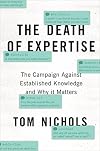
Author of The Death of Expertise: The Campaign Against Established Knowledge and Why It Matters
For other authors named Tom Nichols, see the disambiguation page.
Tom Nichols (2) has been aliased into Thomas M. Nichols.
Works by Tom Nichols
Works have been aliased into Thomas M. Nichols.
The Death of Expertise: The Campaign Against Established Knowledge and Why It Matters (2017) 1,044 copies, 31 reviews
Tagged
Common Knowledge
- Legal name
- Nichols, Thomas M.
- Birthdate
- 1960-12-07
- Gender
- male
- Education
- Georgetown University (Ph.D|1988)
Columbia University (M.A.|1984)
Boston University (B.A.|1983) - Occupations
- professor
- Organizations
- United States Naval War College
- Awards and honors
- Meritorious Civilian Service Medal (2005)
Citta della Rose Book Prize (2018) - Nationality
- USA
- Associated Place (for map)
- USA
Members
Reviews
The Death of Expertise: The Campaign against Established Knowledge and Why it Matters by Tom Nichols

The Death of Expertise is the best curmudgeonly, "get off my lawn" argument for returning to better norms I've ever read. The author makes his case as reasoned and articulate as possible but you can practically hear the resignation in his voice because it's as if he knows he's trying to stem an unstoppable tide.
There's plenty of understated humor in the book which helps to offset its pervasive pessimism. Take this quote for example, "Imagine what the 1920s would've sounded like if every show more crank in every small town had his own radio station. Maybe it's not that people are any dumber or any less willing to listen to experts than they were 100 years ago, it's just that we can hear them all now."
I think the death of expertise is mostly the result of timing. Given the rise of globalism and our increasing interconnectedness of the past half century, it's not that experts are making more wrong calls but rather their occasional stumbles are now affecting more people. And those same people, a much larger group than ever before, will only see the stumbles and not the greater number of correct decisions. It's human nature, really, but this time there's weight in numbers to swing the pendulum further the other way. show less
There's plenty of understated humor in the book which helps to offset its pervasive pessimism. Take this quote for example, "Imagine what the 1920s would've sounded like if every show more crank in every small town had his own radio station. Maybe it's not that people are any dumber or any less willing to listen to experts than they were 100 years ago, it's just that we can hear them all now."
I think the death of expertise is mostly the result of timing. Given the rise of globalism and our increasing interconnectedness of the past half century, it's not that experts are making more wrong calls but rather their occasional stumbles are now affecting more people. And those same people, a much larger group than ever before, will only see the stumbles and not the greater number of correct decisions. It's human nature, really, but this time there's weight in numbers to swing the pendulum further the other way. show less
The death of expertise : the campaign against established knowledge and why it matters by Tom Nichols

Democratic societies work by having responsible, informed citizens choosing political representatives whom we trust to take complicated decisions on our behalf. Those representatives take their decisions based on the best advice they can assemble from competent professional advisers — analysts, administrators, technicians — who are experts in the topic in question. At least that’s the theory…
According to Nichols (who is a self-confessed foreign-policy expert as well as being a show more celebrated Jeopardy contestant), this model is breaking down in the USA because of a growing distrust of specialist professional knowledge. Lay-people have an exaggerated sense of our own expertise (we can Google it, after all, so we know as much as they do, don’t we?) and a tendency to resent anyone who tells us that they know better. We’re all too ready to suspect conspiracies and ulterior motives, we like to think that our opinion is (at least) as valuable as the next person’s, and we rarely bother to read anything written by people with a different point of view from our own. Nichols talks a lot about stupid, wilfully ignorant people, but he also makes the point — which I found rather more interesting — that this kind of thinking is also prevalent among people who are educated, experienced professionals in one field but dangerously willing to assume knowledge in other fields where they have no proper training and experience.
Nichols reminds us that expertise is gained through an education that challenges us to step outside our comfort zone and defend our ideas in serious logical argument, and through a long process of gaining practical experience and making mistakes. Things which he argues are no longer easily available to most Americans, because of the way the education system has turned into a commercial service-industry where the customer is always right.
There’s probably nothing new about any of these effects — I can remember a fellow-delegate at an important scientific conference forty years ago lecturing me over lunch about what he saw as the strong evidence for biblical-style creation. But they seem to have been accelerated by the effect of the internet, which allows stupid ideas and misinformation to spread around the world faster than ever before, and by developments in the way that news media work, serving us with the news they know their customers want to read, rather than the news they think it’s important for informed citizens to be aware of.
Obviously a lot of what Nichols says can be dismissed as the gloom-and-doom of an older, conservative academic, who sees the world changing around him, or as the reaction of a mainstream Republican to the rise of Trumpery. I’ve been reading British versions of the same kind of thinking since the Brexit referendum (apart from the fact that British commentators have the additional advantage of being able to blame America, which always goes down well…). I found a lot of what Nichols said quite patronising — for example, he is dismissive of the independence of mind of the current generation of students in the US, an assumption that is belied by the current protests against the Israeli actions in Gaza; and he implies that only stupid people could possibly vote for Trump, which clearly can’t be true: in real life a large proportion of the people who voted for him must have been decent, intelligent people who somehow allowed themselves to be convinced that the alternative was worse. But he does make some good points, although he unfortunately doesn’t come up with a solution to the problem… show less
According to Nichols (who is a self-confessed foreign-policy expert as well as being a show more celebrated Jeopardy contestant), this model is breaking down in the USA because of a growing distrust of specialist professional knowledge. Lay-people have an exaggerated sense of our own expertise (we can Google it, after all, so we know as much as they do, don’t we?) and a tendency to resent anyone who tells us that they know better. We’re all too ready to suspect conspiracies and ulterior motives, we like to think that our opinion is (at least) as valuable as the next person’s, and we rarely bother to read anything written by people with a different point of view from our own. Nichols talks a lot about stupid, wilfully ignorant people, but he also makes the point — which I found rather more interesting — that this kind of thinking is also prevalent among people who are educated, experienced professionals in one field but dangerously willing to assume knowledge in other fields where they have no proper training and experience.
Nichols reminds us that expertise is gained through an education that challenges us to step outside our comfort zone and defend our ideas in serious logical argument, and through a long process of gaining practical experience and making mistakes. Things which he argues are no longer easily available to most Americans, because of the way the education system has turned into a commercial service-industry where the customer is always right.
There’s probably nothing new about any of these effects — I can remember a fellow-delegate at an important scientific conference forty years ago lecturing me over lunch about what he saw as the strong evidence for biblical-style creation. But they seem to have been accelerated by the effect of the internet, which allows stupid ideas and misinformation to spread around the world faster than ever before, and by developments in the way that news media work, serving us with the news they know their customers want to read, rather than the news they think it’s important for informed citizens to be aware of.
Obviously a lot of what Nichols says can be dismissed as the gloom-and-doom of an older, conservative academic, who sees the world changing around him, or as the reaction of a mainstream Republican to the rise of Trumpery. I’ve been reading British versions of the same kind of thinking since the Brexit referendum (apart from the fact that British commentators have the additional advantage of being able to blame America, which always goes down well…). I found a lot of what Nichols said quite patronising — for example, he is dismissive of the independence of mind of the current generation of students in the US, an assumption that is belied by the current protests against the Israeli actions in Gaza; and he implies that only stupid people could possibly vote for Trump, which clearly can’t be true: in real life a large proportion of the people who voted for him must have been decent, intelligent people who somehow allowed themselves to be convinced that the alternative was worse. But he does make some good points, although he unfortunately doesn’t come up with a solution to the problem… show less
The Death of Expertise: The Campaign Against Established Knowledge and Why it Matters by Tom Nichols

I think this book is so prescient and correct in so many ways, and really off track in others. We live in a world where people don't trust doctors to give medical advice, yet will take their plumber's recommendation that they take a horse de-worming pill to ward off infection from a deadly virus. As I was reading this book and listening to the mid 2010s examples of anti-expert-ism, I thought "oh, isn't that cute." Would that people were only as misinformed as they were 10 years ago!
I found show more the author's description of higher education to be very similar to my experiences, where students have a sense of entitlement about receiving a passing grade for merely showing up and "trying hard." While that is frustrating to me beyond belief (especially as an engineering professor), as I have only been a professor for 7 years, I cannot say for sure that it was any better or worse in the 60s / 70s / 80s / 90s. I do know that the corporatization of administration in higher ed is one of the problems, as many experts in education have already pointed out. The author did not blame the gaggle of $250,000/year deans and provosts with MBAs and EdDs, but students.
I disagree when the author scoffs at students wishing not to see racist Halloween costumes or swastikas in public. (Which has nothing to do with disrespect of expertise, that's just straight up calling out people for bigotry.) The author comes across as a typical entitled white man who doesn't like to have the younger generation calling out transphobic, racist, antisemitic, etc., bullsh*t from older folks who think it's OK just because they've never been held accountable or suffered consequences of being bigots before.
I also found it annoying and exhausting, but not surprising, to hear the author complain about getting 'splained things by non-experts, as if women don't deal with this all the time. I have had non-pilots tell me how to land an airplane (I'm a licensed pilot, so I know how to land an airplane and, furthermore, HAVE DONE IT HUNDREDS OF TIMES). I have had men tell me how quantum physics works (not that I'm an expert, but I know a lot more about it than my massage therapist, and I did take graduate classes on quantum mech and quantum optics while getting my PhD). I have had men explain to me how electricity works, as if I don't have three degrees in electrical engineering. Not that it justifies any 'splaining, but WELCOME TO HOW ALL WOMEN FEEL ALL THE TIME, WHITE GUY AUTHOR!
Without having the time or desire to look up every study cited by the author, I wondered about selection bias and lack of expertise of the author in some of the fields he cited. How many times is an extremely technical medical paper showing kind of a low stakes result (x has shown to be correlated with y, and we know that y leads to disease z) spun by the media to be X CAUSES Z! The author goes on about how scientists told people to stop eating eggs and that caused people to get fat. Which strikes me as disingenuous at best. I'm not sure what the initial study says, but wonder how much of the hype was caused by journalists and folks like him who don't know how to interpret scientific study results. And the fatphobia was unnecessary. Body size does not correlate with intelligence, nor is there a causal relationship between the two variables.
It's not news that the journalism field has been pretty much redefined and completely decimated as a serious profession over the past 20-30 years. When clickbait reigns supreme, and with the massive reduction in local newspapers and journals, news media organizations don't want to spend money on actual reporting. The author discusses this peripherally, and sort of blames the journalists. He doesn't blame the system that we have that has lead to this dearth of expertise in the journalism field. (Let's blame entitled millennials who cried their way to unearned college diplomas at small schools that shouldn't exist because they aren't ivy league instead!)
Finally, I was disturbed on how little flak the author gives to one of the HUGEST causes of the spread of misinformation: social media CEOs. What, so Facebook and Google get off the hook? They haven't lead to the proliferation of conspiracy theories, misinformation, anti-science, racism, and worse, through their algorithms? Nothing? No, the author says nothing about this at all. It's a shame, because this problem cannot be corrected until the root causes are identified.
I had read this book after just having completed Off the Edge, and I think the two books paired well together. Still, with all its flaws, I think it raises some important topics. I wish it held up to the expert level of scrutiny called for in the text itself. show less
I found show more the author's description of higher education to be very similar to my experiences, where students have a sense of entitlement about receiving a passing grade for merely showing up and "trying hard." While that is frustrating to me beyond belief (especially as an engineering professor), as I have only been a professor for 7 years, I cannot say for sure that it was any better or worse in the 60s / 70s / 80s / 90s. I do know that the corporatization of administration in higher ed is one of the problems, as many experts in education have already pointed out. The author did not blame the gaggle of $250,000/year deans and provosts with MBAs and EdDs, but students.
I disagree when the author scoffs at students wishing not to see racist Halloween costumes or swastikas in public. (Which has nothing to do with disrespect of expertise, that's just straight up calling out people for bigotry.) The author comes across as a typical entitled white man who doesn't like to have the younger generation calling out transphobic, racist, antisemitic, etc., bullsh*t from older folks who think it's OK just because they've never been held accountable or suffered consequences of being bigots before.
I also found it annoying and exhausting, but not surprising, to hear the author complain about getting 'splained things by non-experts, as if women don't deal with this all the time. I have had non-pilots tell me how to land an airplane (I'm a licensed pilot, so I know how to land an airplane and, furthermore, HAVE DONE IT HUNDREDS OF TIMES). I have had men tell me how quantum physics works (not that I'm an expert, but I know a lot more about it than my massage therapist, and I did take graduate classes on quantum mech and quantum optics while getting my PhD). I have had men explain to me how electricity works, as if I don't have three degrees in electrical engineering. Not that it justifies any 'splaining, but WELCOME TO HOW ALL WOMEN FEEL ALL THE TIME, WHITE GUY AUTHOR!
Without having the time or desire to look up every study cited by the author, I wondered about selection bias and lack of expertise of the author in some of the fields he cited. How many times is an extremely technical medical paper showing kind of a low stakes result (x has shown to be correlated with y, and we know that y leads to disease z) spun by the media to be X CAUSES Z! The author goes on about how scientists told people to stop eating eggs and that caused people to get fat. Which strikes me as disingenuous at best. I'm not sure what the initial study says, but wonder how much of the hype was caused by journalists and folks like him who don't know how to interpret scientific study results. And the fatphobia was unnecessary. Body size does not correlate with intelligence, nor is there a causal relationship between the two variables.
It's not news that the journalism field has been pretty much redefined and completely decimated as a serious profession over the past 20-30 years. When clickbait reigns supreme, and with the massive reduction in local newspapers and journals, news media organizations don't want to spend money on actual reporting. The author discusses this peripherally, and sort of blames the journalists. He doesn't blame the system that we have that has lead to this dearth of expertise in the journalism field. (Let's blame entitled millennials who cried their way to unearned college diplomas at small schools that shouldn't exist because they aren't ivy league instead!)
Finally, I was disturbed on how little flak the author gives to one of the HUGEST causes of the spread of misinformation: social media CEOs. What, so Facebook and Google get off the hook? They haven't lead to the proliferation of conspiracy theories, misinformation, anti-science, racism, and worse, through their algorithms? Nothing? No, the author says nothing about this at all. It's a shame, because this problem cannot be corrected until the root causes are identified.
I had read this book after just having completed Off the Edge, and I think the two books paired well together. Still, with all its flaws, I think it raises some important topics. I wish it held up to the expert level of scrutiny called for in the text itself. show less
The death of expertise : the campaign against established knowledge and why it matters by Tom Nichols
“These are dangerous times. Never have so many people had so much access to so much knowledge and yet have been so resistant to learning anything.”
This is a depressing, timely, and important book, although one that I fear will not be read by those who most need to read it. In this age of people diagnosing medical conditions through Google, getting their news from Facebook and deriding anyone who bothers to read a book as an egghead, it’s hard for experts to defend their expertise show more without being branded as “elitists”.
I agreed with most of the author’s arguments and spent a good chunk of the book shaking my head sadly in agreement. However, I bristled a bit when university students were presented as coddled and entitled. I don’t dispute that grade inflation is rampant, and that some students are entitled whiners who consider themselves customers rather than learners. I do dispute the idea that having to share a room with a stranger without knowing anything about them beforehand somehow builds character and is “better” than the modern approach, which could involve matching roommates based on their sleeping habits or their programs, and enabling them to meet on social media in advance of the school year. For an introvert especially, the thought of rooming with an unknown person is terrifying. Allowing roommates to meet beforehand gives them an opportunity to get to know each other, perhaps divvy up buying shared things for the room, and maybe even discuss some areas of potential conflict so that they can figure out a plan before the conflict arises.
Apart from this admittedly highly specific gripe (I speak from experience in terms of benefitting from roommate compatibility surveys), I would certainly recommend that everyone read it—and then go and read more about the wider world. That is one thing this book does well: remind the reader of how vital it is to be well informed about current affairs. Because if you disengage, you’re letting others do your thinking for you. show less
This is a depressing, timely, and important book, although one that I fear will not be read by those who most need to read it. In this age of people diagnosing medical conditions through Google, getting their news from Facebook and deriding anyone who bothers to read a book as an egghead, it’s hard for experts to defend their expertise show more without being branded as “elitists”.
I agreed with most of the author’s arguments and spent a good chunk of the book shaking my head sadly in agreement. However, I bristled a bit when university students were presented as coddled and entitled. I don’t dispute that grade inflation is rampant, and that some students are entitled whiners who consider themselves customers rather than learners. I do dispute the idea that having to share a room with a stranger without knowing anything about them beforehand somehow builds character and is “better” than the modern approach, which could involve matching roommates based on their sleeping habits or their programs, and enabling them to meet on social media in advance of the school year. For an introvert especially, the thought of rooming with an unknown person is terrifying. Allowing roommates to meet beforehand gives them an opportunity to get to know each other, perhaps divvy up buying shared things for the room, and maybe even discuss some areas of potential conflict so that they can figure out a plan before the conflict arises.
Apart from this admittedly highly specific gripe (I speak from experience in terms of benefitting from roommate compatibility surveys), I would certainly recommend that everyone read it—and then go and read more about the wider world. That is one thing this book does well: remind the reader of how vital it is to be well informed about current affairs. Because if you disengage, you’re letting others do your thinking for you. show less
Lists
Awards


You May Also Like
Associated Authors
Statistics
- Works
- 3
- Members
- 1,187
- Popularity
- #21,659
- Rating
- 3.8
- Reviews
- 33
- ISBNs
- 48
- Languages
- 5