
Lawrence S. Ritter (1922–2004)
Author of The Glory of Their Times : The Story of Baseball Told By the Men Who Played It
About the Author
Lawrence s. Ritter (1922-2004) was chairman of the Department of Finance at the Graduate School of Business Administration of New York University. He collaborated with fellow baseball historian Donald Honig on The Image of Their Greatness and The 100 Greatest Baseball Players of All Time but is show more best known for The Glory of Their Times, one of the most famous sports books ever published. show less
Works by Lawrence S. Ritter
The Glory of Their Times : The Story of Baseball Told By the Men Who Played It (1966) 793 copies, 20 reviews
The Image of Their Greatness: An Illustrated History of Baseball from 1900 to the Present (1988) 108 copies, 1 review
Associated Works
We Played the Game: 65 Players Remember Baseball's Greatest Era, 1947-1964 (1994) — Introduction — 83 copies
Baseball Tales: How I Got My Nickname / You Could Look It Up / The Rollicking God (1993) — Foreword — 1 copy
Tagged
Common Knowledge
- Other names
- Ritter, Lawrence Stanley
- Birthdate
- 1922-05-23
- Date of death
- 2004-02-15
- Gender
- male
- Occupations
- baseball historian
economist - Organizations
- New York University
- Nationality
- USA
- Places of residence
- New York, New York, USA
- Associated Place (for map)
- New York, USA
Members
Reviews
The Glory of Their Times : The Story of Baseball Told By the Men Who Played It by Lawrence S. Ritter
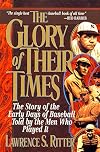
Jeez, where do I even start with this?
A couple of weeks ago I was overcome with memories of having been a big baseball fan when I was young -- we're talking late 1960s-mid 1970s, the years of the Big Red Machine in Cincinnati, my home town. Strangely, although I tried I couldn't remember where I'd picked up this passion: unlike most things, I don't recall that I got it from my father or my older brother. So ... maybe it was just mine.
Anyhoo, I recalled reading a book (probably one of those show more Scholastic Book Service things) about baseball, and specifically about the early years and players like Christy Mathewson and Honus Wagner. I decided I wanted to re-familiarize myself with this topic, and so after poking around a bit I got Ritter's book from the library.
Oh my. This is really the sh*t. It really really is. This is the sort of book that makes one nostalgic for a time when one wasn't even alive. If you even just *like* baseball, you have to read this one.
NB: Mathewson, Wagner, et al aren't in the Table of Contents (that is, they were not available to be interviewed, having died) but they are very much here -- in both words and pictures. The illustrations are, of course, marvelous.
I'm now trying to find a good book re: the Negro Leagues, because those players are not, alas, included here. show less
A couple of weeks ago I was overcome with memories of having been a big baseball fan when I was young -- we're talking late 1960s-mid 1970s, the years of the Big Red Machine in Cincinnati, my home town. Strangely, although I tried I couldn't remember where I'd picked up this passion: unlike most things, I don't recall that I got it from my father or my older brother. So ... maybe it was just mine.
Anyhoo, I recalled reading a book (probably one of those show more Scholastic Book Service things) about baseball, and specifically about the early years and players like Christy Mathewson and Honus Wagner. I decided I wanted to re-familiarize myself with this topic, and so after poking around a bit I got Ritter's book from the library.
Oh my. This is really the sh*t. It really really is. This is the sort of book that makes one nostalgic for a time when one wasn't even alive. If you even just *like* baseball, you have to read this one.
NB: Mathewson, Wagner, et al aren't in the Table of Contents (that is, they were not available to be interviewed, having died) but they are very much here -- in both words and pictures. The illustrations are, of course, marvelous.
I'm now trying to find a good book re: the Negro Leagues, because those players are not, alas, included here. show less
The Glory of Their Times: The Story of the Early Days of Baseball Told by the Men Who Played It by Lawrence S. Ritter
The late, great evolutionary scientist and baseball fan, Stephen Jay Gould, said of this book: "I could happily reread every summer for the rest of my life that greatest of all baseball books, The Glory of Their Times."
It's a truly wonderful book made up of interviews with old-time baseball players from the early twentieth century. The author tells us that he "traveled 75,000 miles searching for the heroes of a bygone era."
Ritter points out how amazing it is that these old-timers remember so show more much detail of their playing days. He says, "Many of the people I talked to had to think longer to get the names of all their great-grandchildren straight than they did to run down the batting order of the 1906 Chicago Cubs." As an old-timer myself I can empathise with Ritter's comment that "it is not at all unusual as one gets older for the more distant past to be remembered more clearly than what happened three weeks ago..."
I would love to have watched baseball as it was played in those days, when, as Sam Crawford points out in his interview/chapter, most home runs were of the inside-the-park variety.
And Chief Meyers says, "Nowadays, the pitcher wastes so much time out there it's ridiculous - fixing his cap...pulling up his pants...rubbing his chin...They waste an hour or so every day that way. We ALWAYS played a game in less than two hours."
There is a lot of humour in the book, as when Rube Bressler slams the "conference on the mound", which so often happens when a pitcher is in trouble. "The pitcher KNOWS he's in a jam. What can they say to him? They just remind him of it, that's all...All it does is make you even more worried than you already were, which was plenty. There are mighty few pitchers who can survive those conferences on the mound, take it from me."
At the risk of making this review too long, I'm going to end with two poems that are reproduced in this must-buy book: "The old-fashioned pitcher" by George E. Phair and "The old-fashioned batter", which was either also written by Phair or perhaps by Ritter himself. For me these two poems capture the spirit of the book.
How dear to my heart was the old-fashioned hurler
who labored all day on the old village green.
He did not resemble the up-to-date twirler
who pitches four innings and ducks from the scene.
The up-to-date twirler I’m not very strong for;
He has a queer habit of pulling up lame.
And that is the reason I hanker and long for
the pitcher who started and finished the game.
The old-fashioned pitcher,
The iron-armed pitcher,
The stout-hearted pitcher,
Who finished the game.
*****
How dear to my heart was the old-fashioned batter
Who scattered line drives from the spring to the fall.
He did not resemble the up-to-date batter
Who swings from his heels and then misses the ball.
The up-to-date batter I'm not very strong for;
He shatters the ozone with all of his might.
And that is the reason I hanker and long for
Those who doubled to left, and tripled to right.
The old-fashioned batter,
The eagle-eyed batter,
The thinking-man's batter,
Who tripled to right. show less
It's a truly wonderful book made up of interviews with old-time baseball players from the early twentieth century. The author tells us that he "traveled 75,000 miles searching for the heroes of a bygone era."
Ritter points out how amazing it is that these old-timers remember so show more much detail of their playing days. He says, "Many of the people I talked to had to think longer to get the names of all their great-grandchildren straight than they did to run down the batting order of the 1906 Chicago Cubs." As an old-timer myself I can empathise with Ritter's comment that "it is not at all unusual as one gets older for the more distant past to be remembered more clearly than what happened three weeks ago..."
I would love to have watched baseball as it was played in those days, when, as Sam Crawford points out in his interview/chapter, most home runs were of the inside-the-park variety.
And Chief Meyers says, "Nowadays, the pitcher wastes so much time out there it's ridiculous - fixing his cap...pulling up his pants...rubbing his chin...They waste an hour or so every day that way. We ALWAYS played a game in less than two hours."
There is a lot of humour in the book, as when Rube Bressler slams the "conference on the mound", which so often happens when a pitcher is in trouble. "The pitcher KNOWS he's in a jam. What can they say to him? They just remind him of it, that's all...All it does is make you even more worried than you already were, which was plenty. There are mighty few pitchers who can survive those conferences on the mound, take it from me."
At the risk of making this review too long, I'm going to end with two poems that are reproduced in this must-buy book: "The old-fashioned pitcher" by George E. Phair and "The old-fashioned batter", which was either also written by Phair or perhaps by Ritter himself. For me these two poems capture the spirit of the book.
How dear to my heart was the old-fashioned hurler
who labored all day on the old village green.
He did not resemble the up-to-date twirler
who pitches four innings and ducks from the scene.
The up-to-date twirler I’m not very strong for;
He has a queer habit of pulling up lame.
And that is the reason I hanker and long for
the pitcher who started and finished the game.
The old-fashioned pitcher,
The iron-armed pitcher,
The stout-hearted pitcher,
Who finished the game.
*****
How dear to my heart was the old-fashioned batter
Who scattered line drives from the spring to the fall.
He did not resemble the up-to-date batter
Who swings from his heels and then misses the ball.
The up-to-date batter I'm not very strong for;
He shatters the ozone with all of his might.
And that is the reason I hanker and long for
Those who doubled to left, and tripled to right.
The old-fashioned batter,
The eagle-eyed batter,
The thinking-man's batter,
Who tripled to right. show less
The Glory of Their Times : The Story of Baseball Told By the Men Who Played It by Lawrence S. Ritter
Right around when pitchers and catchers report, I dust off my well-worn, oft-borrowed copy of Glory of Their Times. I've probably read it a dozen times all the way through and each time I'm charmed all over again. The beauty and genius of Glory is in the fact that Ritter had the sense not to interfere with the players' stories. You get a feel for their voices and personalities, and how their experiences helped shape them as individuals. In its own way, the book is a vivid and important show more portrait of American life at the beginning of the twentieth century. And it's a dang good baseball book. show less
The Glory of Their Times: The Story of the Early Days of Baseball Told by the Men Who Played It (Harper Perennial Modern Classics) by Lawrence S. Ritter
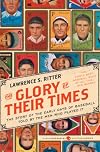
Summary: Oral histories by twenty-six former players from the early days of baseball, playing from the 1900’s to the 1940’s.
I’m old enough to remember great baseball players of the 1960’s–Mays, Mantle, Koufax, Mazeroski, Bob Gibson, Hank Aaron. This book reaches back another twenty to sixty years, going back to the early years of major league baseball. Some of the things I learned were that the gloves were smaller, the bats tended to be heavier, the balls deader, and the outfield show more fences further away. The game was one of strategy and speed and defense rather than power. There were years when a person with ten home runs stood a good chance of being homerun champ. Getting “discovered” wasn’t the result of an intensive scouting system. Often, the tip came from a friend, or someone just happened to stop by a semi-pro game and find you.
Lawrence S. Ritter, back in the 1960’s, set out to capture the stories of this time before the players of that generation had passed. Many, like Ruth, Gehrig, and Cobb already had. In this book, he has published oral histories of twenty-six players whose playing years stretch between 1898 to 1947. Many are in the Hall of Fame, some being inducted as a result of their stories appearing in this book.
The narratives cover their growing up years, how they fell in love with the game and made it to the majors, major career events and their afterlife when their playing days were done. One of the things that struck me was how many talked about other great players and managers. For example, Sam Crawford raved about what a great pitcher and fun person was Rube Waddell, about the hitting skills of Wee Willie Keeler, and the greatness of Walter Johnson as a pitcher.
But most noteworthy was the fact that Crawford played beside Ty Cobb in the outfield for thirteen years. He didn’t think he was the greatest overall, arguing instead for Honus Wagner as the best all round player. Cobb was a great hitter, a terror on the base paths, but just an average fielder who could only play outfield. An he was not a nice human being, a fact that several others in the book confirm.
John McGraw (“Mr. McGraw”) comes up in the accounts of many players. He was the manager for the Giants. Rube Marquard, a pitcher who once won 19 straight games (it would be 20 under current rules) loved playing for him. He loved his players, they loved him, but he was a strict disciplinarian.
I remember as a kid and a Cleveland fan hearing from my grandfather about Stanley Coveleski. In 1920, he won three games against the Giants to lead Cleveland to a World Championship. In all, he won 214 games. I also learned he pitched in the days when the spitter was legal, and it was his main pitch!
The book closes out with my other favorite team from my youth, the Pirates and Paul Waner. The most fascinating part of the story is that he and his brother Lloyd played together for many years. Together they had 5600 hits in their careers, more than the three Dimaggio brothers or all five Delahanty brothers.
Ritter did a great job with the interviews. The players were great storytellers. One senses something of what the game was like back then. There’s a lot of “inside baseball” in the book. We see how players translated the mental game into the difference between wins and losses. And not unlike today, the stories capture the ‘brief, shining moment” that is a baseball career. Hank Greenberg’s story makes us wonder, as we did later with Ted Williams, “what if” military service hadn’t interrupted a career in its prime.
There is a debate that runs through the book of how today’s players compare. Players come down on both sides. So much has changed. At the same time, the stories hint at those who would have been great in any era–Mathewson and Johnson as pitchers, Cobb, and Speaker, and Wagner as hitters and fielders, and many more with them. We’ll never know but Ritter certainly captures “the glory of their times,” in these twenty-six histories. Any lover of the game should read this book! show less
I’m old enough to remember great baseball players of the 1960’s–Mays, Mantle, Koufax, Mazeroski, Bob Gibson, Hank Aaron. This book reaches back another twenty to sixty years, going back to the early years of major league baseball. Some of the things I learned were that the gloves were smaller, the bats tended to be heavier, the balls deader, and the outfield show more fences further away. The game was one of strategy and speed and defense rather than power. There were years when a person with ten home runs stood a good chance of being homerun champ. Getting “discovered” wasn’t the result of an intensive scouting system. Often, the tip came from a friend, or someone just happened to stop by a semi-pro game and find you.
Lawrence S. Ritter, back in the 1960’s, set out to capture the stories of this time before the players of that generation had passed. Many, like Ruth, Gehrig, and Cobb already had. In this book, he has published oral histories of twenty-six players whose playing years stretch between 1898 to 1947. Many are in the Hall of Fame, some being inducted as a result of their stories appearing in this book.
The narratives cover their growing up years, how they fell in love with the game and made it to the majors, major career events and their afterlife when their playing days were done. One of the things that struck me was how many talked about other great players and managers. For example, Sam Crawford raved about what a great pitcher and fun person was Rube Waddell, about the hitting skills of Wee Willie Keeler, and the greatness of Walter Johnson as a pitcher.
But most noteworthy was the fact that Crawford played beside Ty Cobb in the outfield for thirteen years. He didn’t think he was the greatest overall, arguing instead for Honus Wagner as the best all round player. Cobb was a great hitter, a terror on the base paths, but just an average fielder who could only play outfield. An he was not a nice human being, a fact that several others in the book confirm.
John McGraw (“Mr. McGraw”) comes up in the accounts of many players. He was the manager for the Giants. Rube Marquard, a pitcher who once won 19 straight games (it would be 20 under current rules) loved playing for him. He loved his players, they loved him, but he was a strict disciplinarian.
I remember as a kid and a Cleveland fan hearing from my grandfather about Stanley Coveleski. In 1920, he won three games against the Giants to lead Cleveland to a World Championship. In all, he won 214 games. I also learned he pitched in the days when the spitter was legal, and it was his main pitch!
The book closes out with my other favorite team from my youth, the Pirates and Paul Waner. The most fascinating part of the story is that he and his brother Lloyd played together for many years. Together they had 5600 hits in their careers, more than the three Dimaggio brothers or all five Delahanty brothers.
Ritter did a great job with the interviews. The players were great storytellers. One senses something of what the game was like back then. There’s a lot of “inside baseball” in the book. We see how players translated the mental game into the difference between wins and losses. And not unlike today, the stories capture the ‘brief, shining moment” that is a baseball career. Hank Greenberg’s story makes us wonder, as we did later with Ted Williams, “what if” military service hadn’t interrupted a career in its prime.
There is a debate that runs through the book of how today’s players compare. Players come down on both sides. So much has changed. At the same time, the stories hint at those who would have been great in any era–Mathewson and Johnson as pitchers, Cobb, and Speaker, and Wagner as hitters and fielders, and many more with them. We’ll never know but Ritter certainly captures “the glory of their times,” in these twenty-six histories. Any lover of the game should read this book! show less
Lists
Awards


You May Also Like


Associated Authors
Statistics
- Works
- 14
- Also by
- 3
- Members
- 1,423
- Popularity
- #18,081
- Rating
- 4.3
- Reviews
- 23
- ISBNs
- 68
- Languages
- 1
- Favorited
- 4