
Pat Mora
Author of A Birthday Basket for Tía
About the Author
Pat Mora is a bilingual author with a special focus on children's literature. Among her awards are Honorary Doctorates from North Carolina State University and SUNY Buffalo, Honorary Membership in the American Library Association, Life-Time Membership in USBBY, a Civitella Ranieri Fellowship to show more write in Umbria, Italy, and a Distinguished Alumni Award from the University of Texas at El Paso. She was a recipient and judge of a Poetry Fellowship from the National Endowment for the Arts and a recipient and advisor of the Kellogg National Leadership Fellowships. Her children's books include: Water Rolls, Water Rises/El agua rueda, el agua sube. With her daughter, Libby Martinez, Pat also recently wrote I Pledge Allegiance and Bravo, Chico Canta! Bravo!. A literacy advocate, Pat founded Children's Day, Book Day, El día de los niños, El día de los libros often known as Día. The year-long commitment promotes creatively linking all children and families to books, and establishing annual April Children's Day, Book Day celebrations across the country. April 2016 will be Día's 20th Anniversary. Pat's Book Fiesta captures the Día spirit. A former teacher, university administrator, museum director, and consultant, Pat is a popular national speaker who promotes creativity, inclusivity and bookjoy. (Bowker Author Biography) show less
Series
Works by Pat Mora
Book Fiesta!: Celebrate Children's Day/Book Day; Celebremos El dia de los ninos/El dia de los libros (2009) 715 copies, 85 reviews
The Desert Is My Mother / El desierto es mi madre (English and Spanish Edition) (1994) 149 copies, 8 reviews
Wiggling Pockets/Los bolsillos saltarines: Bilingual Spanish-English (My Family / Mi Familia) (2009) 65 copies
The Remembering Day / El dia de los muertos (English and Spanish Edition) (2015) 53 copies, 4 reviews
Here, Kitty, Kitty!/Ven, gatita, ven!: Bilingual Spanish-English (My Family: Mi Familia) (2008) 30 copies, 1 review
Pablo's Tree 1 copy
Listen to the Desert/Oye Al Desierto[SPA-LISTEN TO THE DESERT/OYE A][Spanish Edition][Paperback] (2001) 1 copy, 1 review
Yummmmm! Que Rico! 1 copy
Associated Works
Sisters of the Earth: Women's Prose and Poetry About Nature (1991) — Contributor — 443 copies, 5 reviews
The Year's Best Fantasy and Horror: Ninth Annual Collection (1996) — Contributor — 258 copies, 3 reviews
Daughters of the Fifth Sun: A Collection of Latina Fiction and Poetry (1995) — Contributor — 60 copies, 1 review
Currents from the Dancing River: Contemporary Latino Fiction, Nonfiction, and Poetry (1994) — Contributor — 54 copies
Hecho en Tejas: An Anthology of Texas-Mexican Literature (Southwestern Writers Collection) (2006) — Contributor — 32 copies
Tagged
Common Knowledge
- Canonical name
- Mora, Pat
- Birthdate
- 1942-01-19
- Gender
- female
- Education
- Texas Western College (BA/1963)
University of Texas, El Paso (MA/1967) - Occupations
- professor (University of New Mexico)
poet
memoirist
essayist
children's book author
teacher - Organizations
- American Library Association (honorary)
United States Board on Books for Young People - Awards and honors
- May Hill Arbuthnot Lecturer (2016)
North Carolina State University (DLitt, honorary)
State University of New York, Buffalo (DLitt, honorary)
Lifetime Achievement Award (Texas Institute of Letters)
Virginia Hamilton Literary Award - Relationships
- Martinez, Libby (daughter, co-author)
- Birthplace
- El Paso, Texas, USA
- Places of residence
- El Paso, Texas, USA
Santa Fe, New Mexico, USA
Cincinnati, Ohio, USA - Associated Place (for map)
- USA
Members
Reviews

The giant Doña Flor looks out for her smaller neighbors in this original Tall Tale, set in the American Southwest, from author Pat Mora and illustrator Raúl Colón. Whether reading to the children or baking massive tortillas that can be used as roofs or rafts, she is constantly working to help others. But when the whole neighborhood is frightened by the terrible roar of a massive puma, our greathearted heroine has trouble finding the threatening cat. Still, Doña Flor persists, and show more eventually finds someone else who needs a friend...
I greatly enjoyed Tomás and the Library Lady, the previous collaboration between this author and illustrator, so I picked up Doña Flor: A Tall Tale about a Giant Woman with a Great Big Heart with every expectation of loving it. I was not disappointed, as I discovered an engaging and heartwarming tale about a friendly giant, one in the best tradition of such American Tall Tale heroes as Paul Bunyan, and absolutely lovely artwork. It's easy to see why Raúl Colón won a Pura Belpré Medal for illustration! His use of color and shape, the soft but somehow well-defined figures in his paintings - they all combine to create beautiful scenes. Recommended to anyone who enjoys Tall Tales about friendly giants, or who is looking for picture-books with a Latino cultural setting. show less
I greatly enjoyed Tomás and the Library Lady, the previous collaboration between this author and illustrator, so I picked up Doña Flor: A Tall Tale about a Giant Woman with a Great Big Heart with every expectation of loving it. I was not disappointed, as I discovered an engaging and heartwarming tale about a friendly giant, one in the best tradition of such American Tall Tale heroes as Paul Bunyan, and absolutely lovely artwork. It's easy to see why Raúl Colón won a Pura Belpré Medal for illustration! His use of color and shape, the soft but somehow well-defined figures in his paintings - they all combine to create beautiful scenes. Recommended to anyone who enjoys Tall Tales about friendly giants, or who is looking for picture-books with a Latino cultural setting. show less
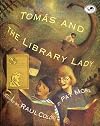
I think what I appreciate most about about this simply wonderful picture book is how sensitive, caring and culturally aware the Library Lady is towards Tomas. She not only inspires his love of books, she is very much aware of his potential problems and requirements. The first time Tomas arrives at the library, the Library Lady gives him a cool glass of water to drink, and she actually signs out the library books for him in her own name. Not only does this show her sensitivities to the show more possible needs of migrant farm workers (lack of money, lack of owning a library card, that Tomas would probably be hot and thirsty after his long walk), the Library Lady trusts that Tomas will return the books that she has signed out in her own name (a less sympathetic and sensitive person might have had negative attitudes towards migrant farm workers and Latinos/Latinas, so this part of the story really touched me, and continues to touch me).
The Library Lady also shows interest in Tomas' mother tongue, asking Tomas to teach her some Spanish words. For her Spanish is a language, a beautiful language to be learned. Both she and Tomas respect each other's traditions, and the Library Lady never assumes that English and/or Anglo-American culture is in any way superior. A final wonderful touch is the fact that when Tomas brings his (probably uni-lingual) grandfather to the library, the Library Lady greets him respectfully in his own language. I love this story, and the illustrations accompanying the text are warm, enticing and really capture both the magic of books and the feelings and emotions of the characters.
Finally and for me, very importantly, I also I think that [b:Tomas and the Library Lady|1372657|Tomas and the Library Lady|Pat Mora|http://photo.goodreads.com/books/1183058122s/1372657.jpg|1362528] clearly demonstrates the responsibility and obligation that teachers, librarians and the like have or should have towards making the educational experience wonderful and rewarding for everyone. For if a librarian or a teacher act respectfully to a stranger, to a recent immigrant, to a member of a visible minority, this might very well cause others to imitate this behaviour (or to learn from this behaviour). Conversely, a bigoted teacher or librarian might also cause his/her students and others to imitate and accept bigotry. Tomas' Library Lady should be seen as a wonderful role model, of how strangers, members of visible minorities, immigrants should be approached, namely with respect, kindness, admiration and acceptance. show less
The Library Lady also shows interest in Tomas' mother tongue, asking Tomas to teach her some Spanish words. For her Spanish is a language, a beautiful language to be learned. Both she and Tomas respect each other's traditions, and the Library Lady never assumes that English and/or Anglo-American culture is in any way superior. A final wonderful touch is the fact that when Tomas brings his (probably uni-lingual) grandfather to the library, the Library Lady greets him respectfully in his own language. I love this story, and the illustrations accompanying the text are warm, enticing and really capture both the magic of books and the feelings and emotions of the characters.
Finally and for me, very importantly, I also I think that [b:Tomas and the Library Lady|1372657|Tomas and the Library Lady|Pat Mora|http://photo.goodreads.com/books/1183058122s/1372657.jpg|1362528] clearly demonstrates the responsibility and obligation that teachers, librarians and the like have or should have towards making the educational experience wonderful and rewarding for everyone. For if a librarian or a teacher act respectfully to a stranger, to a recent immigrant, to a member of a visible minority, this might very well cause others to imitate this behaviour (or to learn from this behaviour). Conversely, a bigoted teacher or librarian might also cause his/her students and others to imitate and accept bigotry. Tomas' Library Lady should be seen as a wonderful role model, of how strangers, members of visible minorities, immigrants should be approached, namely with respect, kindness, admiration and acceptance. show less

Every summer, Tomás and his family would travel from their home in Texas to the corn fields of Iowa, where his parents worked as farmhands. Sitting in the shade of a tree with their grandfather, Papá Grande, on the hot afternoons, Tomás and his brother Enrique would listen to his many wonderful stories. When Tomás completed one of those stories for him, Papá Grande suggested that it was time for him to find some of his own... at the local library. And so began a wonderful summer of show more discovery, in which a kind library lady pointed Tomás towards a wealth of informative and entertaining books, about everything from dinosaurs to tigers.
Based upon the life of Mexican-American poet and educator Tomás Rivera, the son of migrant farm-workers, who eventually became the chancellor of the University of California, Riverside, Tomás and the Library Lady is a lovely tribute to a remarkable man, and to the woman who first set him on his journey of discovery. It emphasizes the joy of reading - its transformative and transportive power - as young Tomás becomes so absorbed in his books that Iowa, Texas, the entire world, all fade away as he reads. I was reminded, in fact, of one of my favorite early readers - also about a library - Crosby Bonsall's Tell Me Some More..., and that is high praise! The accompanying artwork by Raul Colón is beautiful, accentuating the magical aspects of Tomás' reading. All in all, a wonderful picture-book, highly recommended to all young bibliophiles and library lovers! show less
Based upon the life of Mexican-American poet and educator Tomás Rivera, the son of migrant farm-workers, who eventually became the chancellor of the University of California, Riverside, Tomás and the Library Lady is a lovely tribute to a remarkable man, and to the woman who first set him on his journey of discovery. It emphasizes the joy of reading - its transformative and transportive power - as young Tomás becomes so absorbed in his books that Iowa, Texas, the entire world, all fade away as he reads. I was reminded, in fact, of one of my favorite early readers - also about a library - Crosby Bonsall's Tell Me Some More..., and that is high praise! The accompanying artwork by Raul Colón is beautiful, accentuating the magical aspects of Tomás' reading. All in all, a wonderful picture-book, highly recommended to all young bibliophiles and library lovers! show less

Estelita - or Stella, as she was known at school - loved both her quiet home life, with her gentle mother and book-reading father, and her livelier school (and after-school) life, playing with her friends, and helping her teacher. Speaking Spanish at home, with her Mexican immigrant family, and English at school, with her American friends, she was always aware of the differences that set her apart, but that awareness reached a critical point during her class's celebration of May Day, when show more she was the only girl dressed in a multi-colored tulip costume, and her mother was the only parent unable to communicate with the teacher, and with the other parents.
Based upon the childhood experiences of Pat Mora's mother, whose parents immigrated from Mexico to El Paso, Texas in 1910, The Rainbow Tulip is a book that sensitively addresses themes - feeling different, being bilingual - that will be very familiar to children of immigrants. I really appreciated the fact that Estelita/Stella was depicted as a happy, well-adjusted child, and that her feelings about being different from her peers were quite mixed: alternately ashamed and proud. The narrative felt very true to life, as a result, and will have relevance for the widest range of readers. The accompanying illustrations by Elizabeth Sayles are soft and appealing, emphasizing the emotional undercurrent of each scene. All in all, a solidly engaging story, recommended to children from immigrant and bilingual homes, or to young readers interested in the immigrant experience. show less
Based upon the childhood experiences of Pat Mora's mother, whose parents immigrated from Mexico to El Paso, Texas in 1910, The Rainbow Tulip is a book that sensitively addresses themes - feeling different, being bilingual - that will be very familiar to children of immigrants. I really appreciated the fact that Estelita/Stella was depicted as a happy, well-adjusted child, and that her feelings about being different from her peers were quite mixed: alternately ashamed and proud. The narrative felt very true to life, as a result, and will have relevance for the widest range of readers. The accompanying illustrations by Elizabeth Sayles are soft and appealing, emphasizing the emotional undercurrent of each scene. All in all, a solidly engaging story, recommended to children from immigrant and bilingual homes, or to young readers interested in the immigrant experience. show less
Lists
Youth: Poetry (1)
Awards


Book Fiesta!: Celebrate Children's Day/Book Day; Celebremos El dia de los ninos/El dia de los libros (K-2 – 2016)
Book Fiesta!: Celebrate Children's Day/Book Day; Celebremos El dia de los ninos/El dia de los libros (2013)


You May Also Like


Associated Authors
Statistics
- Works
- 70
- Also by
- 18
- Members
- 8,945
- Popularity
- #2,688
- Rating
- 4.0
- Reviews
- 455
- ISBNs
- 327
- Languages
- 2
- Favorited
- 2

