
Jack Bogle (1929–2019)
Author of The Little Book of Common Sense Investing
About the Author
John Clifton Bogle was born in Montclair, New Jersey on May 8, 1929. He received a bachelor's degree in economics from Princeton University in 1951. After graduation, he was hired by the Wellington Fund, a Philadelphia-based fund management company. He was named president of Wellington in 1967. He show more founded the Vanguard Group of Investment Companies in 1974. In 1976, he founded the Vanguard Index Trust, the first index fund for individual investors. In 1977, he started selling mutual funds directly to investors rather than through brokers, thus eliminating the sales fees. He officially stepped down as chief executive of Vanguard in January 1996 and remained as chairman until the end of 1999. He wrote several books including Bogle on Mutual Funds, Common Sense on Mutual Funds, and The Clash of the Cultures: Investment vs. Speculation. He died from esophageal cancer on January 16, 2019 at the age of 89. (Bowker Author Biography) show less
Works by Jack Bogle
Common Sense on Mutual Funds: New Imperatives for the Intelligent Investor (1999) 451 copies, 4 reviews
The Battle for the Soul of Capitalism: How the Financial System Underminded Social Ideals, Damaged Trust in the Markets, Robbed Investors of Trillions - and What to Do About It (2005) 181 copies, 6 reviews
Don't Count on It! Reflections on Investment Illusions, Capitalism, "Mutual" Funds, Indexing, Entrepreneurship, Idealism, and Heroes (2010) 70 copies, 1 review
Predators and Profits: 100+ Ways for Investors to Protect Their Nest Eggs (2003) — Author — 8 copies
Associated Works
Leading from Within: Poetry That Sustains the Courage to Lead (2007) — Contributor — 114 copies, 3 reviews
Keynes's Way to Wealth: Timeless Investment Lessons from The Great Economist (1976) — Foreword — 21 copies, 2 reviews
Putting Investors First: Real Solutions for Better Corporate Governance (2003) — Foreword — 6 copies
Tagged
Common Knowledge
- Canonical name
- Bogle, Jack
- Legal name
- Bogle, John Clifton
- Birthdate
- 1929-05-08
- Date of death
- 2019-01-16
- Gender
- male
- Education
- Princeton University (magna cum laude in Economics)
- Occupations
- executive
author - Organizations
- Phi Beta Kappa
American Philosophical Society
National Constitution Center
Wellington Management
The Vanguard Group (founder) - Awards and honors
- Commonwealth’s Chamber of Commerce as Pennsylvania’s Business Leader of the Year.
Honorary doctorate degrees from Princeton University, University of Delaware, University of Rochester, New School University, Susquehanna University, Eastern University, Widener University, Albright College, Pennsylvania State University, and Drexel University. - Short biography
- John Clifton "Jack" Bogle (1929-2019) was the founder and retired CEO of The Vanguard Group. He attended Blair Academy on a full scholarship, earned his undergraduate degree from Princeton University in 1951, and attended evening and weekend classes at the University of Pennsylvania.
- Nationality
- USA
- Birthplace
- Montclair, New Jersey, USA
- Place of death
- Bryn Mawr, Pennsylvania, USA
- Associated Place (for map)
- USA
Members
Reviews
The Little Book of Common Sense Investing: The Only Way to Guarantee Your Fair Share of Stock Market Returns by Jack Bogle

Reading this book is like eating a plate of vegetables—your (financial) health will benefit for years to come if you commit to it, but the journey getting there is going to be a boring one.
That being said, this approach to investing is what I've been seeking out ever since I became interested in personal finance. The smoke and mirrors horse race that is the daily financial market is of little interest to me mostly because it appears to be almost entirely noise (and increasingly more show more evidently fraught with corruption).
The advice found in The Little Book of Common Sense Investing is the proverbial tortoise racing against the hare, the hare being the more active investor. Slow and steady wins 99.9% of the time, but in the least exciting way possible. Pick what you value. show less
That being said, this approach to investing is what I've been seeking out ever since I became interested in personal finance. The smoke and mirrors horse race that is the daily financial market is of little interest to me mostly because it appears to be almost entirely noise (and increasingly more show more evidently fraught with corruption).
The advice found in The Little Book of Common Sense Investing is the proverbial tortoise racing against the hare, the hare being the more active investor. Slow and steady wins 99.9% of the time, but in the least exciting way possible. Pick what you value. show less
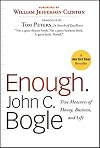
There are few books that I come back to time and again for inspiration, yet this is one of them. I should have known that this would be the case based on the prologue, where Tom Peters says that he does the very same thing.
The value of this book comes from its sensible, straightforward recommendations that are phrased in "too much... not enough" format. While these recommendations at first seem vague, they are followed by perspectives that clarify the problems that they respond to, and how show more the shift in thinking keeps corruption at bay. This is a book about values, because what we value leads to actions.
Throughout, the author's genuine joy for life and passion for his work comes through like a song. He has reaped tremendous rewards from his work, and he is deeply grateful while still acknowledging those that made it possible. He also clearly remains connected to the society he is a part of, and cares for people still growing up (his work in cheap index funds only strengthens this case). Not a bad example for other billionaires.
The title is connected to a wonderful anecdote about Joseph Heller and Kurt Vonnegut. Do not miss this!
RIP, John C Bogle! show less
The value of this book comes from its sensible, straightforward recommendations that are phrased in "too much... not enough" format. While these recommendations at first seem vague, they are followed by perspectives that clarify the problems that they respond to, and how show more the shift in thinking keeps corruption at bay. This is a book about values, because what we value leads to actions.
Throughout, the author's genuine joy for life and passion for his work comes through like a song. He has reaped tremendous rewards from his work, and he is deeply grateful while still acknowledging those that made it possible. He also clearly remains connected to the society he is a part of, and cares for people still growing up (his work in cheap index funds only strengthens this case). Not a bad example for other billionaires.
The title is connected to a wonderful anecdote about Joseph Heller and Kurt Vonnegut. Do not miss this!
RIP, John C Bogle! show less
The Little Book of Common Sense Investing: The only way to guarantee your fair share of stock market returns by Jack Bogle
If you're investing in the stock market, you should start with this book. Hands down. It compares the long term performance of index investing to managed or mutual fund investing. The statistics and studies are compelling. Over 20-30 years, there is no comparison to index investing. It wins 100%.
If I was building a book list as a curriculum to learn investing, this would be first on the list. It's underlying principle is all about the power of compounding. In fact, the third last page sums show more this principle up wonderfully. I quote, "I am 85 years old and have never earned more than $25,000 a year. I started investing in 1974 with $500 (55YO). I have only bought - never sold. I remember when things were not going well, your advice was, 'stay the course.' (Author) He enclosed a list of his investments at the start of 2004: Total value, $1,391, 407".
Based on the studies in this book, it's alarming how over 10+ years, 90-something percent of managed funds underperform the broad stock market indices; In this case, the S&P500. This occurs for a variety of reasons, too many to discuss here, but still, the stats are black and white in favour of index investing. The book's case is that passive investing beats active investing easily over 20+ years, especially when factoring in brokerage and management costs.
An interesting point also from the book is the author's principle of asset allocation. Here, he advocats an investor direct 90% of their spare income (after living expenses) to passive index funds with the remaining 5-10% used for funny-money to speculate on other direct investment. Thinking about it, he has a very valid point. If an investment technique or strategy can significantly beat the market, then a 5-10% asset allocation will quickly catch and outperform the 90% passive allocation. If it can't, then just stick with the 90% passive index investing for the long term. Simple really.
This book is bundled with studies and statistics that shouldn't be ignored. show less
If I was building a book list as a curriculum to learn investing, this would be first on the list. It's underlying principle is all about the power of compounding. In fact, the third last page sums show more this principle up wonderfully. I quote, "I am 85 years old and have never earned more than $25,000 a year. I started investing in 1974 with $500 (55YO). I have only bought - never sold. I remember when things were not going well, your advice was, 'stay the course.' (Author) He enclosed a list of his investments at the start of 2004: Total value, $1,391, 407".
Based on the studies in this book, it's alarming how over 10+ years, 90-something percent of managed funds underperform the broad stock market indices; In this case, the S&P500. This occurs for a variety of reasons, too many to discuss here, but still, the stats are black and white in favour of index investing. The book's case is that passive investing beats active investing easily over 20+ years, especially when factoring in brokerage and management costs.
An interesting point also from the book is the author's principle of asset allocation. Here, he advocats an investor direct 90% of their spare income (after living expenses) to passive index funds with the remaining 5-10% used for funny-money to speculate on other direct investment. Thinking about it, he has a very valid point. If an investment technique or strategy can significantly beat the market, then a 5-10% asset allocation will quickly catch and outperform the 90% passive allocation. If it can't, then just stick with the 90% passive index investing for the long term. Simple really.
This book is bundled with studies and statistics that shouldn't be ignored. show less
The Little Book of Common Sense Investing: The Only Way to Guarantee Your Fair Share of Stock Market Returns (Little Books, Big Profits) by Jack Bogle
This is the first of several books on investing that I plan to read to better educate myself and take greater personal control of my finances. If John Bogle had his way, it would probably be my last. That is because his investment strategy is rather simple. He thinks most investors should pick a very low-cost index fund, his pick would be the S & P 500 or a total market fund, both of which are near identical. He advises you to purchase this as early as you can and then hold onto it for as show more long as you can, basically until you retire. With this simple strategy, he argues you will capture most of the growth of the total market, which is better than the vast majority of investors who believe they can beat the market through timing, stock picking, having talented money managers, or some other strategy. This value strategy may be a bit boring, but he makes a strong argument, through pure math and statistics, that it is sound. If you're really into cryptocurrency, poker, trying to figure out what company or sector will be the hottest, or other high stakes and exciting gambles, you won't necessarily gravitate to this kind of investing. It's just too plain vanilla and dull and won't give you the returns to turn on your adrenaline. On the other hand, this slow and steady approach to wealth-building might just be the advice that you should follow. show less
Lists
Awards


You May Also Like


Associated Authors
Statistics
- Works
- 17
- Also by
- 5
- Members
- 2,752
- Popularity
- #9,324
- Rating
- 3.9
- Reviews
- 41
- ISBNs
- 107
- Languages
- 7
- Favorited
- 3
