

John W. Cresswell
Author of Research Design: Qualitative, Quantitative, and Mixed Methods Approaches
About the Author
In this Third Edition of his bestselling text, John W. Creswell explores the philosophical underpinnings, history, and key elements of each of five qualitative inquiry traditions: narrative research, phenomenology, grounded theory, ethnography, and case study. In his signature writing style, the show more author relates research designs to each of the traditions of inquiry in a highly accessible manner. He compares theoretical frameworks, ways to employ standards of quality, and strategies for writing introductions to studies, collecting data, analyzing data, writing a narrative, and verifying results. show less
Image credit: via author's website
Works by John W. Cresswell
Research Design: Qualitative, Quantitative, and Mixed Methods Approaches (2002) 1,167 copies, 6 reviews
Qualitative Inquiry and Research Design: Choosing Among Five Approaches (1998) 631 copies, 2 reviews
Educational Research: Planning, Conducting, and Evaluating Quantitative and Qualitative Research (2001) 199 copies, 1 review
A Concise Introduction to Mixed Methods Research (Sage Mixed Methods Research) (2014) 33 copies, 1 review
Study Guide for Educational Research: Planning, Conducting, and Evaluating Quantitative and Qualitative Research (2007) 4 copies
Faculty Research Performance: Lessons from the Sciences and the Social Sciences (Ashe Eric Higher Education Reports) (1985) 2 copies
Nitel Araştırma Yöntemleri: Beş Yaklaşıma Göre Nitel Araştırma ve Araştırma Deseni (Turkish Edition) (2014) 1 copy
BUNDLE: Creswell: Qualitative Inquiry and Research Design 4E + Creswell: 30 Essential Skills for the Qualitative Researcher (2017) 1 copy
Qualitative Inquiry and Research Design - International Student Edition: Choosing Among Five Approaches (2024) 1 copy
Research Design 6th Edition 1 copy
Associated Works
Tagged
Common Knowledge
- Canonical name
- Cresswell, John W.
- Legal name
- Cresswell, John Ward
- Birthdate
- 1945
- Gender
- male
- Education
- Muskingum College (BA|History and Political Science)
University of Iowa (MA|Student Affairs and Counseling)
University of Iowa (PhD|College Leadership and Sociology) - Occupations
- professor
- Organizations
- University of Michigan
University of Nebraska - Awards and honors
- McGuffey Longevity Award
- Relationships
- Cresswell, Karen Drumm (wife)
Cresswell, J. David (son) - Nationality
- USA
- Places of residence
- Ashiya, Hyogo, Japan
Honolulu, Hawaii, USA - Map Location
- USA
Members
Reviews
Educational Research: Planning, Conducting, and Evaluating Quantitative and Qualitative Research (6th Edition) by John W. Cresswell
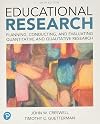
I work in an academic field at the crossroads of biomedical research and research into higher education practices. (I pursue research about research.) I have familiarized myself with biomedical research practices, but I also wanted to familiarize myself with educational research practices. Biomedical research is heavy on quantitative analysis, but educational research seems to involve qualitative methods much more. I needed deeper introduction to the latter. Creswell’s 650-page opus seemed show more to fit the bill, and I was not left disappointed.
As expected, this work is especially heavy on qualitative methods. Most – if not all – of its examples come from educational settings. It emphasizes applicability to the practice of teaching, especially in the K-12 arena. The various ways to pursue qualitative research are especially appreciated here – whether explanatory, exploratory, action-oriented, experimental, or correlational.
This book is suitable for graduate-level researchers in the field of education (especially at the K-12 level). It explains from square-one how to identify and pursue a research question; then it covers how to design, implement a study, and analyze the results to address that given research question. Creswell is especially strong when addressing mixed-methods research designs (both qualitative and quantitative) and action research designs.
The text is approachable and easy to read, even for non-native English speakers. Examples are drawn from the field of education and serve to teach the reader more about good instructional practice. Following each chapter sits an example paper to elucidate the principles taught in the proceeding chapter. The content is thorough in both its depth and its breadth. Each chapter also addresses ethical issues (each with its own case study) and contains a guide about how to interpret findings from this style of research.
Especially coming from the biomedical research world, this work seems short on quantitative methods and statistical applications. It engages statistical software use only at a very high level, and I do not recall any mathematical formulae ever being present. That perhaps is its prevailing weakness, but the mainstream of educational research tends to avoid these topics, too. At four editions currently, this work has stood the test of time and has had a global impact. My paperback edition from Pearson India was affordable while not skimping on content. Overall, I have been pleased with my time spent reading this book. show less
As expected, this work is especially heavy on qualitative methods. Most – if not all – of its examples come from educational settings. It emphasizes applicability to the practice of teaching, especially in the K-12 arena. The various ways to pursue qualitative research are especially appreciated here – whether explanatory, exploratory, action-oriented, experimental, or correlational.
This book is suitable for graduate-level researchers in the field of education (especially at the K-12 level). It explains from square-one how to identify and pursue a research question; then it covers how to design, implement a study, and analyze the results to address that given research question. Creswell is especially strong when addressing mixed-methods research designs (both qualitative and quantitative) and action research designs.
The text is approachable and easy to read, even for non-native English speakers. Examples are drawn from the field of education and serve to teach the reader more about good instructional practice. Following each chapter sits an example paper to elucidate the principles taught in the proceeding chapter. The content is thorough in both its depth and its breadth. Each chapter also addresses ethical issues (each with its own case study) and contains a guide about how to interpret findings from this style of research.
Especially coming from the biomedical research world, this work seems short on quantitative methods and statistical applications. It engages statistical software use only at a very high level, and I do not recall any mathematical formulae ever being present. That perhaps is its prevailing weakness, but the mainstream of educational research tends to avoid these topics, too. At four editions currently, this work has stood the test of time and has had a global impact. My paperback edition from Pearson India was affordable while not skimping on content. Overall, I have been pleased with my time spent reading this book. show less
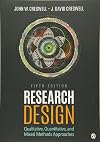
The academic field of research methods describes how different approaches to research can yield insight and results. Historically, quantitative (i.e., numerical) approaches have dominated. Recently, qualitative (i.e., descriptive in words) approaches have increased. Also recently, mixed methods approaches have combined the two to tell interesting stories more expeditiously. In this work, Creswell and Creswell delineate all three methods and help the reader make the most of their research show more efforts.
The fact that this book is in a fifth edition speaks to its strength and staying power. Copious references to the literature adorn its text. In addition, concepts – like putting interventions into action through, say, social-justice or feminist perspectives – are covered concisely yet in detail. Newer, activist approaches provide ways for research to reach outside of the so-called “ivory tower.”
Examples of the concepts in action are provided through boxes that illustrate the concepts. The text gets to the point and does not ramble. As such, the reader can transit efficiently from ignorance to knowledge to action. From the examples, one can easily transform this information into a robust product of writing. Useful strategies like concept-mapping and coding are also exposited and help the reader grasp how to gain further insight into their field.
Obviously, those engaged in research efforts are targeted by this work. It is appropriate for graduate students, teachers, and researchers of many stripes – especially in medicine, education, psychology, and the social sciences. It provides a helpful way to structure their work. It is accessible and readable enough that anyone engaged in critical inquiry can gain from this work. One does not need to be a Harvard professor to appreciate the Creswells’ contribution… though Harvard professors, too, might appreciate their clarity and erudition! show less
The fact that this book is in a fifth edition speaks to its strength and staying power. Copious references to the literature adorn its text. In addition, concepts – like putting interventions into action through, say, social-justice or feminist perspectives – are covered concisely yet in detail. Newer, activist approaches provide ways for research to reach outside of the so-called “ivory tower.”
Examples of the concepts in action are provided through boxes that illustrate the concepts. The text gets to the point and does not ramble. As such, the reader can transit efficiently from ignorance to knowledge to action. From the examples, one can easily transform this information into a robust product of writing. Useful strategies like concept-mapping and coding are also exposited and help the reader grasp how to gain further insight into their field.
Obviously, those engaged in research efforts are targeted by this work. It is appropriate for graduate students, teachers, and researchers of many stripes – especially in medicine, education, psychology, and the social sciences. It provides a helpful way to structure their work. It is accessible and readable enough that anyone engaged in critical inquiry can gain from this work. One does not need to be a Harvard professor to appreciate the Creswells’ contribution… though Harvard professors, too, might appreciate their clarity and erudition! show less

I am in the awkward situation of learning sociological method after having spent my entire higher education studying theology. Starting from scratch is overwhelming, to say the least! Creswell and Poth's text makes the journey easier.
Qualitative Inquiry and Research Design describes five overarching ways to do research:
1. Narrative Research studies individuals and their stories.
2. Phenomenological Research studies a several people who share the same experience.
3. Grounded Theory Research show more studies a process, action, or interaction with a view to develop a theory.
4. Ethnographic Research studies a group that shares the same culture.
5. Case Study Research studies a specific event, program, or activity.
Each approach digs into the subject in a different way, providing a different perspective. Creswell and Poth bring the unique features of each approach to light brilliantly in the final chapter by taking a case study and reframing it in each of the other four approaches.
Creswell and Poth's text hits the sweet spot where understandability and depth of insight meet. It brings clarity the the research methods required to do effective sociological work. show less
Qualitative Inquiry and Research Design describes five overarching ways to do research:
1. Narrative Research studies individuals and their stories.
2. Phenomenological Research studies a several people who share the same experience.
3. Grounded Theory Research show more studies a process, action, or interaction with a view to develop a theory.
4. Ethnographic Research studies a group that shares the same culture.
5. Case Study Research studies a specific event, program, or activity.
Each approach digs into the subject in a different way, providing a different perspective. Creswell and Poth bring the unique features of each approach to light brilliantly in the final chapter by taking a case study and reframing it in each of the other four approaches.
Creswell and Poth's text hits the sweet spot where understandability and depth of insight meet. It brings clarity the the research methods required to do effective sociological work. show less
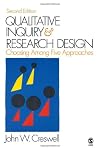
I am still in the process of reading this but so far it is enjoyable. Creswell has a clear writing style with a pleasant personality. He gives practical advice on each of the five qualitative research approaches (grounded theory, ethnographic, phenomenological, case study, and narrative approaches) without neglecting the epistemological bases of the approaches. It also has lots of useful examples and Creswell makes it evident that he benefited from feedback from students and from readers of show more the first edition. show less
Awards

You May Also Like


Associated Authors
Statistics
- Works
- 24
- Also by
- 1
- Members
- 2,476
- Popularity
- #10,355
- Rating
- 3.7
- Reviews
- 12
- ISBNs
- 89
- Languages
- 4