
William McNaughton
Author of Reading and Writing Chinese: A Guide to the Chinese Writing System
About the Author
William McNaughton was the founding teacher of Chinese at Oberlin College, one of the best known American undergraduate programs in Chinese. Since 1986 he has taught at Hong Kong's City University, where he was the founding program leader of the BA (Honours) in Translation and Interpretation. He is show more the author of numerous books and journal articles on Chinese literature and language Li Ying was born in Beijing. She has a BA from the Beijing Foreign Languages Institute and an MA from Middlebury College. She has taught at Beijing's Capital Normal University and now teaches at Hong Kong University show less
Works by William McNaughton
Associated Works
19 Ways of Looking at Wang Wei: How a Chinese Poem is Translated (1987) — Translator — 319 copies, 10 reviews
Tagged
Common Knowledge
- Canonical name
- McNaughton, William
- Birthdate
- 1933
- Gender
- male
Members
Reviews
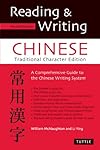
When I was attempting to (re)learn Chinese on my own, I found this to be one of the most useful books. Note that I grew up speaking Mandarin at home, but had limited literacy at the time. This book works best as a supplement to other studies, but it can help provide a very solid foundation. I committed myself to a personal regime of memorizing 50-100 characters a week. My literacy improved noticeably within weeks.
The characters are arranged in such a way that you build upon previous words in show more a very intuitive way. They provide short etymological descriptions and sometimes mnemonic devices to help you remember the components to each word -- very useful for things such as the Heavenly Stems.
Each character up to the basic 1062 is given with stroke order, stroke count, pinyin, definition, a simple vocabulary combination to help you remember its usage. Indices include alphabetical (pinyin) index and stroke index. No radical index, but charts of traditional and modern radicals are provided on inside front and back covers.
It takes a very serious and academic approach, which I appreciate in contrast to a lot of other beginners' textbooks which attempt to make learning Chinese "fun" by mysticizing or exoticizing the language. McNaughton and Li don't bother with the whole pictographic evolutionary bruhaha that some other textbooks go through to introduce the history of the language; their preface is succinct and sticks to the facts. I appreciate that. show less
The characters are arranged in such a way that you build upon previous words in show more a very intuitive way. They provide short etymological descriptions and sometimes mnemonic devices to help you remember the components to each word -- very useful for things such as the Heavenly Stems.
Each character up to the basic 1062 is given with stroke order, stroke count, pinyin, definition, a simple vocabulary combination to help you remember its usage. Indices include alphabetical (pinyin) index and stroke index. No radical index, but charts of traditional and modern radicals are provided on inside front and back covers.
It takes a very serious and academic approach, which I appreciate in contrast to a lot of other beginners' textbooks which attempt to make learning Chinese "fun" by mysticizing or exoticizing the language. McNaughton and Li don't bother with the whole pictographic evolutionary bruhaha that some other textbooks go through to introduce the history of the language; their preface is succinct and sticks to the facts. I appreciate that. show less
For beginners, advanced students who start learning Chinese
You May Also Like


Associated Authors
Statistics
- Works
- 12
- Also by
- 1
- Members
- 622
- Popularity
- #40,475
- Rating
- 3.8
- Reviews
- 3
- ISBNs
- 16
- Languages
- 1