

Tim Mason (2) (1937–)
Author of The Secret Years: Flight Testing at Boscombe Down 1939-1945
For other authors named Tim Mason, see the disambiguation page.
Works by Tim Mason
Tagged
Common Knowledge
- Birthdate
- 1937-08-27
- Gender
- male
Members
Reviews
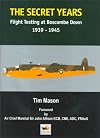
This review is based on my reading of the first edition of this book, dating from 1998. It is important to note that a second, revised edition has since been published (in 2012) which makes many changes in the organisation of the book. I have not seen this second edition, so my comments must be read as relating to the first edition only. My comments are intended for anyone encountering this book on the second-hand market.
In terms of content, this is an encyclopaedic volume giving an account show more of the creation of the Aircraft and Armament Experimental Establishment (A&AEE) at Boscombe Down in Wiltshire. It gives a brief history of the wartime years, and then details all the testing carried out on aircraft in the years 1939-45. In this, it is comprehensive, with summaries of technical reports and detailed, high-quality photographs of the majority of types flown. There are also colour profiles of a selection of aircraft tested.
The work of A&AEE is highlighted in the scope of the testing. Types supplied under Lend-Lease were tested, as well as new British types and aircraft with modifications, often comparatively minor. Here the testing explored the scope of the modifications and their effectiveness. The work done by A&AEE contributed much to aircrew safety in what was already a dangerous environment. There was especial concentration on the ergonomics of cockpit design - can the pilot actually reach and use the controls? - and often overlooked issues such as carbon monoxide contamination, amongst other issues. New armament types were also checked out on a range of aircraft types. In particular, there are a considerable number of photographs showing aircraft carrying "smoke curtain dispensers", which was the code name for devices intended to deliver poison gas. (Had the expected German invasion of Britain taken place, Churchill intended using poison gas against the landing beaches.)
There is a slightly irritating aspect of the book: with its self-imposed cut-off date of 1945 (i.e. the end of the war), some accounts of testing are truncated because of the war's end, even if testing continued after VJ-Day for types that continued into service in the post-war era. This includes types which saw considerable RAF and Naval use in the 1950s, but whose development started during the war, especially in anticipation of the invasion of the Japanese Home Islands. Types such as the De Havilland Hornet, Bristol Brigand and Hawker Sea Fury are well-known to enthusiasts, but only get a brief mention in this book because they came to A&AEE late in the war. The author has produced a second volume covering the post-war era, but a better completion of the testing story for these types (possibly with a reference to the future second volume; perhaps this is addressed in the second edition) would have been welcome.
(I was slightly amused to find A&AEE referred to as “the Establishment” throughout. This made me think of the Soho nightclub run by the late Peter Cook, which I'm sure was not the intention.)
However, I had major problems with this book. The author, Tim Mason, was a test pilot. For that alone, he deserves respect. But it does not make him a good or fluent writer. The content reads like a technical report, with no concessions made to readability. Indeed, in a few places there are sentences that actually make no sense.
This could have been addressed by a good editor, and indeed the editor is credited in the colophon. However, there is little evidence in the book of that editor's intervention. Proof-reading and sub-editing is atrocious. Even worse is the handling of the illustrations. One photograph is duplicated within three or four pages. Other photographs have captions that merely repeat text already seen in the main narrative. Perhaps the worst shortcoming is the section of colour profiles. These are all numbered, but nowhere is there any set of captions for them. There is a comprehensive index of aircraft tested, which suggests that it identifies subjects illustrated in colour; but it does not. The references given in the index for those aircraft in the colour section are incorrect. Worse still, the introduction to the index gives contradictory information about how illustrations are referenced. There are also inconsistencies in the way aircraft are referenced within the index. Types are indexed by their type names (i.e. 'Spitfire') rather than manufacturer and type ('Supermarine Spitfire'). This is fine, except that the Messerschmitt Bf.109 that was tested at Boscombe Down is listed in the index under "Messerschmitt" but the entry actually reads "Bf.109", which is completely out of order. It is clear that no-one actually checked this before publication.
Another area where editorial intervention might have paid dividends is that of suggesting new avenues to the author in improving the work. Many of the photographs in the book show aircraft simply carrying national markings and the aircraft's serial number. This is to be expected; A&AEE did not apply unique markings to aircraft sent there to test, and the aircraft it did test had not usually been issued to squadrons and so rarely carried squadron codes or personal markings. But there are a handful of exceptions, but these are not explored. One in particular struck me; there is an illustration of a Spitfire Mk.IX, BS428, coded AE-U. This was immediately familiar to me, as someone who started building plastic aeroplane kits in the 1960s, as the subject of the Airfix Spitfire depicting the personal mount of Canadian Spitfire ace "Johnny" Johnson. It carried a personal marking, a green maple leaf on a white disc, which is clearly visible in the photograph. Yet the text only says that BS428 was sent to test a bomb-carrying installation because "Fighter Command wanted a more offensive role". It seems to me that it is more likely that Johnny Johnson suggested using the Spitfire in a ground-attack role, and was rewarded for his suggestion by being sent to A&AEE to test the idea out! This ought to be easy enough to check, and an editor who knew their stuff, and who recognised that aircraft in squadron markings were unusual visitors to Boscombe Down, should surely have suggested to the author that a bit more research might reveal an interesting story. But no: that didn't happen.
There is another issue which a competent editor would have addressed long before the book was finalised. Reference is made at various points in the text to aircraft with serial numbers suffixed -/G. Some of those references talk about the new or special equipment those aircraft were fitted with; but nowhere does the text actually explain the meaning of the -/G serial suffix. It actually meant that the aircraft should be under armed guard at all times when it was on the ground. Some exploration of this would have thrown an interesting light on operations at Boscombe Down, because none of the photographs show any evidence of such guards. I can imagine that a single aircraft, in transit to a squadron, might well be under guard when making, say, a refuelling stop, or even an overnight stop; and the provision of a couple of "erks" to stand guard should not tax a station commander too much. But A&AEE would have been a place where many aircraft could be expected to carry special equipment, meriting their being under armed guard. Was Boscombe Down's establishment set up for this? Were there sufficient aircraftmen to mount armed guards on twenty or thirty -/G suffixed aircraft? Or was an exception made for this special location? Did Boscombe Down have enhanced perimeter security to fulfil the need to keep all these aircraft under armed guard? It would be interesting to know, but the matter isn't addressed anywhere in the text.
There is also a mention of an aircraft with the code-word 'SNAKE', and again no explanation is given. (This marking was applied to aircraft in transit to distant theatres of operations, such as the Far East, and indicated that the aircraft must not be delayed in transit and should be prioritised for fuelling, servicing and routing to its destination.) There is also one mention of a photograph being taken on "ortho" (i.e. orthochromatic) film. This is not explained, but is important, because the type of film is important for interpreting colour from black-and-white photographs, Orthochromatic film is not sensitive to the red end of the spectrum. Reds and yellows therefore appear as darker shades of grey. The effect is particularly seen in the RAF roundel (red inner spot, blue outer ring), which on orthochromatic film appears to have an outer ring lighter in shade than the inner spot (and therefore looking more like a French roundel with blue inner spot and red outer ring!). It also renders the standard RAF target tug scheme of black and yellow stripes as two tones of very dark grey. Many of the photographs in this book were taken on orthochromatic film, but the term is only used once and never explained. Later black-and-white film was "panchromatic", i.e. it rendered all colours accurately into a gradated grey scale, and quite a few of the photographs in the book were taken on panchromatic film. The RAF continued to use ortho film right up into the 1970s, particularly because its rendering of different colours was useful in the interpretation of reconnaissance photographs involving identifying installations and vehicles under foliage; the RAF was not particularly worried about which film official photographs were taken on, resulting in photographs of RAF Phantoms over Germany in the Cold War era displaying the same roundel shades as some of those seen in this book!
Nonetheless, it would have been consistent with a book purporting to be a serious historical exploration of its subject to explain these things.
All in all, the errors and omissions in this book seriously degrade it in my view. At the time of publication, this was a premium product, priced at nearly £30 when the average aviation book of similar format was priced at £20-£25. Had I actually read this immediately upon purchase, I would have complained to the publisher, because editing faults of this sort are completely unacceptable in any book, let alone one commanding an increased price.
As I said at the outset, I understand that the second edition of this book has been reset and quite possibly re-edited. I have not seen a copy, and would be unlikely to buy one, if only because the information I would want - the aircraft photographs - are pretty much the same in both editions. I am only making this highly critical review so that anyone contemplating buying this book on the second-hand market can be alerted to the readability and quality issues with the first edition, and make an informed decision for themselves over whether they can live with such gross errors or whether they should keep their cash in their wallet against a time when they see a second edition. (My experiences with later books from this publisher have not been so problematical.) Caveat emptor! show less
In terms of content, this is an encyclopaedic volume giving an account show more of the creation of the Aircraft and Armament Experimental Establishment (A&AEE) at Boscombe Down in Wiltshire. It gives a brief history of the wartime years, and then details all the testing carried out on aircraft in the years 1939-45. In this, it is comprehensive, with summaries of technical reports and detailed, high-quality photographs of the majority of types flown. There are also colour profiles of a selection of aircraft tested.
The work of A&AEE is highlighted in the scope of the testing. Types supplied under Lend-Lease were tested, as well as new British types and aircraft with modifications, often comparatively minor. Here the testing explored the scope of the modifications and their effectiveness. The work done by A&AEE contributed much to aircrew safety in what was already a dangerous environment. There was especial concentration on the ergonomics of cockpit design - can the pilot actually reach and use the controls? - and often overlooked issues such as carbon monoxide contamination, amongst other issues. New armament types were also checked out on a range of aircraft types. In particular, there are a considerable number of photographs showing aircraft carrying "smoke curtain dispensers", which was the code name for devices intended to deliver poison gas. (Had the expected German invasion of Britain taken place, Churchill intended using poison gas against the landing beaches.)
There is a slightly irritating aspect of the book: with its self-imposed cut-off date of 1945 (i.e. the end of the war), some accounts of testing are truncated because of the war's end, even if testing continued after VJ-Day for types that continued into service in the post-war era. This includes types which saw considerable RAF and Naval use in the 1950s, but whose development started during the war, especially in anticipation of the invasion of the Japanese Home Islands. Types such as the De Havilland Hornet, Bristol Brigand and Hawker Sea Fury are well-known to enthusiasts, but only get a brief mention in this book because they came to A&AEE late in the war. The author has produced a second volume covering the post-war era, but a better completion of the testing story for these types (possibly with a reference to the future second volume; perhaps this is addressed in the second edition) would have been welcome.
(I was slightly amused to find A&AEE referred to as “the Establishment” throughout. This made me think of the Soho nightclub run by the late Peter Cook, which I'm sure was not the intention.)
However, I had major problems with this book. The author, Tim Mason, was a test pilot. For that alone, he deserves respect. But it does not make him a good or fluent writer. The content reads like a technical report, with no concessions made to readability. Indeed, in a few places there are sentences that actually make no sense.
This could have been addressed by a good editor, and indeed the editor is credited in the colophon. However, there is little evidence in the book of that editor's intervention. Proof-reading and sub-editing is atrocious. Even worse is the handling of the illustrations. One photograph is duplicated within three or four pages. Other photographs have captions that merely repeat text already seen in the main narrative. Perhaps the worst shortcoming is the section of colour profiles. These are all numbered, but nowhere is there any set of captions for them. There is a comprehensive index of aircraft tested, which suggests that it identifies subjects illustrated in colour; but it does not. The references given in the index for those aircraft in the colour section are incorrect. Worse still, the introduction to the index gives contradictory information about how illustrations are referenced. There are also inconsistencies in the way aircraft are referenced within the index. Types are indexed by their type names (i.e. 'Spitfire') rather than manufacturer and type ('Supermarine Spitfire'). This is fine, except that the Messerschmitt Bf.109 that was tested at Boscombe Down is listed in the index under "Messerschmitt" but the entry actually reads "Bf.109", which is completely out of order. It is clear that no-one actually checked this before publication.
Another area where editorial intervention might have paid dividends is that of suggesting new avenues to the author in improving the work. Many of the photographs in the book show aircraft simply carrying national markings and the aircraft's serial number. This is to be expected; A&AEE did not apply unique markings to aircraft sent there to test, and the aircraft it did test had not usually been issued to squadrons and so rarely carried squadron codes or personal markings. But there are a handful of exceptions, but these are not explored. One in particular struck me; there is an illustration of a Spitfire Mk.IX, BS428, coded AE-U. This was immediately familiar to me, as someone who started building plastic aeroplane kits in the 1960s, as the subject of the Airfix Spitfire depicting the personal mount of Canadian Spitfire ace "Johnny" Johnson. It carried a personal marking, a green maple leaf on a white disc, which is clearly visible in the photograph. Yet the text only says that BS428 was sent to test a bomb-carrying installation because "Fighter Command wanted a more offensive role". It seems to me that it is more likely that Johnny Johnson suggested using the Spitfire in a ground-attack role, and was rewarded for his suggestion by being sent to A&AEE to test the idea out! This ought to be easy enough to check, and an editor who knew their stuff, and who recognised that aircraft in squadron markings were unusual visitors to Boscombe Down, should surely have suggested to the author that a bit more research might reveal an interesting story. But no: that didn't happen.
There is another issue which a competent editor would have addressed long before the book was finalised. Reference is made at various points in the text to aircraft with serial numbers suffixed -/G. Some of those references talk about the new or special equipment those aircraft were fitted with; but nowhere does the text actually explain the meaning of the -/G serial suffix. It actually meant that the aircraft should be under armed guard at all times when it was on the ground. Some exploration of this would have thrown an interesting light on operations at Boscombe Down, because none of the photographs show any evidence of such guards. I can imagine that a single aircraft, in transit to a squadron, might well be under guard when making, say, a refuelling stop, or even an overnight stop; and the provision of a couple of "erks" to stand guard should not tax a station commander too much. But A&AEE would have been a place where many aircraft could be expected to carry special equipment, meriting their being under armed guard. Was Boscombe Down's establishment set up for this? Were there sufficient aircraftmen to mount armed guards on twenty or thirty -/G suffixed aircraft? Or was an exception made for this special location? Did Boscombe Down have enhanced perimeter security to fulfil the need to keep all these aircraft under armed guard? It would be interesting to know, but the matter isn't addressed anywhere in the text.
There is also a mention of an aircraft with the code-word 'SNAKE', and again no explanation is given. (This marking was applied to aircraft in transit to distant theatres of operations, such as the Far East, and indicated that the aircraft must not be delayed in transit and should be prioritised for fuelling, servicing and routing to its destination.) There is also one mention of a photograph being taken on "ortho" (i.e. orthochromatic) film. This is not explained, but is important, because the type of film is important for interpreting colour from black-and-white photographs, Orthochromatic film is not sensitive to the red end of the spectrum. Reds and yellows therefore appear as darker shades of grey. The effect is particularly seen in the RAF roundel (red inner spot, blue outer ring), which on orthochromatic film appears to have an outer ring lighter in shade than the inner spot (and therefore looking more like a French roundel with blue inner spot and red outer ring!). It also renders the standard RAF target tug scheme of black and yellow stripes as two tones of very dark grey. Many of the photographs in this book were taken on orthochromatic film, but the term is only used once and never explained. Later black-and-white film was "panchromatic", i.e. it rendered all colours accurately into a gradated grey scale, and quite a few of the photographs in the book were taken on panchromatic film. The RAF continued to use ortho film right up into the 1970s, particularly because its rendering of different colours was useful in the interpretation of reconnaissance photographs involving identifying installations and vehicles under foliage; the RAF was not particularly worried about which film official photographs were taken on, resulting in photographs of RAF Phantoms over Germany in the Cold War era displaying the same roundel shades as some of those seen in this book!
Nonetheless, it would have been consistent with a book purporting to be a serious historical exploration of its subject to explain these things.
All in all, the errors and omissions in this book seriously degrade it in my view. At the time of publication, this was a premium product, priced at nearly £30 when the average aviation book of similar format was priced at £20-£25. Had I actually read this immediately upon purchase, I would have complained to the publisher, because editing faults of this sort are completely unacceptable in any book, let alone one commanding an increased price.
As I said at the outset, I understand that the second edition of this book has been reset and quite possibly re-edited. I have not seen a copy, and would be unlikely to buy one, if only because the information I would want - the aircraft photographs - are pretty much the same in both editions. I am only making this highly critical review so that anyone contemplating buying this book on the second-hand market can be alerted to the readability and quality issues with the first edition, and make an informed decision for themselves over whether they can live with such gross errors or whether they should keep their cash in their wallet against a time when they see a second edition. (My experiences with later books from this publisher have not been so problematical.) Caveat emptor! show less
Statistics
- Works
- 4
- Members
- 53
- Popularity
- #303,172
- Rating
- 3.5
- Reviews
- 1
- ISBNs
- 30
- Languages
- 2