
Polly Atkin
Author of The Company of Owls
Works by Polly Atkin
Associated Works
Tagged
Common Knowledge
- Birthdate
- 1980
- Gender
- female
- Nationality
- UK
- Birthplace
- Nottingham, Nottinghamshire, England, UK
- Places of residence
- Grasmere, Cumbria, England, UK
- Map Location
- England, UK
Members
Reviews
Polly Atkin, a patient who has suffered greatly with Ehlers Danlos Syndrome and hemochromatosis, documents her long struggle to be taken seriously by the medical profession, obtain diagnoses, and manage her condition. Some of Us Just Fall offers insight into what it is like to be a person living with chronic diseases that set her apart from those with normally functioning bodies. Atkin packs a lot of other “stuff” into her book as well: commentaries and reflections on the writing of show more others who live with disabilities; considerable nature writing (focused mostly on Grasmere in the Lake District); academic musings on Thomas de Quincey and the Wordsworths; mini essays on hydrotherapy, cyanobacteria and figures in Scottish history; and excerpts from her journals (some of them recounting nighttime dreams).
I would have much preferred a shorter, more linear narrative. Part of Atkin’s point is that chronological time doesn’t really exist for the chronically ill patient. Life does not progress, move forward, for her in the way that it does for more able-bodied humans. Instead, time is layered, a palimpsest. To a certain degree, the patient is stuck. The same things happen over and over again, though there are variations in the bones broken, the joints dislocated, and the organs that require imaging. To emphasize this deviation from time as most experience it, Atkin’s telling appears to be intentionally fragmented and disorienting. It’s 1997 in one paragraph and almost twenty years later in the next.
Since my own preference is for a clean, economical writing style, I did not get on well with this long and sometimes wordy book. I also grew impatient with the nature writing, the stories about class trips in childhood, and the retelling of dreams. I was most engaged when Atkin wrote plainly about her condition. I didn’t have the mental wherewithal to grapple with her metaphorical musings about liminal realms—the caves under Nottingham or the kingdom of faery. The author was evidently drawing parallels between these places and the illness experience. Unfortunately, I cannot say I always grasped her points.
I was greatly saddened to read of Atkin’s suffering, and while there were aspects of her book that I appreciated and learned from, it often felt too cerebral and highbrow for me.
Many thanks to the publisher and Net Galley for providing me with a digital copy for review purposes. show less
I would have much preferred a shorter, more linear narrative. Part of Atkin’s point is that chronological time doesn’t really exist for the chronically ill patient. Life does not progress, move forward, for her in the way that it does for more able-bodied humans. Instead, time is layered, a palimpsest. To a certain degree, the patient is stuck. The same things happen over and over again, though there are variations in the bones broken, the joints dislocated, and the organs that require imaging. To emphasize this deviation from time as most experience it, Atkin’s telling appears to be intentionally fragmented and disorienting. It’s 1997 in one paragraph and almost twenty years later in the next.
Since my own preference is for a clean, economical writing style, I did not get on well with this long and sometimes wordy book. I also grew impatient with the nature writing, the stories about class trips in childhood, and the retelling of dreams. I was most engaged when Atkin wrote plainly about her condition. I didn’t have the mental wherewithal to grapple with her metaphorical musings about liminal realms—the caves under Nottingham or the kingdom of faery. The author was evidently drawing parallels between these places and the illness experience. Unfortunately, I cannot say I always grasped her points.
I was greatly saddened to read of Atkin’s suffering, and while there were aspects of her book that I appreciated and learned from, it often felt too cerebral and highbrow for me.
Many thanks to the publisher and Net Galley for providing me with a digital copy for review purposes. show less
I enjoyed this literary memoir of illness and nature so much that I purchased her biography of Dorothy Wordsworth called Recovering Dorothy and it is very readable and interesting. Sick women are so often dismissed and Atkin's reflections on illness remind me of Susan Sontag, Hilary Mantel, and Jenny Diski. And of course Virginia Woolf.

nonfiction - "An observant, lyrical memoir exploring what owls can teach us about nature, chronic illness, and ourselves." Set in a forested English countryside (with lots of tawny owls) during and after the 2020 COVID Pandemic; author is a former English lit prof and continues to seek isolation to protect her health, compromised by chronic illness (Ehlers-Danlos).
the first quarter is a bit dry: sometimes she takes walks and looks for owls to observe, other times she delves into the local show more historical lore in search of mentions of owls. She does talk a little about her illness (hypersensitivity to light and sound, fragility of bones/tissues, limited energy, difficulties in getting a diagnosis) but the last 3/4 is solidly owls owls owls, which is not bad if that is indeed what you were hoping for. show less
the first quarter is a bit dry: sometimes she takes walks and looks for owls to observe, other times she delves into the local show more historical lore in search of mentions of owls. She does talk a little about her illness (hypersensitivity to light and sound, fragility of bones/tissues, limited energy, difficulties in getting a diagnosis) but the last 3/4 is solidly owls owls owls, which is not bad if that is indeed what you were hoping for. show less
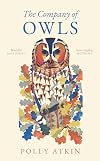
The Company of Owls by Polly Atkin
I am not sure what I was expecting but since my sister is an avid bird watcher and I have lived vicariously through her emails as she shares what she has seen, I thought this might be a book she would like and, I believe she would. I ended up skimming rather than settling in but did find myself more interested in the owls as I read and skimmed my way through the book.
Notes while reading:
* I wonder if short eared owls are the same as the burrowing owls show more cinde told me about?
* Interesting notes from authors and history about owls
* Is this a journal of sightings, feelings, information learned, or…
* Anthropomorphizing owls – I do that with animals and even shapes seen in nature
* I wonder if the owls in Lebanon are like the ones in the Lake District?
* Interesting tidbits about branching, vision/eyes, lifespan, predator vs prey, what happens when owlets outgrow their parents, history, community interaction, feathering, owl behavior…
* How Covid-19 and lockdown played a part in the writing of the book
* This would be fun to for if illustrated or there was an online link to photos of the owls
* I wonder if the photos shared online by the author are located somewhere easy to access?
Did I like this book? Eventually – it grew on me and made me think of the night sounds I hear on my hilltop…including the owls calling to one another and sometimes moving through the night.
Thank you to NetGalley and Elliott & Thompson for the ARC – this is my honest review.
3-4 Stars show less
I am not sure what I was expecting but since my sister is an avid bird watcher and I have lived vicariously through her emails as she shares what she has seen, I thought this might be a book she would like and, I believe she would. I ended up skimming rather than settling in but did find myself more interested in the owls as I read and skimmed my way through the book.
Notes while reading:
* I wonder if short eared owls are the same as the burrowing owls show more cinde told me about?
* Interesting notes from authors and history about owls
* Is this a journal of sightings, feelings, information learned, or…
* Anthropomorphizing owls – I do that with animals and even shapes seen in nature
* I wonder if the owls in Lebanon are like the ones in the Lake District?
* Interesting tidbits about branching, vision/eyes, lifespan, predator vs prey, what happens when owlets outgrow their parents, history, community interaction, feathering, owl behavior…
* How Covid-19 and lockdown played a part in the writing of the book
* This would be fun to for if illustrated or there was an online link to photos of the owls
* I wonder if the photos shared online by the author are located somewhere easy to access?
Did I like this book? Eventually – it grew on me and made me think of the night sounds I hear on my hilltop…including the owls calling to one another and sometimes moving through the night.
Thank you to NetGalley and Elliott & Thompson for the ARC – this is my honest review.
3-4 Stars show less
Lists
Awards


You May Also Like
Associated Authors
Statistics
- Works
- 6
- Also by
- 5
- Members
- 82
- Popularity
- #220,760
- Rating
- 3.9
- Reviews
- 5
- ISBNs
- 16