
Gertrude Chandler Warner (1890–1979)
Author of The Boxcar Children
About the Author
Gertrude Chandler Warner was born in Putnam, Connecticut on April 16, 1890. Due to her poor health, she never finished high school and studied with a tutor. During World War I, a shortage of teachers prompted the local school board to hire her to teach first grade, a position she held for over 30 show more years. She wrote the first Boxcar book in 1924, while home recuperating from an illness, but the version most people are familiar with was originally published in 1942. The Alden children became so popular that she wrote 19 adventures about them including Surprise Island, Mystery Ranch, and Snowbound Mystery. She died at age 89 August 29, 1979, but the Boxcar Children are still being written about by a team of writers faithful to her vision. (Bowker Author Biography) show less
Disambiguation Notice:
Warner is the author of the first 19 books in The Boxcar Children series; all of the remaining volumes were ghostwritten.
Series
Works by Gertrude Chandler Warner
The Yellow House Mystery (The Boxcar Children: Time to Read, Level 2) (The Boxcar Children Early Readers) (2019) 62 copies
The Boxcar Children Guide to Adventure: A How-To for Mystery Solving, Make-It-Yourself Projects, and More (The Boxcar Children Mysteries) (2014) 52 copies
The Boxcar Children Collection, Volume 01 [3-in-1] [Unabridged Audio Book] (2006) 38 copies, 1 review
The Pizza Mystery (The Boxcar Children: Time to Read, Level 2) (The Boxcar Children Early Readers) (2022) 34 copies
The Boxcar Children Favorites 30 Books Boxed Collection with Activity Book, Journal, Sticker Sheet , DVD, Magnifying Glass, and Poster (2019) 33 copies
The Boxcar Children Dog Lovers' Special: Mystery at the Dog Show/The Guide Dog Mystery/The Mystery of the Midnight Dog (2009) 14 copies
The Boxcar Children Books 1-8 Eight Stories of Mystery and Adventure with Bonus Bookmark Boxed Set (2012) 12 copies
The Boxcar Children From Sea to Shining Sea Special (The Boxcar Children Mysteries) (2011) — Creator — 7 copies
Boxcar Children Series 4 copies
The Boxcar Children Special #13 3 copies
The Boxcar Children Deluxe Hardcover Boxed Gift Set (#1-3) (The Boxcar Children Mysteries) (2013) 3 copies
The Boxcar Children Collection, Volume 6: Mystery in the Sand, Mystery Behind the Wall, Bus Station Mystery (2022) 2 copies
The Boxcar Children Collection, Volume 3: The Woodshed Mystery, The Lighthouse Mystery, Mountain Top Mystery (2022) 2 copies
The Boxcar Children Collection Volume 21: The Growling Bear Mystery, The Mystery of the Lake Monster, The Mystery at Peacock Hall (2023) 2 copies
The Boxcar Children Books 33-36 2 copies
The Boxcar Children Collection, Volume 8: The Animal Shelter Mystery, The Old Motel Mystery, The Mystery of the Hidden Painting (2022) 2 copies
The Boxcar Children Collection, Volume 7: Benny Uncovers a Mystery, The Haunted Cabin Mystery, The Deserted Library Mystery (2022) 2 copies
The boxcar children, copy 1 1 copy
The Candy Factory Mystery 1 copy
[The Amusement Park Mystery (Boxcar Children)] [Author: Gertrude Chandler Warner] [January, 1992] 1 copy
The Boxcar Children Collection Volume 2 (Library Edition): Mystery Ranch, Mike's Mystery, Blue Bay Mystery (2012) 1 copy
Superstar Watch 1 copy
The Campout Mystery 1 copy
The Mystery In San Francisco 1 copy
Boxcar Children, books 1-4 1 copy
The Great Shark Mystery 1 copy
The boxercar Children 1 copy
The Dog-Gone Mystery 1 copy
Abduction 1 copy
The Box-Car Adventure 1 copy
The Boxcar Children ~ Gertrude Chandler Warner ~ Volumes 1-15 (1989) (The Boxcar Children, Volumes one through fifteen) (1989) 1 copy
The Boxcar Children Collection Volume 22: The Black Pearl Mystery, The Cereal Box Mystery, The Panther Mystery (1898) 1 copy
Boxcar Children Collection Volume, the 18: The Mystery of the Lost Mine, the Guide Dog Mystery, & the Hurricane Mystery (2015) 1 copy
The House of Delight 1 copy
YellowHouse Mystery,The 1 copy
Treehouse Mystery 1 copy
The Boxcar Children Book 1 1 copy
The Boxcar Children Collection Volume 20: The Mystery at the Alamo, The Outer Space Mystery, The Soccer Mystery (2023) 1 copy
The Boxcar Children Collection Volume 18: The Mystery of the Lost Mine, The Guide Dog Mystery, The Hurricane Mystery (2023) 1 copy
The Boxcar Children Mysteries series. 12 Books collection set. Vol. 25-36 by Gertrude Chandler Warner (1993) 1 copy
The Boxcar Children Collection Volume 22: The Black Pearl Mystery, The Cereal Box Mystery, The Panther Mystery (2023) 1 copy
Children of the Harvest 1 copy
Associated Works
The Boxcar Children, A Graphic Novel #1 [2009 Albert Whitman Series] (2009) — Creator — 147 copies, 17 reviews
The Boxcar Children Graphic Novel #1 [2026 Random House Series] (2026) — Original Author — 5 copies, 1 review
Tagged
Common Knowledge
- Birthdate
- 1890-04-16
- Date of death
- 1979-08-30
- Gender
- female
- Occupations
- children's book author
- Nationality
- USA
- Birthplace
- Putnam, Connecticut, USA
- Places of residence
- Putnam, Connecticut, USA
- Place of death
- Killingly, Connecticut, USA
- Burial location
- Grove Street Cemetery, Putnam, Connecticut, USA
- Disambiguation notice
- Warner is the author of the first 19 books in The Boxcar Children series; all of the remaining volumes were ghostwritten.
- Associated Place (for map)
- Putnam, Connecticut, USA
Members
Discussions
The Boxcar Children - comparative notes in Table For One (July 2023)
Reviews

This very gentle, early-reader Robinsonade was intensely memorable for me as a child, and is still charming today, judging by my 6yo's enjoyment of it. Four orphaned children who are on their on, running from a grandfather they believe to be cruel, find an abandoned boxcar and make it their home. They find a dump (oh, the days when people just started dumping crap in random places) and trashpick a kettle, and pitchers and plates and a cup, and make a soup ladle. They build a stone firepit, show more adopt a dog by picking a thorn from his paw, and dam up a small pool for bathing. The hard-working older brother brings home enough spare cash to provide butter, the girls figure out how to keep milk and butter cold in a rock in a pool -- it's all completely precious.
Anyway, of course it ends happily, and my 6yo seemed quite satisfied with the happy ending.
As an adult, I noticed many interesting strands that I didn't pick up on in my childhood -- the baker & her husband who didn't like children, but would have been happy to "keep" them for child labor! The wealthy grandfather who was a mill owner, but paid for a big town race once a year. Might be fun to read a socialist realistic retelling of The Boxcar Children. The gender roles of the two older siblings were notable too, although they were more matter-of-fact and less annoying than in some more modern works.
This time around, I read a "60th anniversary" edition which included a brief biography of Gertrude Chandler Warner, and a lot of photos. It mentioned she'd written The Boxcar Children originally in 1924, but the version which has been reprinted so many times is the illustrated version published in 1942. Who knew?
Anyway, the book was delightful, and I'm pleased to have had the experience with Ada. I was never that into the books after this first one, when the kids are living the high life with their rich granddad, but the first one I read over and over. show less
Anyway, of course it ends happily, and my 6yo seemed quite satisfied with the happy ending.
As an adult, I noticed many interesting strands that I didn't pick up on in my childhood -- the baker & her husband who didn't like children, but would have been happy to "keep" them for child labor! The wealthy grandfather who was a mill owner, but paid for a big town race once a year. Might be fun to read a socialist realistic retelling of The Boxcar Children. The gender roles of the two older siblings were notable too, although they were more matter-of-fact and less annoying than in some more modern works.
This time around, I read a "60th anniversary" edition which included a brief biography of Gertrude Chandler Warner, and a lot of photos. It mentioned she'd written The Boxcar Children originally in 1924, but the version which has been reprinted so many times is the illustrated version published in 1942. Who knew?
Anyway, the book was delightful, and I'm pleased to have had the experience with Ada. I was never that into the books after this first one, when the kids are living the high life with their rich granddad, but the first one I read over and over. show less

Orphaned children terrified of being sent to live with a nasty grandfather instead run away and end up taking shelter in basically a shipping container in the woods. Faced with starvation the eldest, a 13-year-old boy, seeks work in the nearest township and this source of child labour is readily exploited by a local doctor. His 12-year-old sister meanwhile scavenges in a nearby rubbish dump in order to make a semblance of home - and school! - for her younger siblings. Inevitably however this show more highly suboptimal way of living leads to the 10-year-old falling dangerously ill.
The moral of the story of course is that no matter how badly off you are, pulling yourself up by your bootstraps is fun and surprisingly easy, and if you're ever in any real danger not to worry, that's when your rich relative will appear to save you all.
Would definitely appeal to children and also everyone who'd much rather play housekeeping sim games than do actual housekeeping; is a terrible example for anyone who'll ever have any influence on social policy. show less
The moral of the story of course is that no matter how badly off you are, pulling yourself up by your bootstraps is fun and surprisingly easy, and if you're ever in any real danger not to worry, that's when your rich relative will appear to save you all.
Would definitely appeal to children and also everyone who'd much rather play housekeeping sim games than do actual housekeeping; is a terrible example for anyone who'll ever have any influence on social policy. show less
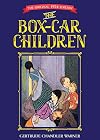
After their parents die, four children run away to avoid being sent to live with their grandfather, who they don't really know but are sure doesn't like them, and end up living for a while in an abandoned railroad freight car in the woods.
I'm honestly not certain whether I read this as a kid or not. The title is vaguely familiar, and it certainly seems like the sort of thing I'd likely have read, but it didn't stir any great sense of familiarity. If I did, I'm willing to bet I enjoyed it, show more appreciating the independence and competence of these kids as they build a cozy domesticity out of nothing and live out the childhood fantasy of adulthood (followed by the childhood fantasy of being adopted by someone rich and indulgent).
As an adult, though, while there is a certain quaint charm to all of that, it feels like it's all wrapped up in an unspoken, much darker tale, what with their mother being dead at the beginning and their father having apparently drunk himself to death by page two. In my own childhood, I probably wouldn't have questioned things like these kids thinking a hunk of bread makes a perfectly acceptable meal, or the fact that they're expecting something so horrible and terrifying from their remaining relative that running away seems like a reasonable alternative, or that a twelve-year-old girl seem perfectly accustomed to doing literally everything necessary to look after her younger siblings. Adult me is sure thinking about all that a lot, though. show less
I'm honestly not certain whether I read this as a kid or not. The title is vaguely familiar, and it certainly seems like the sort of thing I'd likely have read, but it didn't stir any great sense of familiarity. If I did, I'm willing to bet I enjoyed it, show more appreciating the independence and competence of these kids as they build a cozy domesticity out of nothing and live out the childhood fantasy of adulthood (followed by the childhood fantasy of being adopted by someone rich and indulgent).
As an adult, though, while there is a certain quaint charm to all of that, it feels like it's all wrapped up in an unspoken, much darker tale, what with their mother being dead at the beginning and their father having apparently drunk himself to death by page two. In my own childhood, I probably wouldn't have questioned things like these kids thinking a hunk of bread makes a perfectly acceptable meal, or the fact that they're expecting something so horrible and terrifying from their remaining relative that running away seems like a reasonable alternative, or that a twelve-year-old girl seem perfectly accustomed to doing literally everything necessary to look after her younger siblings. Adult me is sure thinking about all that a lot, though. show less

I remembered loving the few Boxcar Children books in my local library when I was young. I think I mostly enamored of children being able to survive on their own without parents.
This book is very disappointing. The first part isn't too bad, but once they meet the old Indian woman it turned into a paternalistic fairy tale. To be expected from a 1964 publication.
Lovan lived to age 90 managing on her own, but once she mentioned a concern about the land being bought out by a logging company, Mr show more Alden decides to buy it himself. He condescendingly says he'll allow her to live there the rest of her life (which at age 90 won't be impossibly long), but he is already considering it "my woodlot" (p.50). We never get a chance to hear Lovan mention her obligation to be a caretaker of the land and protector of the waters. (I know there are wetlands because she gets the sweetgrass for her baskets from a "swamp" (p.51). Mr Alden acknowledges that the government forgets its promises to the Indians (p.44), but he does not mention that a treaty between two nations is more than a promise, it is a legal obligation.
On the basis of this brief meeting, Lovan implores Mr Alden to be a co-owner of the bank account from the sale of a family treasure.
Both Native people in the book state repeatedly that they are the last of their tribe. And Mr Alden is glad that children (presumably white) learn how to do Indian crafts "or we'll lose all the beautiful things that nobody can make as well as the Indian" (p.84) as if there will soon be no more Indians. That perpetrates a common misperception that there are no more Indians when, in fact, they are still here and (now that it is no longer illegal) bringing their cultural practices out of hiding. This is a point that parents or teachers should reinforce with any child who has bothered to read this book.
Other bothersome details: Even tho we assume Mr Alden is an intelligent businessman, he pays no heed to the warnings of local people that a storm is coming. Lovan states she left her family because they called her "stuck up" for liking to learn to read and write. It is more likely that a family would be supportive of a child who can learn a skill that would be useful in dealing with the whites, or that their main reason for not wanting her to go to school was because the Indian Schools in those days were focused on wiping out all traces of their culture from the students. It is not historically accurate for Lovan to state she was allowed to teach students "the good things of Indian life." (p.84) When David is found, he says he had only gone to school for sporadic weeks, yet by the end of the book he is gung-ho on attending school. He feels "for the first time in a long, long time" that he "had a home and someone to care about him." (p.108) Yet he is now still considered a boy and was raised by his grandmother and remembers the stories and the language she taught him. Mr Alden thinks that David looking you "straight in the eyes" (p.118) is a sign of his later well-being, but this is not necessarily a trait of that tribe and only shows that David is following white customs.
On a positive side, we do see David and Lovan initiating a leave -taking without using the words "good-bye," which are typically replaced with some form of "until we meet again" by the indigenous peoples on this continent. show less
This book is very disappointing. The first part isn't too bad, but once they meet the old Indian woman it turned into a paternalistic fairy tale. To be expected from a 1964 publication.
Lovan lived to age 90 managing on her own, but once she mentioned a concern about the land being bought out by a logging company, Mr show more Alden decides to buy it himself. He condescendingly says he'll allow her to live there the rest of her life (which at age 90 won't be impossibly long), but he is already considering it "my woodlot" (p.50). We never get a chance to hear Lovan mention her obligation to be a caretaker of the land and protector of the waters. (I know there are wetlands because she gets the sweetgrass for her baskets from a "swamp" (p.51). Mr Alden acknowledges that the government forgets its promises to the Indians (p.44), but he does not mention that a treaty between two nations is more than a promise, it is a legal obligation.
On the basis of this brief meeting, Lovan implores Mr Alden to be a co-owner of the bank account from the sale of a family treasure.
Both Native people in the book state repeatedly that they are the last of their tribe. And Mr Alden is glad that children (presumably white) learn how to do Indian crafts "or we'll lose all the beautiful things that nobody can make as well as the Indian" (p.84) as if there will soon be no more Indians. That perpetrates a common misperception that there are no more Indians when, in fact, they are still here and (now that it is no longer illegal) bringing their cultural practices out of hiding. This is a point that parents or teachers should reinforce with any child who has bothered to read this book.
Other bothersome details: Even tho we assume Mr Alden is an intelligent businessman, he pays no heed to the warnings of local people that a storm is coming. Lovan states she left her family because they called her "stuck up" for liking to learn to read and write. It is more likely that a family would be supportive of a child who can learn a skill that would be useful in dealing with the whites, or that their main reason for not wanting her to go to school was because the Indian Schools in those days were focused on wiping out all traces of their culture from the students. It is not historically accurate for Lovan to state she was allowed to teach students "the good things of Indian life." (p.84) When David is found, he says he had only gone to school for sporadic weeks, yet by the end of the book he is gung-ho on attending school. He feels "for the first time in a long, long time" that he "had a home and someone to care about him." (p.108) Yet he is now still considered a boy and was raised by his grandmother and remembers the stories and the language she taught him. Mr Alden thinks that David looking you "straight in the eyes" (p.118) is a sign of his later well-being, but this is not necessarily a trait of that tribe and only shows that David is following white customs.
On a positive side, we do see David and Lovan initiating a leave -taking without using the words "good-bye," which are typically replaced with some form of "until we meet again" by the indigenous peoples on this continent. show less
Lists
1960s (10)
Overdue Podcast (1)
Tagged Runaways (1)
Sonlight Books (1)
Five in a Row (1)
1920s (1)
1924 Project (1)
1970s (1)
Ambleside Books (1)
Comfort Reads (1)
Out of Copyright (1)
KID BOOKS (1)
1950s (2)
For My Kids (2)
4th Grade Books (1)
Five star books (1)
1940s (1)
Female Author (1)
Five in a Row (1)
Awards


You May Also Like


Associated Authors
Statistics
- Works
- 390
- Also by
- 21
- Members
- 119,380
- Popularity
- #66
- Rating
- 3.7
- Reviews
- 450
- ISBNs
- 3,356
- Languages
- 8
- Favorited
- 23

