
Dr. Bob Rotella
Author of Golf is Not a Game of Perfect
About the Author
Dr. Bob Rotella was the director of sports psychology at the University of Virginia for twenty years. His client list includes the winners of more than seventy major championships in men's, women's, and senior golf; star athletes in all other major sports, including tennis, baseball, basketball, show more and football; singers, rock stars, and other artistic performers; and business leaders at companies ranging from Ford to Coca-Cola. Dr. Rotella lives in Virginia with his wife, Darlene. show less
Works by Dr. Bob Rotella
The Unstoppable Golfer: Trusting Your Mind & Your Short Game to Achieve Greatness (2012) 20 copies, 2 reviews
The Elements of Successful Trading: Developing Your Comprehensive Strategy Through Psychology, Money Management, and Trading Methods (1992) 15 copies
Tagged
Common Knowledge
- Gender
- male
Members
Reviews
The Unstoppable Golfer: Trusting Your Mind & Your Short Game to Achieve Greatness by Dr. Bob Rotella
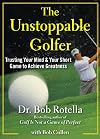
I love the short game in golf. There's no question that striking a full shot is satisfying and momentarily rewarding, but quite frankly there's a certain sameness to it that fails to hold interest very long. The short game, though, is predicated on variety. Chips, pitches, bunker blasts, bump-and-runs, digging a ball out of the collar of rough a dozen feet from the pin--every shot is different, every shot makes you think, and every shot really, really counts. And then there is putting, which show more is the most nerve-wracking of all.
In The Unstoppable Golfer, Dr. Bob Rotella, golf psychologist to stars like Keegan Bradley, Padraig Harrington, and Darren Clarke, says, "...nearly all golfers have the physical ability required to pitch the ball, to chip it, to putt it. If we're not doing those things, It's because we're somehow stopping ourselves." In other words, we get in our own way.
Rotella says it's often fear that crowds our minds, pushing and shoving its way and calling out for negative images, contradictory swing thoughts, and herky-jerky responses. The solution? To achieve a state of calm by focusing on one thing: the hole.
He couldn't be more right, of course. If you focus on your target, visualize the ball getting there, and commit to a play based on belief in its success, you're more than half-way to a great short game. Rotella fills the book with stories of his students (patients?) who learned to quiet their minds and let their instincts lead them to better golf. He covers no swing mechanics, but does break down how your mind should work when faced with typical short game situations like pitch shots over hazards, getting up and down from a bunker, and lining up long putts to go in rather than just lag close.
He has a special section on the "yips" in which he discounts the theory that there's some physical cause behind them but offers instead a solid, results-proven method to mentally overcome them. Of course, Dr. Bob doesn't deal with the little blue gnome that pesters one of the characters in my book of golf stories, Weird Golf, but you can't expect him to cover everything, can you?
The short game is the scoring game, according to nearly every golf guru I've ever talked to. You can drive the ball 340 yards, but if you can't get it in the hole, you can't put birdies and pars on your scorecard. Dr. Bob's book will help. show less
In The Unstoppable Golfer, Dr. Bob Rotella, golf psychologist to stars like Keegan Bradley, Padraig Harrington, and Darren Clarke, says, "...nearly all golfers have the physical ability required to pitch the ball, to chip it, to putt it. If we're not doing those things, It's because we're somehow stopping ourselves." In other words, we get in our own way.
Rotella says it's often fear that crowds our minds, pushing and shoving its way and calling out for negative images, contradictory swing thoughts, and herky-jerky responses. The solution? To achieve a state of calm by focusing on one thing: the hole.
He couldn't be more right, of course. If you focus on your target, visualize the ball getting there, and commit to a play based on belief in its success, you're more than half-way to a great short game. Rotella fills the book with stories of his students (patients?) who learned to quiet their minds and let their instincts lead them to better golf. He covers no swing mechanics, but does break down how your mind should work when faced with typical short game situations like pitch shots over hazards, getting up and down from a bunker, and lining up long putts to go in rather than just lag close.
He has a special section on the "yips" in which he discounts the theory that there's some physical cause behind them but offers instead a solid, results-proven method to mentally overcome them. Of course, Dr. Bob doesn't deal with the little blue gnome that pesters one of the characters in my book of golf stories, Weird Golf, but you can't expect him to cover everything, can you?
The short game is the scoring game, according to nearly every golf guru I've ever talked to. You can drive the ball 340 yards, but if you can't get it in the hole, you can't put birdies and pars on your scorecard. Dr. Bob's book will help. show less
rotella can be a little hokey, but the advice is so solid for us struggling golfers ... unless you are like lydia ko on the course, you could probably use this book to your benefit. i appreciate the brevity, and it's well written and easily digestible.
it's 'the power of now' for golfers.
tiger ... kevin na ...
it's 'the power of now' for golfers.
tiger ... kevin na ...
standard rotella. follow his advice, and it'll make you a better golfer and probably a more effective person.
short and concise, homespun psychology.
short and concise, homespun psychology.
This book was pretty good because it talks about the mental aspect of golf . Most people that don’t play golf too much don’t know the true mental strength needed to play this game and this book talks about how to cope with all the different things that come with the game . For example a practice routine that puts the golfer in a position to hit any given shot is needed on each and every shot. This repetitive routine helps the golfer focus on what he or she needs to do
Lists
You May Also Like


Associated Authors
Statistics
- Works
- 25
- Members
- 982
- Popularity
- #26,222
- Rating
- 3.7
- Reviews
- 13
- ISBNs
- 83
- Languages
- 3