
Serge A. Lang (1927–2005)
Author of Algebra
About the Author
Image credit: Professor Serge Lang lecturing for Math Club at the Louisiana State University in Baton Rouge, Louisiana, on March 8, 2004. Photograph by Bogdan Oporowski. By The original uploader was Bogdan Oporowski at English Wikipedia. - Transferred from en.wikipedia to Commons., CC BY-SA 3.0, https://commons.wikimedia.org/w/index.php?curid=2267583
Works by Serge A. Lang
Tagged
Common Knowledge
- Birthdate
- 1927-05-19
- Date of death
- 2005-09-12
- Gender
- male
- Nationality
- USA
France - Birthplace
- Saint-Germain-en-Laye, Paris, Île-de-France, France
- Place of death
- Berkeley, California, USA
- Map Location
- USA
Members
Reviews
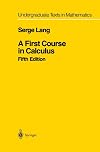
This was an excellent text for self-studying the beginnings of calculus. It makes proofs accessible, and even taught me how to prove concepts that seemed obvious but were easy to forget when not used for a while. Learning how to derive and prove concepts like this is essential for someone who wants to study physics, which is the case for me.
I have reservations for recommending this book for Calculus II and beyond. Seeing second- and third-semester calculus topics listed in the table of show more contents raised my hopes for learning Calc II and III from Lang. Beginning with Taylor polynomials, however, Lang's calculus skipped explanations, became unnecessarily abstract when explaining relatively simple ideas, and yet did not cover the operations I needed in enough depth. This text was not sufficient for learning the calculus of vectors and volume integration.
If you understand pre-calculus and trigonometry, go with this text to learn derivative and integral calculus. Go elsewhere for series, vectors, and multivariable functions. show less
I have reservations for recommending this book for Calculus II and beyond. Seeing second- and third-semester calculus topics listed in the table of show more contents raised my hopes for learning Calc II and III from Lang. Beginning with Taylor polynomials, however, Lang's calculus skipped explanations, became unnecessarily abstract when explaining relatively simple ideas, and yet did not cover the operations I needed in enough depth. This text was not sufficient for learning the calculus of vectors and volume integration.
If you understand pre-calculus and trigonometry, go with this text to learn derivative and integral calculus. Go elsewhere for series, vectors, and multivariable functions. show less
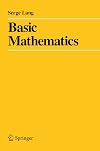
An amazing and easy-to-follow precalculus book, both suited for high-schoolers and undergraduates who are looking to review or expand their knowledge of high-school mathematics. The proofs Lang wrote are simple and straightforward, and the book offers plenty of exercises (albeit, straightforward ones outside of some of the proofs). The book focuses heavily on beginner and informal exposure to the concepts of abstract algebra that pertain to classical non-modern algebra taught in most basic show more K-12 educations, which I'd assume was intentional given Lang's record.
Overall, I'd say it is one of if not the best early mathematics textbooks you can get your hands on. It's a fun read and is definitely worth the time it takes to complete. show less
Overall, I'd say it is one of if not the best early mathematics textbooks you can get your hands on. It's a fun read and is definitely worth the time it takes to complete. show less

This is certainly a classic - but is it any good? This (first) edition is full of typos, has a badly organised index, limited cross-references and very few examples (allegedly it was written entirely linearly by dictation with little editing, and this is wholly believable based only on the text). But it does have a little bit of everything.
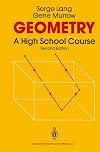
This book is a masterpiece: simple, spare, elegant, and efficient. It's in a class by itself.
Lists
You May Also Like


Statistics
- Works
- 61
- Members
- 1,758
- Popularity
- #14,638
- Rating
- 3.9
- Reviews
- 11
- ISBNs
- 224
- Languages
- 6