
Jo Ann Kay McNamara (1931–2009)
Author of Sisters in Arms: Catholic Nuns through Two Millennia
Works by Jo Ann Kay McNamara
Tagged
Common Knowledge
- Birthdate
- 1931
- Date of death
- 2009
- Gender
- female
- Occupations
- history professor, Hunter College, City University of New York
- Birthplace
- Janesville, Wisconsin, USA
- Place of death
- New York, New York, USA
- Associated Place (for map)
- USA
Members
Reviews
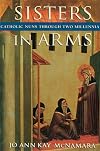
Sisters in Arms is a hefty tome (well over 700 pages in hardback) covering the history of nuns and canonesses in the Catholic tradition from the beginning of the church through to the mid 1990s. McNamara has written an account of women religious and their contributions to both the church and their wider societies which is decidedly celebratory. She sees nuns as more than just adjuncts to monks and priests, but as active preservers of the important role which the laity had in the early show more church.
It's an impressive overview of 2000 years of history, though not without its flaws—neither truly chronologically, geographically or thematically organised, at times it can be a little confusing to follow the threads of McNamara's argument, and her argument means that she's not open to ambiguity in the reception of female religious. Issues of colonialism and cultural imperialism centring on nuns' missionary work are barely dealt with (at one point, I believe, she claims that nuns became less popular in developing countries because the indigenous populations became less grateful!), and McNamara is more interested in discussing nuns as struggling with a misogynistic ecclesiastical hierarchy than in looking at instances where they too became part of an oppressive social/cultural hierarchy. True, many of the instances of abuse in, for instance, female religious run institutions in Ireland were only beginning to be known at the time McNamara was writing. Still, it's hard to believe that the history of nuns is quite so unequivocally positive and feminist as she presents here. show less
It's an impressive overview of 2000 years of history, though not without its flaws—neither truly chronologically, geographically or thematically organised, at times it can be a little confusing to follow the threads of McNamara's argument, and her argument means that she's not open to ambiguity in the reception of female religious. Issues of colonialism and cultural imperialism centring on nuns' missionary work are barely dealt with (at one point, I believe, she claims that nuns became less popular in developing countries because the indigenous populations became less grateful!), and McNamara is more interested in discussing nuns as struggling with a misogynistic ecclesiastical hierarchy than in looking at instances where they too became part of an oppressive social/cultural hierarchy. True, many of the instances of abuse in, for instance, female religious run institutions in Ireland were only beginning to be known at the time McNamara was writing. Still, it's hard to believe that the history of nuns is quite so unequivocally positive and feminist as she presents here. show less
To narrate two millennia of history in a single volume that is both comprehensive and accessible is no easy task, but McNamara's Sisters in Arms succeeds admirably. Though it is not a book for casual readers, it is accessible to a general audience that includes a wide range of serious students. From her explanation of the military metaphor chosen as title to her reflections on "the prayers and services of dedicated women" in the third millenium of Christianity, McNamara weaves a readable and show more compelling account of institutions and structures that have defined and been defined by women in the Roman Catholic Church from its origins. That this history has shaped the whole institution of Christianity is clarified throughout the text by McNamara's lucid discussion of syneisactisim-the name primitive Christians assigned to the practice of "religious men and women living together in chastity, recognizing equal spiritual capacities." That this practice confronts-in any age-the structure of male authority "rooted in the ideology of gender differences" extends the scope and importance of this history beyond the boundaries of Roman Catholicism to include the formation of Europe and its place in the world as well as the continuing formation of Christianity beyond the boundaries of European culture. That makes for a broad audience indeed. The value of the text is further enhanced by excellent notes and an extensive bibliography that will direct interested readers to a wide range of additional resources. show less
The history of nuns is an important part of the larger story of western women whose gender provoked resistance to their claims to autonomy and power. As we enter the third millennium, this groundbreaking work pays fitting tribute to the sisters who have labored with prayer and service for two thousand years, who have struggled to achieve greater recognition and authority, and who have forged opportunities for all women while holding true to the teachings of the Gospel.

Sandra Schneiders comments that in this book McNamara "see the history of women Religious as a two-thousand-year battle against male oppression" ("Selling All, Religious Life in a New Millenium", vol. 2, p.420, note 17).
McNamara speaks of the "virginity movement" which flourished in the first centuries in the Roman world. A question that is not addressed: if the impetus was to escape marriage, childbirth etc., why was there no similar groups among non-Christian women when women (at least in show more Roman society) could initiate divorce? show less
McNamara speaks of the "virginity movement" which flourished in the first centuries in the Roman world. A question that is not addressed: if the impetus was to escape marriage, childbirth etc., why was there no similar groups among non-Christian women when women (at least in show more Roman society) could initiate divorce? show less
You May Also Like


Statistics
- Works
- 1
- Members
- 216
- Popularity
- #103,223
- Rating
- 3.6
- Reviews
- 4
- ISBNs
- 3
- Languages
- 1