

Edward Yourdon (1944–2016)
Author of Death march
About the Author
Edward Yourdon co-founded the influential Cutter Consortium Business Technology Council, and serves on the Board of Directors of Gate and Mascot Systems.
Works by Edward Yourdon
Structured Design: Fundamentals of a Discipline of Computer Program and Systems Design (1978) 96 copies
Object-Oriented Systems Design: An Integrated Approach (Yourdon Press Computing Series) (1993) 19 copies
Mainstream Objects: An Analysis and Design Approach for Business (Yourdon Press Computing Series) (1995) 18 copies
Real-time systems design 1 copy
Die westliche Programmierkunst am Scheideweg (Die Schlüsseltechniken der Softwareentwicklung für das 21. Jahrhundert) (1993) 1 copy
Unified Modeling Language 1 copy
Associated Works
Tagged
Common Knowledge
- Birthdate
- 1944-04-30
- Date of death
- 2016-01-20
- Gender
- male
- Relationships
- Yourdon, Jennifer (dochter)
- Nationality
- USA
- Associated Place (for map)
- USA
Members
Reviews

When I discovered object-oriented software development in the 1990s, it changed the way I designed and build programs, and especially how I thought about software, changed it for the better. This was mostly through Peter Coad's books and blog.
I could only wish there had been such methods in the air when I started programming a decade or two earlier.
Coad's, methods seemed over-simple, but they were not. They were, more than most techniques in those days, based on first analyzing what had to show more be done, thinking about what the expected users would need, more than what the developers wanted to do.
I kept his books on analysis (OOA), design (OOD), programming (OOP), and others, for a long time, until I had retired as a successful software developer. show less
I could only wish there had been such methods in the air when I started programming a decade or two earlier.
Coad's, methods seemed over-simple, but they were not. They were, more than most techniques in those days, based on first analyzing what had to show more be done, thinking about what the expected users would need, more than what the developers wanted to do.
I kept his books on analysis (OOA), design (OOD), programming (OOP), and others, for a long time, until I had retired as a successful software developer. show less
Death March: The Complete Software Developer's Guide to Surviving 'Mission Impossible' Projects (Yourdon Computing by Edward Yourdon
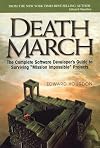
If you are working at a place that believes in the Death March, you owe it to yourself to find time to read this book (not an easy thing when you are working 14 hours a day, seven days a week).
If you have never worked at such a place, you should at least skim the book to understand why you don't want to work for such an employee.
If you've survived a death march and now work at a saner company, you don't need this book in the least.
Word of warning: it is depressing to read this book and show more then see your employer is a textbook example of how not to run a software company.
Knowing what would happen, I scheduled a meeting with my manager and brought in the book with little sticky-notes on key pages. I then cataloged what the company was doing wrong and why it was bad.
They fired me, of course. In a month I was working for a fantastic start-up. I've been at that firm for five years now. We work hard, but we do not do death marches.
That other company? Dead and gone. show less
If you have never worked at such a place, you should at least skim the book to understand why you don't want to work for such an employee.
If you've survived a death march and now work at a saner company, you don't need this book in the least.
Word of warning: it is depressing to read this book and show more then see your employer is a textbook example of how not to run a software company.
Knowing what would happen, I scheduled a meeting with my manager and brought in the book with little sticky-notes on key pages. I then cataloged what the company was doing wrong and why it was bad.
They fired me, of course. In a month I was working for a fantastic start-up. I've been at that firm for five years now. We work hard, but we do not do death marches.
That other company? Dead and gone. show less
Can't rate it as I read this book very long time ago. But I remember it been mildly entertainig and mostly unpractical. There is too much cultural difference.

do you remember a time when we were all afraid of the Y2K bug? I do. The question is did we fix EVERYTHING in time or was it never any big deal after all? It seemed like a good idea at the time--and it still has some good emergency prep ideas (or so we justify)
Awards
You May Also Like


Associated Authors
Statistics
- Works
- 41
- Also by
- 1
- Members
- 1,669
- Popularity
- #15,389
- Rating
- 3.4
- Reviews
- 16
- ISBNs
- 71
- Languages
- 8