
Tom DeMarco
Author of Peopleware: Productive Projects and Teams
About the Author
Tom DeMarco draws on his experience both as participant and manager of large systems development projects, among them development of the first commercial stored-program telephone switching center at Bell Telephone Laboratories, and of distributed on-line banking systems in Europe. He is author of show more Structured Analysis and System Specification and of Concise Notes on Software Engineering, also published by Yourdon Press. show less
Image credit: ATLANTIC SYSTEMS GUILD
Works by Tom DeMarco
Slack: Getting Past Burnout, Busywork, and the Myth of Total Efficiency (2001) 544 copies, 7 reviews
Adrenaline Junkies and Template Zombies: Understanding Patterns of Project Behavior (2007) 109 copies, 3 reviews
Why Does Software Cost So Much?: And Other Puzzles of the Information Age (1995) 86 copies, 1 review
Tagged
Common Knowledge
- Canonical name
- DeMarco, Tom
- Birthdate
- 1940-08-20
- Gender
- male
- Nationality
- USA
- Map Location
- USA
Members
Reviews
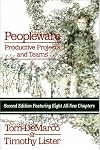
Great read, albeit depressing in that my industry hasn't learned a damn thing in forty years.
This book is one of the few focused specifically on how to manage projects and teams of knowledge-workers. It teaches the reader how management might retain workers and their essential skills instead of treating them like cattle. It treats the central problem of management is sociology and not technology. Keeping knowledge-workers happy and productive requires humanity and not scorched-earth policies.
The book, in its third edition, is organized into 39 short chapters each with its own focus. show more As with most management books, its lessons are absorbed in the industry practice. Nonetheless, it is nice to read the thinking and research behind contemporary practice.
Management of people should focus not merely on the goals/objectives of a project but upon the people involved. This is a lesson which is sometimes forgotten by management. The person who works on a project/team is a knowledge worker with feelings, experience, knowledge, and wisdom. One must not only navigate the objectives of a project but also the care of a person. People work best when they are happy and not actively stressed by poor management. show less
The book, in its third edition, is organized into 39 short chapters each with its own focus. show more As with most management books, its lessons are absorbed in the industry practice. Nonetheless, it is nice to read the thinking and research behind contemporary practice.
Management of people should focus not merely on the goals/objectives of a project but upon the people involved. This is a lesson which is sometimes forgotten by management. The person who works on a project/team is a knowledge worker with feelings, experience, knowledge, and wisdom. One must not only navigate the objectives of a project but also the care of a person. People work best when they are happy and not actively stressed by poor management. show less
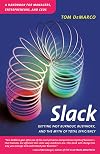
I re-read this book periodically to re-learn some of the many lessons in it. [author: DeMarco] says a lot about "the white space" in your organization and [book: Slack] was one of the books I quoted from in my presentation earlier this year on Managing in the White Space of your Organization. He writes about being a leader, what this really means and what it doesn't mean. He writes about efficiency and effectiveness and how it is easy to have one or the other and very difficult (but ideal) show more to have both.
And mostly he writes about slack: that extra bit of time to think, to re-invent, to create and communicate, that extra bit of resources that you need to adjust quickly to changing environments.
By being too efficient (going somewhere fast), we sometimes forget about being effective (where are we going?) -- quoting Yogi Berra, he observes "We're lost, but we're making good time." show less
And mostly he writes about slack: that extra bit of time to think, to re-invent, to create and communicate, that extra bit of resources that you need to adjust quickly to changing environments.
By being too efficient (going somewhere fast), we sometimes forget about being effective (where are we going?) -- quoting Yogi Berra, he observes "We're lost, but we're making good time." show less
A little dated in some ways but still extremely topical in most others. Really nice thinking about how people can work best and what keeps them from doing so.
Lists
Awards
You May Also Like


Associated Authors
Statistics
- Works
- 18
- Members
- 3,378
- Popularity
- #7,544
- Rating
- 4.2
- Reviews
- 47
- ISBNs
- 59
- Languages
- 5
- Favorited
- 5