
Cynthia Von Buhler
Author of They Called Her Molly Pitcher
About the Author
Series
Works by Cynthia Von Buhler
The Shakespeare Oracle: Let the Bard Predict Your Future (2003) — Illustrator — 38 copies, 2 reviews
Speakeasy Dollhouse: Book One 2 copies
Associated Works
Queen Eleanor: Independent Spirit of the Medieval World (1983) — Cover artist, some editions — 377 copies, 4 reviews
Tagged
Common Knowledge
- Gender
- female
Members
Reviews

This graphic novel in hardcover bande dessinée format was originally published as four individual issues. Cynthia von Buhler was responsible for both the writing and the art, introducing her noir private investigator Minky Woodcock in what ends up being a murder mystery in which the victim is the magician Harry Houdini. Both the mood and the images are dark, with no white gutters dividing the sequential art panels. There are regular helpings of nudity, and the depictions of bondage are show more justified by the story, but they still manage to feel gratuitous. (Not that there's anything wrong with that!)
Woodcock is operating her detective agency as a family business where her father has purportedly left her brother in charge. The story metafictionally enlists mystery writers Agatha Christie and Arthur Conan Doyle, and the latter is a key character because of his relationship with Houdini. Von Buhler has written a pretty tight script in which she draws on a great amount of genuine historical detail, especially regarding the Spiritualists with whom Houdini had a mutual antagonism, and she offers a more restrained factual account in a two-page "Was Houdini Murdered?' appendix to the book.
I have read other graphic novels that purported to put an entertaining fictional spin on true stories of crime and the occult from the twentieth century, and The Girl Who Handcuffed Houdini is one of the best for historical probity and imaginative excitement combined. Von Buhler has since written two further Minky Woodcock tales, and I am definitely interested in these. show less
Woodcock is operating her detective agency as a family business where her father has purportedly left her brother in charge. The story metafictionally enlists mystery writers Agatha Christie and Arthur Conan Doyle, and the latter is a key character because of his relationship with Houdini. Von Buhler has written a pretty tight script in which she draws on a great amount of genuine historical detail, especially regarding the Spiritualists with whom Houdini had a mutual antagonism, and she offers a more restrained factual account in a two-page "Was Houdini Murdered?' appendix to the book.
I have read other graphic novels that purported to put an entertaining fictional spin on true stories of crime and the occult from the twentieth century, and The Girl Who Handcuffed Houdini is one of the best for historical probity and imaginative excitement combined. Von Buhler has since written two further Minky Woodcock tales, and I am definitely interested in these. show less

This third Minky Woodcock crime adventure comics volume breaks the foregoing pattern of titles which would lead a reader to expect The Girl Who Called Cthulhu. But Minky herself actually earns "Cthulhu" as a sobriquet during the course of the story! It is not a sequel to The Girl Who Electrified Tesla, but instead it covers a wider timeframe spanning across both of the two prior volumes.
Author Cynthia von Buhler said that she had originally set out to write this sequence around interactions show more between her gumshoe heroine Minky and spy-cum-novelist Ian Fleming. But with her publisher's encouragement, her plot grew -- through actual connections which she was able to document -- to include H. P. Lovecraft and Aleister Crowley in principal roles. Regarding the likelihood of any actual encounter between those two, von Buhler admits, "I took the liberty of introducing them." She's hardly the only writer of fiction to do so, but she does so with a little more finesse than most, even if her appended discussion of historical sources disappointingly credits the specious notion of their common Sumerian inspirations (a la the 1977 Necronomicon of "Simon").
There is a date at the start of each chapter, but otherwise, there is no third-person narration other than what is implicitly supplied by the point-of-view in the images. The mode was already adopted in the previous volumes, but in this one, I was really struck by the way in which von Buhler was able to detail a nicely complicated plot using only dialogue and embedded documents.
The artwork here is of roughly the same style and quality as its predecessors, and the visual subject matter regularly features nudity, and a sort of eroticized peril that verges on slapstick. There is a cover gallery for the impressive range of variant covers that were used to peddle the four floppy comics issues collected in this book, and most of these are pretty great. show less
Author Cynthia von Buhler said that she had originally set out to write this sequence around interactions show more between her gumshoe heroine Minky and spy-cum-novelist Ian Fleming. But with her publisher's encouragement, her plot grew -- through actual connections which she was able to document -- to include H. P. Lovecraft and Aleister Crowley in principal roles. Regarding the likelihood of any actual encounter between those two, von Buhler admits, "I took the liberty of introducing them." She's hardly the only writer of fiction to do so, but she does so with a little more finesse than most, even if her appended discussion of historical sources disappointingly credits the specious notion of their common Sumerian inspirations (a la the 1977 Necronomicon of "Simon").
There is a date at the start of each chapter, but otherwise, there is no third-person narration other than what is implicitly supplied by the point-of-view in the images. The mode was already adopted in the previous volumes, but in this one, I was really struck by the way in which von Buhler was able to detail a nicely complicated plot using only dialogue and embedded documents.
The artwork here is of roughly the same style and quality as its predecessors, and the visual subject matter regularly features nudity, and a sort of eroticized peril that verges on slapstick. There is a cover gallery for the impressive range of variant covers that were used to peddle the four floppy comics issues collected in this book, and most of these are pretty great. show less

I enjoyed this second Minky Woodcock historical detective adventure graphic novel, although not quite as much as the first. In addition to the case focused on the New York City death of inventor Nikola Tesla, this story advances Minky's own personal narrative with the death of her father seventeen years later than the first volume.
The Woodcock formula at this point is to construct a noir adventure around the death of a famous historical figure, where there were known enigmas but no official show more ruling of homicide. These are not exactly "cold cases" in that only the exploits of the fictional Minky make them into murder cases at all, and she doesn't necessarily conclude that a murder happened, although she always shows the reader why one might have been in the offing.
In a surprising bonus, The Girl Who Electrified Tesla introduces stage performer Josephine Baker as Minky's contemporary and ally. Once more, the writer-illustrator Cynthia von Buhler supplies an appendix to share the highlights of her historical research, emphasizing the points of fact that readers are most likely to find incredible. In this case, those include the employment of Donald Trump's uncle John Trump by Hoover's FBI to review the technological potentials of the materials that were in Tesla's possession when he died.
I had suspected von Buhler was using photography in her process of graphic creation, and her appended article on "The Creative Process" explicitly confirms that, including a number of photo images involved in the compositions for this book. show less
The Woodcock formula at this point is to construct a noir adventure around the death of a famous historical figure, where there were known enigmas but no official show more ruling of homicide. These are not exactly "cold cases" in that only the exploits of the fictional Minky make them into murder cases at all, and she doesn't necessarily conclude that a murder happened, although she always shows the reader why one might have been in the offing.
In a surprising bonus, The Girl Who Electrified Tesla introduces stage performer Josephine Baker as Minky's contemporary and ally. Once more, the writer-illustrator Cynthia von Buhler supplies an appendix to share the highlights of her historical research, emphasizing the points of fact that readers are most likely to find incredible. In this case, those include the employment of Donald Trump's uncle John Trump by Hoover's FBI to review the technological potentials of the materials that were in Tesla's possession when he died.
I had suspected von Buhler was using photography in her process of graphic creation, and her appended article on "The Creative Process" explicitly confirms that, including a number of photo images involved in the compositions for this book. show less
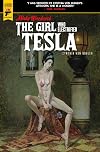
The story has a certain energy to it, but is just too loopy and loosey-goosey for my taste. I was a bit thrown that this does not seem to be in strict continuity with the first story, picking up here in 1943 as if that 1926 adventure occurred just yesterday for the main characters.
The art is fun in its fan service manner, but a making-of feature in the back about the intense photo referencing involved in creating it helps explain its stiff quality.
If a third series is made and I review it, show more no matter how I try to justify it at the time, know in your heart that I just showed up to look at the sexy pictures. show less
The art is fun in its fan service manner, but a making-of feature in the back about the intense photo referencing involved in creating it helps explain its stiff quality.
If a third series is made and I review it, show more no matter how I try to justify it at the time, know in your heart that I just showed up to look at the sexy pictures. show less
Lists
Medieval History (1)
Awards


You May Also Like


Associated Authors
Statistics
- Works
- 19
- Also by
- 11
- Members
- 625
- Popularity
- #40,301
- Rating
- 4.0
- Reviews
- 23
- ISBNs
- 36
- Languages
- 1
