
Guido Giacomo Preparata
Author of Conjuring Hitler: How Britain and America Made the Third Reich
About the Author
Guido Giacomo Preparata is Assistant Professor of Political Economy at the University of Washington
Works by Guido Giacomo Preparata
Tagged
Common Knowledge
- Canonical name
- Preparata, Guido Giacomo
- Birthdate
- 1968-10-25
- Gender
- male
- Education
- Libera Universita degli Studi Sociali (BS|Economics)
University of Cambridge (MPhil|Criminology)
University of Southern California (MS|Economics)
University of Southern California (PhD|Political Economy & Public Policy) - Nationality
- USA
- Birthplace
- Boston, Massachusetts, USA
- Associated Place (for map)
- Massachusetts, USA
Members
Reviews
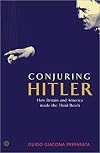
Conjuring Hitler is a full-blown conspiracy theory, accusing “the Anglo-American establishment” of world-historical crimes and attributing to it the successful management of world events since about 1900. Virtually every event of in the British politics in the 1920s and 1930s is held to have been a sham behind “stock masks.”
As the white supremacist and anti-Semitic web sites that have taken up discussion of Preparata’s volume suggest, Conjuring Hitler, with its oracular style, is show more a fine example of what Richard Hofstadter called, in a famous November 1964 Harper’s Magazine essay, “The Paranoid Style in American Politics.”
Hofstadter wrote: “In the history of the United States one finds it, for example, in the anti-Masonic movement, the nativist and anti-Catholic movement, in certain spokesmen of abolitionism who regarded the United States as being in the grip of a slaveholders’ conspiracy, in many alarmists about the Mormons, in some Greenback and Populist writers who constructed a great conspiracy of international bankers, in the exposure of a munitions makers’ conspiracy of World War I, in the popular left-wing press, in the contemporary American right wing, and on both sides of the race controversy today, among White Citizens’ Councils and Black Muslims.”
Hofstadter noted that “this term is pejorative, and it is meant to be; the paranoid style has a greater affinity for bad causes than good. But nothing really prevents a sound program or demand from being advocated in the paranoid style.”
In Preparata’s case, we have a “sound demand” (that national and world politics be liberated from the overweening influence of finance capital) advocated in the classic paranoid style. In this case, a spectacular effect (the rise of Nazism) is taken to require explanation by means of an elaborate intention that is then asserted as an efficient cause.
But history depends on evidence, and there is little of that here, despite the apparatus of scholarship (which reveals itself to be thin when scrutinized). Hofstadter again: “A distinguished historian has said that one of the most valuable things about history is that it teaches us how things do not happen.” show less
As the white supremacist and anti-Semitic web sites that have taken up discussion of Preparata’s volume suggest, Conjuring Hitler, with its oracular style, is show more a fine example of what Richard Hofstadter called, in a famous November 1964 Harper’s Magazine essay, “The Paranoid Style in American Politics.”
Hofstadter wrote: “In the history of the United States one finds it, for example, in the anti-Masonic movement, the nativist and anti-Catholic movement, in certain spokesmen of abolitionism who regarded the United States as being in the grip of a slaveholders’ conspiracy, in many alarmists about the Mormons, in some Greenback and Populist writers who constructed a great conspiracy of international bankers, in the exposure of a munitions makers’ conspiracy of World War I, in the popular left-wing press, in the contemporary American right wing, and on both sides of the race controversy today, among White Citizens’ Councils and Black Muslims.”
Hofstadter noted that “this term is pejorative, and it is meant to be; the paranoid style has a greater affinity for bad causes than good. But nothing really prevents a sound program or demand from being advocated in the paranoid style.”
In Preparata’s case, we have a “sound demand” (that national and world politics be liberated from the overweening influence of finance capital) advocated in the classic paranoid style. In this case, a spectacular effect (the rise of Nazism) is taken to require explanation by means of an elaborate intention that is then asserted as an efficient cause.
But history depends on evidence, and there is little of that here, despite the apparatus of scholarship (which reveals itself to be thin when scrutinized). Hofstadter again: “A distinguished historian has said that one of the most valuable things about history is that it teaches us how things do not happen.” show less
A very important book which dares to question one of the sacred cow assumptions of the 20th century: that Hitler's rise to power was unforseeable and unpreventable. From the early chapters, this author builds a credible case that World War I and II both served long-term British foreign policy objectives. From the advent of the Prussian army to the proposed Berlin-Baghdad rail line, the ascendency of Germany (the last European nation to unify into a modern nation-state) was troubling to Anglo show more imperialists. A powerful land force spreading across Europe and (should they join forces with Russia) Asia would nullify the value of England's unopposable navy.
Taken in the context of the Rothschild/Bank of England ambitions to found a one-world government, with themselves at the top, Hitler's rise makes much more sense than was ever presented in highschool social studies textbooks. This is a wonderful introductory book, but I would love to hear much more. Complementary books include How The World Really Works, by Alan B Jones, [book:Secrecy or Freedom|520054],[book:The House of Rothschild Volume 1 Money's Prophets 1798-1848:|173745], and [book:War is a Racket: The Anti-War Classic by America's Most Decorated General|198259]. show less
Charlie Wilson's war was not the first one to give juice to fascism or fanaticism, in the service of holding back threats to capitalism or in the way of frustrating Russia/Soviet Union in what the British at least acknowledge is The Great Game. It is something other than pure representative democracy at work, which gives rise to the really great wars. We should acquaint ourselves with The Great Game, so that we recognize its blandishments
Statistics
- Works
- 6
- Members
- 86
- Popularity
- #213,012
- Rating
- 3.8
- Reviews
- 3
- ISBNs
- 10
- Languages
- 1