
Blythe Camenson
Author of Careers for History Buffs & Others Who Learn from the Past
About the Author
Blythe Camenson is a full-time writer who has authored more than two dozen McGraw-Hill career books
Works by Blythe Camenson
Associated Works
Tagged
Common Knowledge
- Gender
- female
Members
Reviews
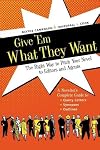
I died a little bit inside when I read this book. Yes, I should know better. When I write about self-publishing, the recurrent theme is that “publishing is a business.” And the goal of a business is to make money. (With a few exceptions, those being a selection of small presses that look to break even in order to present artistically valuable, non-commerical work.) The big however is that being an artist is not a business. Being an artist is about creating something new, a form, whether show more it be on stage, on the written page, or on a canvas. Then, once you’ve poured your heart into a work, you need to decide whether it’s publishable or salable, and if so to whom and how.
The problem with this book is that it never acknowledges the artist. By contrast, I recommend a book that covers the exact same strategies and advice as this one, but presents it in a way that understands the struggles of the writer. Read my review of The Sell Your Novel Tool Kit by Elizabeth Lyon for a more humane and broader examination of the process of finding an agent or publisher.
Even the title “Give ‘Em What They Want” makes me rather ill. How about, no, “Create What You Want and If They Don’t Like It Then Screw ‘Em, Do It Yourself.” I’m not being completely fair because for most writers the goal is to get published. Even so, the question becomes, how can you be true to your artistic aspirations and the commercial needs of a publishing house? What is a matter of integrity and what is a matter of respectable editing? Each writer needs to decide within their own conscience and by their own goals what is important to them. But this book acts like the be-all, end-all goal is to be published at all costs.
Here's a story from this book:
And that made me throw up a little in my mouth.
Some straightforward, decent tips in here for writing query letters, but I much preferred the presentation by Elizabeth Lyon. show less
The problem with this book is that it never acknowledges the artist. By contrast, I recommend a book that covers the exact same strategies and advice as this one, but presents it in a way that understands the struggles of the writer. Read my review of The Sell Your Novel Tool Kit by Elizabeth Lyon for a more humane and broader examination of the process of finding an agent or publisher.
Even the title “Give ‘Em What They Want” makes me rather ill. How about, no, “Create What You Want and If They Don’t Like It Then Screw ‘Em, Do It Yourself.” I’m not being completely fair because for most writers the goal is to get published. Even so, the question becomes, how can you be true to your artistic aspirations and the commercial needs of a publishing house? What is a matter of integrity and what is a matter of respectable editing? Each writer needs to decide within their own conscience and by their own goals what is important to them. But this book acts like the be-all, end-all goal is to be published at all costs.
Here's a story from this book:
Robert Walker…was nearly crushed when the synopsis for a book to be called Downfall got rejected. So he telephoned the editor and asked why he’d been turned down (something we usually advise against doing).
“Two reasons,” he remembers her replying. “We’re doing long books now, not short. Our novels have to be at least 80,000 words, and that leaves Downfall 20,000 words short....[and:] we’re full up on mysteries right now. What we really need is more horror scripts.”
“All right. Give me a contract, and I’ll add 20,000 words and put in a monster.”
She agreed, and Walker had a sale. That’s flexibility.”
And that made me throw up a little in my mouth.
Some straightforward, decent tips in here for writing query letters, but I much preferred the presentation by Elizabeth Lyon. show less
A marvelous book for learning how to pitch your book! And a great how-to in writing query letters, synopses and outlines. Provides loads of examples ... even how to rewrite the bad ones. It's an easy read and one I've gone back to more than a few times.
Good advice for first timers about formatting paper submissions and query letters. However, the section on email query versus snail mail query needs help! The same goes for the section with quotes from agents about what they're looking for. I have noticed over the years that generalizations about literary agents and the market are dangerous because we're talking about people and an industry that's all about "the exception." Also, I won't name names here, but the agent who claimed that email show more queries are effortless compared with paper submissions, so she doesn't take them as seriously really doesn't have a clue. Writing an effective e-query takes just as much time as writing an effective letter. The only steps the writer avoids are the trip to visit all the happy people at the post office and wasting paper and toner printing out a bunch of pages that may or may not ever be returned. As a writer, I have doubts about the idea of working with someone who has a bias against technophiles and who wants to do all their correspondence by snail mail. Yeck! I really don't understand the reasoning the agent used to determine the more effort/higher quality inquiry equation. Does she think manuscripts typed on a typewriter are superior to the ones written with a word processor? Sheesh. show less
Opportunities in Teaching English to Speakers of Other Languages (Opportunities In...Series) by Blythe Camenson
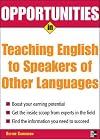
I am currently an M.Ed.-TESOL student, and found that this concise guide aligns very well with what I've already encountered. It is informative, well-organized, well-researched and written in an easy-to-read, even-handed tone.
While there are many similar titles out there, most are focused on teaching abroad. This book gives equal attention to opportunities in the U.S., Canada, and abroad. It also addresses TESOL-related non-teaching positions such as program directorships, administrative show more positions, etc. This means it is equally useful for new teachers just looking for their first job and experienced teachers who may want to leverage that experience to do something a little different while staying in the field. show less
While there are many similar titles out there, most are focused on teaching abroad. This book gives equal attention to opportunities in the U.S., Canada, and abroad. It also addresses TESOL-related non-teaching positions such as program directorships, administrative show more positions, etc. This means it is equally useful for new teachers just looking for their first job and experienced teachers who may want to leverage that experience to do something a little different while staying in the field. show less
You May Also Like


Statistics
- Works
- 53
- Also by
- 1
- Members
- 1,168
- Popularity
- #22,016
- Rating
- 3.1
- Reviews
- 10
- ISBNs
- 206