

Annalee Whitmore Fadiman (1916–2002)
Author of Thunder Out of China
Works by Annalee Whitmore Fadiman
Associated Works
Reporting World War II Part One : American Journalism, 1938-1944 (1995) — Contributor — 482 copies, 3 reviews
Tagged
Common Knowledge
- Canonical name
- Fadiman, Annalee Whitmore
- Other names
- Whitmore, Annalee (birth)
Fadiman, Annalee Jacoby - Birthdate
- 1916-05-27
- Date of death
- 2002-02-05
- Gender
- female
- Education
- Stanford University (BA|1937)
- Occupations
- scriptwriter
war correspondent - Organizations
- MGM
- Relationships
- Fadiman, Clifton (husband)
Fadiman, Anne (daughter) - Cause of death
- suicide
- Nationality
- USA
- Birthplace
- Price, Utah, USA
- Place of death
- Captiva, Florida, USA
- Associated Place (for map)
- USA
Members
Reviews

I found this book at a used book store and stashed it away on a shelf with several other books I was collecting about China. What a treasure of information this book turned out to be! Theodore White gives us the history of China's politics from the time of their revolution through WWII in a style that is informative, yet a page turner. His book includes many first hand observations of the situation in China during WWII, a perspective few Americans can offer. He was not a fan of the show more Communists or the Kuomintang, but rather a supporter of a middle ground, a federal union that would allow for Democracy in China. I'm so glad I found this book, and thrilled that it is now available via Kindle! If you are at all curious about China's history this is a MUST READ. show less
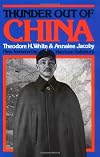
The biography of N. Eldon Tanner's (N. Eldon Tanner, his life and service) mentioned that this book was very meaningful to him. Therefore I became interested in it.
I read this book at the same time as The Righteous Mind: Why Good People are Divided by Politics and Religion. They both deal with politics and reading them at the same time I made a lot of connections that I might not have otherwise gotten.
There is a lot of history in here, and although it painted a very different picture than I show more had ever heard before, it felt credible. As I got into the last chapter or two, it began to feel more like a position paper. Unfortunately, the warning wasn't enough.
Written more than 50 years ago, the blunders described in here are common throughout history, and thus this book is still meaningful. I was impressed with the depth and to a lesser extent the breadth of coverage of China starting within the time of WWII, and continuing until about a year after Japan surrendered. I had hoped to learn how the Communists came to power, but as of the end of the book, it was about an equal match between them and the old government. I looked up what happened, and learned a little about what happened after the end of the book. http://en.wikipedia.org/wiki/Chinese_Civil_War
I have long wondered how the Chinese went from a millennium of being perhaps the greatest power on the earth to being a backward country. This book didn't directly address that question, but from having read it, I now have an intriguing piece of the puzzle filled in.
It gave enough information that now I have a rudimemtary understanding of why the Communists came into power. The abuse of the people was a continual scene throughout the book. Before reading this, I had little love for Communists and thought that Chiang Kai-shek was a "good guy". Now I have a much better feel for why the people found them attractive. Chiang Kai-shek had one "good" trait in that he was violently anti-Communist. On the other hand as an oppressive dictator who tolerated graft and corruption, he did not alleviate the suffering of the people. "Believing that corruption and a lack of morals were key reasons that the KMT lost mainland China to the Communists, Chiang attempted to purge corruption by dismissing members of the KMT accused of graft." (http://en.wikipedia.org/wiki/Chiang_Kai-shek)
If a person read and understood this book, they would have a good idea what not to do. Doing things right is a lot harder task, but understanding history is a good start. show less
I read this book at the same time as The Righteous Mind: Why Good People are Divided by Politics and Religion. They both deal with politics and reading them at the same time I made a lot of connections that I might not have otherwise gotten.
There is a lot of history in here, and although it painted a very different picture than I show more had ever heard before, it felt credible. As I got into the last chapter or two, it began to feel more like a position paper. Unfortunately, the warning wasn't enough.
Written more than 50 years ago, the blunders described in here are common throughout history, and thus this book is still meaningful. I was impressed with the depth and to a lesser extent the breadth of coverage of China starting within the time of WWII, and continuing until about a year after Japan surrendered. I had hoped to learn how the Communists came to power, but as of the end of the book, it was about an equal match between them and the old government. I looked up what happened, and learned a little about what happened after the end of the book. http://en.wikipedia.org/wiki/Chinese_Civil_War
I have long wondered how the Chinese went from a millennium of being perhaps the greatest power on the earth to being a backward country. This book didn't directly address that question, but from having read it, I now have an intriguing piece of the puzzle filled in.
It gave enough information that now I have a rudimemtary understanding of why the Communists came into power. The abuse of the people was a continual scene throughout the book. Before reading this, I had little love for Communists and thought that Chiang Kai-shek was a "good guy". Now I have a much better feel for why the people found them attractive. Chiang Kai-shek had one "good" trait in that he was violently anti-Communist. On the other hand as an oppressive dictator who tolerated graft and corruption, he did not alleviate the suffering of the people. "Believing that corruption and a lack of morals were key reasons that the KMT lost mainland China to the Communists, Chiang attempted to purge corruption by dismissing members of the KMT accused of graft." (http://en.wikipedia.org/wiki/Chiang_Kai-shek)
If a person read and understood this book, they would have a good idea what not to do. Doing things right is a lot harder task, but understanding history is a good start. show less
Old as it is this is essential reading for anyone wanting to understand the course and end of World War II in China. White was there. Widely read in the US at the time.White gives his evaluation at the end of the intentions of Russia and the US at the close of the war.
Rather Maoist but interesting as an account by a journalist who was in China at the time.
Awards

You May Also Like
Associated Authors
Statistics
- Works
- 1
- Also by
- 1
- Members
- 274
- Popularity
- #84,602
- Rating
- 4.3
- Reviews
- 5
- ISBNs
- 5