
Dan Kennedy (3)
Author of Little People: Learning to See the World Through My Daughter's Eyes
For other authors named Dan Kennedy, see the disambiguation page.
About the Author
Dan Kennedy is assistant professor of journalism at Northeastern University and has been a working journalist for nearly forty years. He currently contributes to the Huffington Post and the Nieman Journalism Lab. Follow Kennedy's Media Nation blog at www.dankennedy.net.
Works by Dan Kennedy
The Return of the Moguls: How Jeff Bezos and John Henry Are Remaking Newspapers for the Twenty-First Century (2018) 27 copies, 11 reviews
The Wired City: Reimagining Journalism and Civic Life in the Post-Newspaper Age (2013) 10 copies, 1 review
Tagged
Common Knowledge
Members
Reviews
The Return of the Moguls: How Jeff Bezos and John Henry Are Remaking Newspapers for the Twenty-First Century by Dan Kennedy
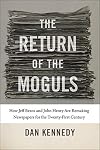
To which extent is there still a need for the printed press? The author, Dan Kennedy is a specialist in the study of Press organizations. He excels in describing the ownership of these organizations which in capitalist America, are products that one can buy and sell, often for futile reasons. But what makes a newspaper so unique from another product like a toothbrush?
The author contends that often wealthy individuals invest for various motives in a Newspaper organization but that one of show more their primary motivations is to be able to differentiate themselves from other Billionaires who do not own a Newspaper. Do they view this ownership as a challenge, in an age of declining circulation for print increasingly competed by digital? And do they have the will to reverse this trend while facing all the headwinds possible? Is it an ego trip like that of Orson Welles' character in the film "Citizen Kane"? Is it to compete in being the next successful Hamlet who will have proven how wrong they were? The author asserts that like the Greeting Cards, it will continue to exist in print but will expand its reach through digital platforms.
What I like about this study about the Press is that no matter which newspaper, the "Washington Post" or the "Boston Globe", or which support it opts for - print or digital - the fundamentals of how to run a newspaper have not changed.
Even as journalists were laid-off by the hundreds in the United States, working in a newspaper was, is and will be about "Vitam Impendere Vero." Jean-Paul Marat, a newspaper owner, demonstrated this during the French Revolution up and until he was assassinated in his bathtub by a female counter-revolutionary in 1793.
But if the existence of the modern Press is still dependent on divulging the Truth, then what happens when there is conflict about what the Truth is?
Are the news moguls like Jeff Bezos' ownership of the "Washington Post", and through their considerable wealth, capable of securing a Press organization's existence and, more importantly, its capacity of remonstrating to the highest authorities of the land. Can it still guarantee the independence necessary for the individual journalist which narrative of the facts opposes powerful pressure groups and vectors of public opinion like the Catholic Church, the NRA or even the Presidency of the United States? These are some of the questions answered by the "Return of the Moguls".
A well documented work that comforts you in knowing that next to Facebook or a shower of tweets, the modern human being can still take a pause in this wired existence to think about the good Press article he or she has just read. Another Newspaper owner, Benjamin Franklin, who had on October 2, 1729 purchased with a partner, Hugh Meredith, the "Pennsylvania Gazette" from Samuel Keimer, later commented in 1737: "Freedom of speech is a principal pillar of a free government; when this support is taken away, the constitution of a free society is dissolved, and tyranny is erected on its ruins. Republics…derive their strength and vigor from a popular examination into the action of the magistrates". This was true then and it is more than ever the Truth in this digital age. This book eloquently and convincingly vocalizes the tensions between a free Press and the Power which tries to limit its influence. show less
The author contends that often wealthy individuals invest for various motives in a Newspaper organization but that one of show more their primary motivations is to be able to differentiate themselves from other Billionaires who do not own a Newspaper. Do they view this ownership as a challenge, in an age of declining circulation for print increasingly competed by digital? And do they have the will to reverse this trend while facing all the headwinds possible? Is it an ego trip like that of Orson Welles' character in the film "Citizen Kane"? Is it to compete in being the next successful Hamlet who will have proven how wrong they were? The author asserts that like the Greeting Cards, it will continue to exist in print but will expand its reach through digital platforms.
What I like about this study about the Press is that no matter which newspaper, the "Washington Post" or the "Boston Globe", or which support it opts for - print or digital - the fundamentals of how to run a newspaper have not changed.
Even as journalists were laid-off by the hundreds in the United States, working in a newspaper was, is and will be about "Vitam Impendere Vero." Jean-Paul Marat, a newspaper owner, demonstrated this during the French Revolution up and until he was assassinated in his bathtub by a female counter-revolutionary in 1793.
But if the existence of the modern Press is still dependent on divulging the Truth, then what happens when there is conflict about what the Truth is?
Are the news moguls like Jeff Bezos' ownership of the "Washington Post", and through their considerable wealth, capable of securing a Press organization's existence and, more importantly, its capacity of remonstrating to the highest authorities of the land. Can it still guarantee the independence necessary for the individual journalist which narrative of the facts opposes powerful pressure groups and vectors of public opinion like the Catholic Church, the NRA or even the Presidency of the United States? These are some of the questions answered by the "Return of the Moguls".
A well documented work that comforts you in knowing that next to Facebook or a shower of tweets, the modern human being can still take a pause in this wired existence to think about the good Press article he or she has just read. Another Newspaper owner, Benjamin Franklin, who had on October 2, 1729 purchased with a partner, Hugh Meredith, the "Pennsylvania Gazette" from Samuel Keimer, later commented in 1737: "Freedom of speech is a principal pillar of a free government; when this support is taken away, the constitution of a free society is dissolved, and tyranny is erected on its ruins. Republics…derive their strength and vigor from a popular examination into the action of the magistrates". This was true then and it is more than ever the Truth in this digital age. This book eloquently and convincingly vocalizes the tensions between a free Press and the Power which tries to limit its influence. show less
 This review was written for LibraryThing Early Reviewers.
The Return of the Moguls: How Jeff Bezos and John Henry Are Remaking Newspapers for the Twenty-First Century by Dan Kennedy
The decline of newspapers began not with the arrival of the Internet but with the departure of the moguls, wealthy and powerful men like Joseph Pulitzer and William Randolph Hearst, and others even if not as famous, who built and guided their papers and helped them thrive. Eventually, as they died off, their proud newspapers fell into the hands of corporate newspaper chains committed more to profit than journalism.
So writes Dan Kennedy in a new book “The Return of the Moguls.” If moguls show more were the key to newspapers' past, he says, perhaps they are also the key to their future.
Kennedy's assessment of the fall of newspapers conforms with my own. I spent most of my career with The News Journal in Mansfield, Ohio, one of five mid-sized papers once owned by Harry Horvitz, a Cleveland millionaire who usually spent one day a week at each of his papers (four in Ohio and one in New York). In the 1980s Horvitz sold The News Journal to the Ingersoll chain, which then sold it to Thomson, after which it was sold to Gannett. Each chain paid a higher price for it and other papers in the group and, to maximize profits, found it necessary to cut both staff and content, leaving our newspaper just an echo of what it once was. Then came the Internet to give newspaper readers and advertisers an alternative.
Similar scenarios played out in communities large and small across the country. Yet newspapers are far from finished, Kennedy writes. Most of them remain profitable, their paper product much more so than their web pages, and most remain a vital source of news for their communities. They may still have a future, and that future, argues Kennedy, may like their past depend upon newspaper moguls, individual owners with big bank accounts and a commitment to quality journalism.
He mentions several but focuses primarily on three: Aaron Kushner, who tried but quickly failed at the Orange County Register; John Henry, who has been doing exciting things at the Boston Globe; and especially Jeff Bezos, with his Amazon fortune behind him, bringing hope (and lots of new technology) to the Washington Post.
If newspapers are to survive, Kennedy thinks it may depend upon the deep pockets of moguls like these who will support their papers' experimentation to find ways to bring back both subscribers and advertisers. Other newspapers across the country will be watching closely, ready to quickly copy any strategy that works. show less
So writes Dan Kennedy in a new book “The Return of the Moguls.” If moguls show more were the key to newspapers' past, he says, perhaps they are also the key to their future.
Kennedy's assessment of the fall of newspapers conforms with my own. I spent most of my career with The News Journal in Mansfield, Ohio, one of five mid-sized papers once owned by Harry Horvitz, a Cleveland millionaire who usually spent one day a week at each of his papers (four in Ohio and one in New York). In the 1980s Horvitz sold The News Journal to the Ingersoll chain, which then sold it to Thomson, after which it was sold to Gannett. Each chain paid a higher price for it and other papers in the group and, to maximize profits, found it necessary to cut both staff and content, leaving our newspaper just an echo of what it once was. Then came the Internet to give newspaper readers and advertisers an alternative.
Similar scenarios played out in communities large and small across the country. Yet newspapers are far from finished, Kennedy writes. Most of them remain profitable, their paper product much more so than their web pages, and most remain a vital source of news for their communities. They may still have a future, and that future, argues Kennedy, may like their past depend upon newspaper moguls, individual owners with big bank accounts and a commitment to quality journalism.
He mentions several but focuses primarily on three: Aaron Kushner, who tried but quickly failed at the Orange County Register; John Henry, who has been doing exciting things at the Boston Globe; and especially Jeff Bezos, with his Amazon fortune behind him, bringing hope (and lots of new technology) to the Washington Post.
If newspapers are to survive, Kennedy thinks it may depend upon the deep pockets of moguls like these who will support their papers' experimentation to find ways to bring back both subscribers and advertisers. Other newspapers across the country will be watching closely, ready to quickly copy any strategy that works. show less
This review was written for LibraryThing Early Reviewers.The Return of the Moguls: How Jeff Bezos and John Henry Are Remaking Newspapers for the Twenty-First Century by Dan Kennedy
A very important and timely examination into the newspaper industry in general, and three titles - The Washington Post, the Orange County Register, and the Boston Globe - in particular. The pace and magnitude of the changes facing this industry are considered by Northeastern University professor and former Guardian media editor, Dan Kennedy. Each of the newspapers he guides us through share common characteristics, but the thread Kennedy pursues in depth is their ownership by private show more individuals – the “Moguls” of the title.
The traditional business model of the newspaper industry has been, and continues to be, radically transformed in the Internet and mobile era. In this unprecedented environment of ‘alternate facts’ and ‘fake news’, dominated by a president who considers the media 'the enemy of the people', trusted news sources are more vital than ever in holding those in power accountable. The pressure on newspapers to produce quality but affordable journalism and a trusted source of local, national and international news is intensifying. Arguably, without the intervention of public-spirited owners like Jeff Bezos and John Henry, we would have fewer choices in news, given the decline of print (and associated advertising revenue) and the pressure on rising production costs. At it’s heart, says Kennedy, the challenge facing the newspaper of 2018 is “the failure of digital advertising to offset the decline of print advertising”. The author then analyzes and evaluates the emergence of digital news through subscriptions, evaluating the paywall business model. He focuses on the rapidly evolving ways in which we consume news, with the distractions of social media and ‘hyperlexia’. While Bezos’ stewardship of the Post, and Henry’s of the Globe, are success stories in an industry beset by transformational change, the same could not be said of the Register experience under Aaron Kushner. Kennedy’s treatment of the Kushner era in Orange County is even-handed and empathetic, but the facts of his failed enterprise are clear to all. This was clearly a decision ruled by the heart and not the head. It’s hard to fault the intent, however adverse the impact on the journalists and readership.
As an alternative to the ‘mogul’ experience, Kennedy also examines the corporate newspaper business model. His description of the woes of the Chicago Tribune, the LA Times and Philadelphia Inquirer are both enjoyable and instructional. It prompted me to follow up on each, and it’s here that Kennedy’s book could have been more comprehensive. A bibliography would have been valuable; while there are thorough notes and references, suggestions for further reading would have added value to my experience. I was confused by the short story about the Burlington [Vermont] Free Press; Kennedy asserts that the Press’ peak circulation was “nearly 50,000” in a “small place…of 42,000 [population]”. Either that’s incorrect, or the denizens of Burlington VT are news junkies of a unique disposition. Finally, it would have been helpful to see data on market share by readership through print/subscription across the US and in turn, to insert a chart detailing the state of play for newspaper ownership (and perhaps, political orientation) in all of the major metro markets.
One of the great pleasures in life is to sit down with a newspaper that you trust, to take the time to absorb the news and the way in which it’s presented, and to branch off into supplements like sport, books, travel or cookery. I have a lifelong love of newspapers and have happily paid to subscribe to two or three I particularly like and – crucially – trust. ‘The Return of the Moguls’ is a sensitive and pragmatic insight into how the needs of consumers like me might be met in future. Dan Kennedy’s book whetted my appetite to read more deeply into the newspaper industry, and that’s a great compliment to The Return of the Moguls. This is an enjoyable and important book, published at an opportune time, and I’d highly recommend it to anyone who cherishes our free press and how we might interact with it in future.
Disclaimer: I received a copy in return for an impartial review through LibraryThing’s Early Reviewers program. show less
The traditional business model of the newspaper industry has been, and continues to be, radically transformed in the Internet and mobile era. In this unprecedented environment of ‘alternate facts’ and ‘fake news’, dominated by a president who considers the media 'the enemy of the people', trusted news sources are more vital than ever in holding those in power accountable. The pressure on newspapers to produce quality but affordable journalism and a trusted source of local, national and international news is intensifying. Arguably, without the intervention of public-spirited owners like Jeff Bezos and John Henry, we would have fewer choices in news, given the decline of print (and associated advertising revenue) and the pressure on rising production costs. At it’s heart, says Kennedy, the challenge facing the newspaper of 2018 is “the failure of digital advertising to offset the decline of print advertising”. The author then analyzes and evaluates the emergence of digital news through subscriptions, evaluating the paywall business model. He focuses on the rapidly evolving ways in which we consume news, with the distractions of social media and ‘hyperlexia’. While Bezos’ stewardship of the Post, and Henry’s of the Globe, are success stories in an industry beset by transformational change, the same could not be said of the Register experience under Aaron Kushner. Kennedy’s treatment of the Kushner era in Orange County is even-handed and empathetic, but the facts of his failed enterprise are clear to all. This was clearly a decision ruled by the heart and not the head. It’s hard to fault the intent, however adverse the impact on the journalists and readership.
As an alternative to the ‘mogul’ experience, Kennedy also examines the corporate newspaper business model. His description of the woes of the Chicago Tribune, the LA Times and Philadelphia Inquirer are both enjoyable and instructional. It prompted me to follow up on each, and it’s here that Kennedy’s book could have been more comprehensive. A bibliography would have been valuable; while there are thorough notes and references, suggestions for further reading would have added value to my experience. I was confused by the short story about the Burlington [Vermont] Free Press; Kennedy asserts that the Press’ peak circulation was “nearly 50,000” in a “small place…of 42,000 [population]”. Either that’s incorrect, or the denizens of Burlington VT are news junkies of a unique disposition. Finally, it would have been helpful to see data on market share by readership through print/subscription across the US and in turn, to insert a chart detailing the state of play for newspaper ownership (and perhaps, political orientation) in all of the major metro markets.
One of the great pleasures in life is to sit down with a newspaper that you trust, to take the time to absorb the news and the way in which it’s presented, and to branch off into supplements like sport, books, travel or cookery. I have a lifelong love of newspapers and have happily paid to subscribe to two or three I particularly like and – crucially – trust. ‘The Return of the Moguls’ is a sensitive and pragmatic insight into how the needs of consumers like me might be met in future. Dan Kennedy’s book whetted my appetite to read more deeply into the newspaper industry, and that’s a great compliment to The Return of the Moguls. This is an enjoyable and important book, published at an opportune time, and I’d highly recommend it to anyone who cherishes our free press and how we might interact with it in future.
Disclaimer: I received a copy in return for an impartial review through LibraryThing’s Early Reviewers program. show less
This review was written for LibraryThing Early Reviewers.The Return of the Moguls: How Jeff Bezos and John Henry Are Remaking Newspapers for the Twenty-first Century by Dan Kennedy

Kennedy provides a thorough look at the modern newspaper industry through the ownerships of John Henry, of the Boston Red Sox, and Jeff Bezos, of Amazon, as well as one that isn’t mentioned on the cover: entrepreneur Aaron Kushner. Kushner’s is probably the most interesting story with his failed attempts to buy various papers before finally buying the Orange County Register, and the troubles with that paper.
This review was written for LibraryThing Early Reviewers.You May Also Like
Associated Authors
Statistics
- Works
- 3
- Members
- 70
- Popularity
- #248,178
- Rating
- 3.6
- Reviews
- 13
- ISBNs
- 81
- Languages
- 1
- Favorited
- 1
