
Ivan I. Bilibin (1876–1942)
Author of Russian Fairy Tales
About the Author
Works by Ivan I. Bilibin
Sister Alyonushka and Brother Ivanushka / The White Duck (1978) — Illustrator — 42 copies, 3 reviews
Associated Works
Off with Their Heads! Fairy Tales and the Culture of Childhood (1992) — Cover artist, some editions — 228 copies, 2 reviews
The Great Composers and their Music : 36 : Rimsky-Korsakov : Scheherazade {magazine} (1984) — Illustrator — 1 copy
Charles le téméraire — Illustrator — 1 copy
Tagged
Common Knowledge
- Canonical name
- Bilibin, Ivan I.
- Legal name
- Bilibin, Ivan Jakovlevic
- Other names
- Bilibin, Ivan I︠A︡kovlevich
- Birthdate
- 1876-08-04
- Date of death
- 1942-02-07
- Education
- Anton Ažbe Art School, Munich, Germany
- Occupations
- painter
illustrator
Stage Designer - Relationships
- Ažbe, Anton (teacher)
Repin, Ilya (teacher)
Chambers, Mary (wife) - Short biography
- Ivan Yakovlevich Bilibin (Russian: Ива́н Я́ковлевич Били́бин) was a 20th-century Russian illustrator and stage designer who took part in the Mir iskusstva movement and contributed to the Ballets Russes. He co-founded the Union of Russian Painters, and from 1937 was a member of the Artists' Union of the USSR.
Born in 1876 in St. Petersburg, in 1898 Bilibin studied at the Anton Ažbe Art School in Munich, where he was heavily influenced by Art Nouveau and the German satirical journal Simplicissimus, and then under Ilya Repin in St. Petersburg. After graduating in May 1901 he went to Munich, where he completed his training with the painter Anton Ažbe. In 1902-1904 Bilibin travelled in the Russian North, where he became fascinated with old wooden architecture and Russian folklore. He published his findings in the monograph Folk Arts of the Russian North in 1904.
Bilibin gained renown in 1899, when he released his illustrations of Russian fairy tales. His satirical cartoon work, during the Russian Revolution of 1905, was controversial, due to his depiction of the Tsar as a donkey. After the October Revolution in 1917, Bilibin left Russia for a number of years, settling and working in Egypt. He returned to Soviet Russia in 1936, and died of starvation during the Siege of Leningrad in 1942.
(source: Wikipedia) - Nationality
- Russia (birth)
- Birthplace
- Tarchovka, Russian Empire
- Places of residence
- Cairo, Egypt
Alexandria, Egypt
Paris, France - Place of death
- Leningrad, Russia, USSR
- Map Location
- Russia
Members
Reviews
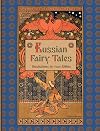
This book contains five Russian fairy tales and features a couple of quintessential characters: the Baby Yaga, living in her hut on hens' legs, and the firebird. While there are echoes to the collected tales by the brothers Grimm, I don't believe that these stories were modelled after them, as one reviewer remarked; I think that some of these tales represent archetypal stories that have their roots in the deep past, when they were shared around campfires and travelled vast distances, and show more then evolved into the recognisable tales we find today, albeit with local and regional variations.
Three of the stories ('Vasilisa the Beautiful', 'The Feather of Finist the Falcon' and 'The Frog-Tsarevna') offer a commendable variation to most fairy tales: they have as their main character a woman, whereas the man is very much on the sidelines and has to be rescued or assisted, if he appears at all. The latter two tales made a very deep impression on me when I was growing up, and I still remembered a couple of plot points more than thirty years later!
As some reviewers have already mentioned, the illustrations by Ivan Bilibin are stunning: intricate, highly detailed, atmospheric and very colourful, they enhance the stories no end and provide a flavour of Russian folklore and culture. show less
Three of the stories ('Vasilisa the Beautiful', 'The Feather of Finist the Falcon' and 'The Frog-Tsarevna') offer a commendable variation to most fairy tales: they have as their main character a woman, whereas the man is very much on the sidelines and has to be rescued or assisted, if he appears at all. The latter two tales made a very deep impression on me when I was growing up, and I still remembered a couple of plot points more than thirty years later!
As some reviewers have already mentioned, the illustrations by Ivan Bilibin are stunning: intricate, highly detailed, atmospheric and very colourful, they enhance the stories no end and provide a flavour of Russian folklore and culture. show less

When Vassilisa's cruel stepmother and stepsisters send her into the forest to seek a light from the terrible witch Baba Yaga, the brave young girl must rely upon her magical doll - given to her by her mother - for help. Successfully completing the impossible tasks set for her, Vassilisa is sent home by Baba Yaga, who informs her: "People like you have no business to be here at all." After the terrible punishment meted out to her step-family by the witch's light, Vassilisa's cloth-making soon show more brings her to the attention of the Tsar...
Part of a collection of tales retold by poet and folklorist Alexandr Pushkin, Vassilisa the Beautiful is another fairytale featuring the incredible Baba Yaga, a seminal figure in Russian folk culture. The description of her eerie hut, with its gruesome gate of human bones, lit by skull-lanterns, is not easily forgotten. But for all her terrifying appearance, Baba Yaga is an ambivalent character, who almost never harms the pure and virtuous...
This retelling, published in the former Soviet Union in the 1970s, includes Ivan Bilibin's fantastic folk-motif artwork. His depiction of Baba Yaga's three riders - the white horseman to usher in the "Bright Day", the red one to herald the "Radiant Sun," and the black one to bring the "Dark Night" - are particularly powerful. I love to collect and compare various retellings of the same tale, and there is no question that Ivan Bilibin's illustrations are among my favorites. Another rendition of this tale that the reader might want to examine is Baba Yaga and Vasilisa the Brave, retold by Marianna Mayer, and illustrated by the marvelous Kinuko Craft. Both are excellent, in their way. show less
Part of a collection of tales retold by poet and folklorist Alexandr Pushkin, Vassilisa the Beautiful is another fairytale featuring the incredible Baba Yaga, a seminal figure in Russian folk culture. The description of her eerie hut, with its gruesome gate of human bones, lit by skull-lanterns, is not easily forgotten. But for all her terrifying appearance, Baba Yaga is an ambivalent character, who almost never harms the pure and virtuous...
This retelling, published in the former Soviet Union in the 1970s, includes Ivan Bilibin's fantastic folk-motif artwork. His depiction of Baba Yaga's three riders - the white horseman to usher in the "Bright Day", the red one to herald the "Radiant Sun," and the black one to bring the "Dark Night" - are particularly powerful. I love to collect and compare various retellings of the same tale, and there is no question that Ivan Bilibin's illustrations are among my favorites. Another rendition of this tale that the reader might want to examine is Baba Yaga and Vasilisa the Brave, retold by Marianna Mayer, and illustrated by the marvelous Kinuko Craft. Both are excellent, in their way. show less

Beautifully illustrated (by Ivan Bilibin, which is oddly not mentioned in this edition) translation of a Russian fairy tale analogous to the more familiar (in the West) Norwegian "East of the Sun, West of the Moon," but more dissimilar from the Cupid & Psyche myth. "Fenist" is more straightforwardly moral than "East" - I find the redemptive storyline of "East," where the heroine's own curiosity is responsible for her separation from her lover, both more troubling and more interesting - but show more features the bonus of Baba Yaga appearing as a helpful witch. With regard to the rich, woodsy illustrations, I can't help noting if I had read this version as a child, I would only have been disappointed that the book didn't end with a picture of the reunited couple (elaborately dressed, of course!) at their wedding. show less
These tales are very similar in nature to the Grimm Fairy Tales. Since they were modeled after the Grimm Fairy Tales, I guess this can be expected. Really entertaining if you're into dark stories. There is a stronger streak of feminism than the Grimm fairy tales with more autonomy and independence for women in stories such as The Death of Koschei the Deathless.
Lists
Awards


You May Also Like


Associated Authors
Statistics
- Works
- 28
- Also by
- 16
- Members
- 840
- Popularity
- #30,424
- Rating
- 4.0
- Reviews
- 24
- ISBNs
- 66
- Languages
- 11
