

Aswath Damodaran
Author of Investment Valuation: Tools and Techniques for Determining the Value of Any Asset, Second Edition
About the Author
Aswath Damodaran is Professor of Finance at New York University's Leonard N. Stern School of Business
Image credit: Copyright © Prof Aswath Damodaran. All rights reserved.
Works by Aswath Damodaran
Investment Valuation: Tools and Techniques for Determining the Value of Any Asset, Second Edition (1995) 243 copies, 2 reviews
The Little Book of Valuation: How to Value a Company, Pick a Stock and Profit (2011) 153 copies, 1 review
Narrative and Numbers: The Value of Stories in Business (Columbia Business School Publishing) (2017) 76 copies, 2 reviews
Investment Philosophies: Successful Investment Philosophies and the Greatest Investors Who Made Them Work (2003) 49 copies
Damodaran on Valuation, Study Guide: Security Analysis for Investment and Corporate Finance (Wiley Professional Banking (1994) 12 copies
Valuation. Como Avaliar Empresas e Escolher as Melhores Ações (Em Portuguese do Brasil) (2012) 8 copies
Tagged
Common Knowledge
- Birthdate
- 1957
- Gender
- male
- Education
- Madras University (B.Com)
Indian Institute of Management, Bangalore (MS)
University of California, Los Angeles (MBA, PhD) - Occupations
- Professor of Finance, New York University
- Nationality
- India (birth)
- Associated Place (for map)
- India
Members
Reviews
Narrative and Numbers: The Value of Stories in Business (Columbia Business School Publishing) by Aswath Damodaran
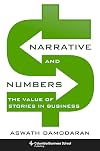
Professor Damodaran basically holds that narrative and numbers are linked: The founder needs a story to justify his valuation, and the publicist needs numbers to validate her pitch. Quants will enjoy Damodaran's portfolio manager approach, judging from the sharp-pencil references to Tufte and Bayes in the margins of my borrowed copy. Still, communicators who can handle a bit of MBA-level analysis can learn a lot from his observations. A forecast can be imprecise yet accurate (reading this in show more 2020, I thought about Bill Gates warning of a once-in-a-century pathogen). A market can grow only so big, and one brand gets only a share of it. VCs and value investors have different outlooks on growth. Corporate news is better framed around assets rather than earnings (would accountants agree?). Often the economy's in charge, not the boardroom. Startups have more room for narrative than mature companies. Finally, CEOs should stick to their story and act accordingly to reach a satisfying conclusion. show less
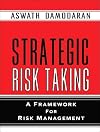
Too many of the books I have read on risk deal with the subject as something to be avoided.
Risk, properly assessed and entered into with open eyes, is essential to business and investing success. In Strategic Risk Taking: A Framework for Risk Management, Aswath Damodaran covers both sides. He offers a framework to limit some risks and exploit others.
The New York University finance professor draws a thorough portrait of risk measurement, hedging, and mitigation. He discusses the broad range show more of risk assessment tools, including risk adjusted value, scenario analysis, decision trees, VAR, and real options. Damodaran goes further. His discussion of when to increase risk exposure is insightful and rarely found in risk management texts.
Damodaran argues there are 10 principles that should govern all risk assessment and management. Risk:
1. Is everywhere.
2. Is threat and opportunity.
3. Evokes mixed feelings about its existence.
4. Is not created equal.
5. Is measurable.
6. Measurement and assessment leads to better decisions.
7. Should be apportioned. The key to risk management is deciding which risks to avoid, to pass through and to exploit.
8. Management results in value creation.
9. Management is everyone’s job.
10. Taking organizations that are successful do not arrive there by accident.
Simply put, this is the most complete treatment of risk I have read. Proper implementation of its principles will help readers drive increased returns and value. show less
Risk, properly assessed and entered into with open eyes, is essential to business and investing success. In Strategic Risk Taking: A Framework for Risk Management, Aswath Damodaran covers both sides. He offers a framework to limit some risks and exploit others.
The New York University finance professor draws a thorough portrait of risk measurement, hedging, and mitigation. He discusses the broad range show more of risk assessment tools, including risk adjusted value, scenario analysis, decision trees, VAR, and real options. Damodaran goes further. His discussion of when to increase risk exposure is insightful and rarely found in risk management texts.
Damodaran argues there are 10 principles that should govern all risk assessment and management. Risk:
1. Is everywhere.
2. Is threat and opportunity.
3. Evokes mixed feelings about its existence.
4. Is not created equal.
5. Is measurable.
6. Measurement and assessment leads to better decisions.
7. Should be apportioned. The key to risk management is deciding which risks to avoid, to pass through and to exploit.
8. Management results in value creation.
9. Management is everyone’s job.
10. Taking organizations that are successful do not arrive there by accident.
Simply put, this is the most complete treatment of risk I have read. Proper implementation of its principles will help readers drive increased returns and value. show less
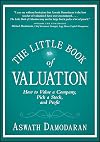
Clearly I'm not up to the level of this book; there's lots I still have to learn about this business and I do plan to revisit this book after I get a better hold on this subject.
Having said, I did learn quite a few things about valuation - intrinsic vs relative, being the main categories there are towards the valuation of a company. The author explanation about how banks, tech/pharma and manufacturing companies are all very different types of companies.
But after doing for some accounting show more practices (honestly, I didn't understand what those were), apparently, they're all on the same field and the value of any company rests on three ingredients: cash flows from existing assets, the expected growth in these cash flows, and the discount rate / uncertainty that reflects the risk in those cash flows.
The core of the book seemed to be about Discounted Cash Flow - again one of those things that I'd like a book that teaches DCF from the very basics.
Giving a 5-star since this book definitely taught me some things and I'm encouraged to learn more about it. show less
Having said, I did learn quite a few things about valuation - intrinsic vs relative, being the main categories there are towards the valuation of a company. The author explanation about how banks, tech/pharma and manufacturing companies are all very different types of companies.
But after doing for some accounting show more practices (honestly, I didn't understand what those were), apparently, they're all on the same field and the value of any company rests on three ingredients: cash flows from existing assets, the expected growth in these cash flows, and the discount rate / uncertainty that reflects the risk in those cash flows.
The core of the book seemed to be about Discounted Cash Flow - again one of those things that I'd like a book that teaches DCF from the very basics.
Giving a 5-star since this book definitely taught me some things and I'm encouraged to learn more about it. show less
Excellent merger of numbers and stories.
This is a great recap of how words and numbers make a compelling investment thesis. It provides a structure for both types of analysis.
This is a great recap of how words and numbers make a compelling investment thesis. It provides a structure for both types of analysis.
You May Also Like


Statistics
- Works
- 32
- Members
- 1,048
- Popularity
- #24,587
- Rating
- 3.8
- Reviews
- 6
- ISBNs
- 119
- Languages
- 11
- Favorited
- 1