
Charles Bracelen Flood (1929–2014)
Author of Grant and Sherman: The Friendship That Won the Civil War
About the Author
Charles Bracelen Flood is the author of twelve previous books, including the bestselling Lee: The Last Years and Grant and Sherman, which Salon com named one of the "Top 12 Civil War Books Ever Written." He is a past president of PEN American Center and has served on the governing bodies of the show more Authors League and the Authors Guild. Rood and his wife, Katherine, live in Richmond, Kentucky. show less
Image credit: Laura Wolfrom
Works by Charles Bracelen Flood
First to Fly: The Story of the Lafayette Escadrille, the American Heroes Who Flew For France in World War I (2015) 62 copies, 3 reviews
A distant drum 4 copies
Associated Works
Tagged
Common Knowledge
- Birthdate
- 1929
- Date of death
- 2014-08-14
- Gender
- male
- Education
- Harvard University (BA)
- Occupations
- novelist
reporter
biographer - Nationality
- USA
- Birthplace
- Manhattan, New York, USA
- Places of residence
- Richmond, Kentucky, USA
- Associated Place (for map)
- USA
Members
Reviews
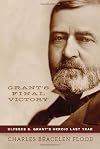
This book is not about Grant’s military campaigns; rather, it concerns his struggle to finish his still-celebrated memoirs before cancer killed him, so that his wife and children would have an income after he died. It is also a love story: about how so many people adored Grant for his goodness and unwavering trust in them. This made him, tragically, an easy mark for the many who would exploit that trust, but provided enduring inspiration for those who deserved it. At the end of the book, show more when the author describes how a bugler playing taps at Grant’s tomb caused General William Tecumseh Sherman to begin sobbing, I was sobbing right there with him.
Grant was diagnosed with cancer of the tongue and throat in 1884. (Remarkably, considering the long hold tobacco has had on this country, Grant’s doctors quite quickly and confidently attributed the affliction to Grant’s life-long cigar habit.) At the time, Grant and his family were newly impecunious, following a huge financial swindle by his partners in an investment firm. All of Grant’s family had invested there also. It turned out Grant didn’t even own his house; one of his partner’s had offered to take care of the purchase, but had taken the money instead. Grant was furious; he had trusted these men, just as he had trusted so many in his presidential administration who also had succumbed to venality and graft. Grant, throughout his life, conducted his affairs as he had led the Union Army; he found men he thought worthy, delegated tasks to them, and then counted on them to carry out his directives. But too many men lacked Grant’s moral strength. In the end, Grant had no choice but to take care of his affairs on his own.
For the last year of his life, Grant struggled to put together a two-volume memoir that would prevent his family from financial ruin. He was in immense pain and eventually had a tumor the size of “two fists put together” on the side of his throat. He wrote that he was plagued by hemorrhaging, strangulation, and exhaustion. Nevertheless, he carried on valiantly. Three days after he was done, and months after the doctors thought he couldn’t live another day, he finally let go.
Grant was originally to publish his memoirs with Robert Underwood Johnson, but Mark Twain offered him better terms, and he went with Twain. Nevertheless, he remained on good terms with Johnson and prepared four articles for him that final year in addition to working on his book. Johnson came to see Grant shortly before his death, and later wrote:
"I could hardly keep back the tears as I made my farewell to the great soldier who saved the Union for all its people and to the man of warm and courageous heart who had fought his last long battle for those he so tenderly loved.”
Grant had been heralded for personal bravery in the Mexican War, leading attacks at San Cosme and moving soldiers across the cholera-infested Isthmus of Panama. And of course his valor in the Civil War is more widely known. But those who watched him in his final year contend that his bravest act of all was his perseverance and shear determination to stay alive until his memoir was in place for his family’s future. As one clergyman later said, “the sight of Grant at work while in pain was the finest sermon at which he had ever been present.”
Discussion: Grant was a remarkable figure whose generosity of spirit was rivaled only by Lincoln’s. Following “his simple, gracious, generous treatment of Robert E. Lee and his men at Appomattox Court House,” for the rest of his life Lee never allowed a negative word to be said about Grant in his presence. One of Lee’s great generals, James Longstreet (who also happened to be Julia Grant’s cousin and had been Grant’s best man at his wedding to Julia), remarked at Grant’s death:
"He was the truest as well as the bravest man who ever lived. … Grant was a modest man, a simple man, a man believing in the honesty of his fellows, true to his friends, faithful to traditions, and of great personal honor.”
There is a wonderful story in the book about how both former Federals and Confederates in Congress worked to get Grant’s military pension reinstated (he had to forfeit it when he became U.S. President), even physically turning back the clock in the U.S. Capitol before Congress adjourned so that the bill could be passed before Congress got dismissed.
Both Union and Confederate former generals served as pallbearers.
Evaluation: Although this is a work of nonfiction, under the able hands of the entertaining historian Charles Bracelen Flood, this book is a page-turner that has you not only reaching for the Kleenex box, but aching to get to Grant’s memoir itself, which has been lauded as one of the finest presidential memoirs ever written. (Mark Twain wrote, "General Grant's book is a great, unique, and unapproachable literary masterpiece.") I didn’t really see this book as a hagiography; it's really meant to be an examination of Grant's last year, taken at face value. From historical biographies, we know that Grant was human, and a man of his times. In other words, he had his flaws as do most people. But like Lincoln, he was also a man who could transcend his times and rise above them. I don’t think you can come away from this book with many negative impressions about the last year, at any rate, of one of our greatest public figures. show less
Grant was diagnosed with cancer of the tongue and throat in 1884. (Remarkably, considering the long hold tobacco has had on this country, Grant’s doctors quite quickly and confidently attributed the affliction to Grant’s life-long cigar habit.) At the time, Grant and his family were newly impecunious, following a huge financial swindle by his partners in an investment firm. All of Grant’s family had invested there also. It turned out Grant didn’t even own his house; one of his partner’s had offered to take care of the purchase, but had taken the money instead. Grant was furious; he had trusted these men, just as he had trusted so many in his presidential administration who also had succumbed to venality and graft. Grant, throughout his life, conducted his affairs as he had led the Union Army; he found men he thought worthy, delegated tasks to them, and then counted on them to carry out his directives. But too many men lacked Grant’s moral strength. In the end, Grant had no choice but to take care of his affairs on his own.
For the last year of his life, Grant struggled to put together a two-volume memoir that would prevent his family from financial ruin. He was in immense pain and eventually had a tumor the size of “two fists put together” on the side of his throat. He wrote that he was plagued by hemorrhaging, strangulation, and exhaustion. Nevertheless, he carried on valiantly. Three days after he was done, and months after the doctors thought he couldn’t live another day, he finally let go.
Grant was originally to publish his memoirs with Robert Underwood Johnson, but Mark Twain offered him better terms, and he went with Twain. Nevertheless, he remained on good terms with Johnson and prepared four articles for him that final year in addition to working on his book. Johnson came to see Grant shortly before his death, and later wrote:
"I could hardly keep back the tears as I made my farewell to the great soldier who saved the Union for all its people and to the man of warm and courageous heart who had fought his last long battle for those he so tenderly loved.”
Grant had been heralded for personal bravery in the Mexican War, leading attacks at San Cosme and moving soldiers across the cholera-infested Isthmus of Panama. And of course his valor in the Civil War is more widely known. But those who watched him in his final year contend that his bravest act of all was his perseverance and shear determination to stay alive until his memoir was in place for his family’s future. As one clergyman later said, “the sight of Grant at work while in pain was the finest sermon at which he had ever been present.”
Discussion: Grant was a remarkable figure whose generosity of spirit was rivaled only by Lincoln’s. Following “his simple, gracious, generous treatment of Robert E. Lee and his men at Appomattox Court House,” for the rest of his life Lee never allowed a negative word to be said about Grant in his presence. One of Lee’s great generals, James Longstreet (who also happened to be Julia Grant’s cousin and had been Grant’s best man at his wedding to Julia), remarked at Grant’s death:
"He was the truest as well as the bravest man who ever lived. … Grant was a modest man, a simple man, a man believing in the honesty of his fellows, true to his friends, faithful to traditions, and of great personal honor.”
There is a wonderful story in the book about how both former Federals and Confederates in Congress worked to get Grant’s military pension reinstated (he had to forfeit it when he became U.S. President), even physically turning back the clock in the U.S. Capitol before Congress adjourned so that the bill could be passed before Congress got dismissed.
Both Union and Confederate former generals served as pallbearers.
Evaluation: Although this is a work of nonfiction, under the able hands of the entertaining historian Charles Bracelen Flood, this book is a page-turner that has you not only reaching for the Kleenex box, but aching to get to Grant’s memoir itself, which has been lauded as one of the finest presidential memoirs ever written. (Mark Twain wrote, "General Grant's book is a great, unique, and unapproachable literary masterpiece.") I didn’t really see this book as a hagiography; it's really meant to be an examination of Grant's last year, taken at face value. From historical biographies, we know that Grant was human, and a man of his times. In other words, he had his flaws as do most people. But like Lincoln, he was also a man who could transcend his times and rise above them. I don’t think you can come away from this book with many negative impressions about the last year, at any rate, of one of our greatest public figures. show less

This terrific recent contribution to Lincolniana manages to convey reverence for Lincoln without falling into the tempting trap of hagiography that so often characterizes books on Lincoln. Furthermore, although it’s a story familiar to many, Flood tells it in a most entertaining way, from a refreshingly objective perspective.
Flood has said in interviews that he believes there are only two years in American history that are absolutely critical, pivotal years: The first was 1776 and the show more second was 1864. This last full year of Lincoln’s life wrenched the President and the public from one end of the emotional spectrum to the other: for a while it looked like the North had lost the Civil War, as disasters and dead bodies mounted on the battlefields. Then Sherman took Atlanta followed by Savannah, and Sheridan tamed and reclaimed the Shenandoah Valley. Similarly, Lincoln’s prospects for winning a second term went from absolutely zero to overwhelmingly positive. And throughout this entire whip ride, Lincoln was manipulating everything and everybody he could, behind the scenes.
A little background: the Civil War started just five weeks after Lincoln’s first inauguration on March 4, 1861. By 1864, close to a million Union soldiers faced 700,000 Confederates. Also by that year, some quarter million Union soldiers were already lost from all causes. In addition, more than 100,000 had deserted.
Politics in the North was mainly divided into four camps: the “conservative” Republicans who supported Lincoln’s approach; the “Radicals” who thought Lincoln was too conciliatory toward the South; the “Peace Democrats” who wanted immediate peace negotiations and compromise with the South; and the “War Democrats” who were willing to keep fighting but did not care about the status of the slaves.
1864 was the year of some huge battles, including the Wilderness Campaign and Cold Harbor, in Virginia. The stories Flood tells about these battles are just awe-inspiring, even if you’ve heard them before! In one instance, Lee rode up in front of his troops to spur them on, and it took three men to wrestle him back to safety. Sheridan too, at Cedar Creek, rallied his retreating men when he “soared above the barricade on his massive black horse, landing in an open area. Wheeling [his horse] Rienzi around where his soldiers could see him for a hundred yards in either direction, he bellowed, "‘Men, by God, we’ll whip ‘em yet!” We’ll sleep in our old tents tonight!” And they did. In Cold Harbor, one soldier wrote in his diary: “June 3. Cold Harbor. I was killed.” The diary was found on his body. In mid-July, when D.C. was in danger of attack by the Confederates and Grant’s army was far away, some 2,800 wounded solders left their hospital beds to march to Fort Stevens, north of Washington. As Flood reports, “Many limped and most had bandages somewhere on their bodies, but they all carried muskets.”
Lincoln’s desire to get reelected was never far from his mind, and even influenced his war strategy. (It was more than just a “desire” – he felt no one else was capable of being elected who wanted to keep the Union intact.) Benjamin Butler was deemed to be an incompetent general, but Lincoln wanted him kept busy in the field, because it was thought he might head up his own campaign for the presidency. So Butler amassed failure after failure, with yet more lives lost. Grant wanted to get rid of him, but he knew Lincoln wanted him handled with kid gloves. Finally they compromised; Butler was sent off “to await further orders” (which of course never came). (Lincoln first tried to co-opt Butler by sending someone to offer him the vice presidency. Butler laughingly replied that “I would not quit the field to be Vice-President, even with himself as President, unless he will give me…[assurances] that he will die or resign within three months after his inauguration.”)
Salmon Chase, the Secretary of the Treasury, was another potential threat to Lincoln’s reelection. Chase, favored by many Radical Republicans, saw the election results of 1860 (in which he also ran) as a hideous mistake, and hid his thirst to be president from no one. Chase was contemptuous of Lincoln. Although Lincoln’s origins were humble, Lincoln the man was nothing of the kind when it came to his sense of intellectual superiority, and he didn’t hesitate to let others know this. Chase burned with resentment over the presumption of such a bumpkin! As for Lincoln, he wasn’t so fond of Chase either, but thought he would do a good job at Treasury. More importantly, however, for Lincoln, with Chase serving in the Cabinet, it would be too awkward for him to come right out and challenge in the 1864 presidential election the man it was his duty to serve.
At the Republican convention in June, Flood gives evidence that Lincoln himself desired, and worked for (surreptitiously), the nomination of Andrew Johnson as his vice-presidential candidate. Johnson, a Democrat from Tennessee, was the only senator from the states that seceded who remained loyal to the Union. Lincoln felt his nomination would have powerful symbolic importance. In one sense his selection would be a concession to the South and evidence of the rewards of staying in the Union. In another, it would be “something of a political offensive into the South to parallel the military advances.” And finally, Lincoln thought that to nominate a Southerner who was a Union loyalist would prove to England and France (in danger of recognizing the Confederacy as a separate country) that America as one country was still viable.
Most people know that during the War, Lincoln suspended habeas corpus. (Habeas corpus, or the Great Writ, is the legal procedure by which prisoners can challenge the legality their detention; it was designed as a protection against the government from holding people indefinitely without showing cause.) But the extent to which his administration had people jailed questionably is not as well known. Not all of the people who landed in prison had engaged in “seditious” behaviors. Sometimes, however, the extra vigilance was justified. The Confederate Secret Service, operating in Canada, came up with a number of plots to destabilize the North. Confederate sympathizers in the North also worked against the government. One notable plan Lincoln discovered in 1864 involved a conspiracy by a secret organization to stage an armed insurrection, taking Ohio, Indiana, Illinois, and Missouri out of the Union in a second secession. This “Northwestern Confederacy” would then hopefully attract membership by Michigan, Wisconsin, Minnesota, Iowa, and Kansas. Then, they would form a partnership with the South.
With all his problems of state, Lincoln had trials on the home front as well. Mary had become more and more unstable since the death of their second son Willie in 1862. She eased her anxiety by having séances conducted in the White House, and by compulsive shopping, once buying 400 pairs of gloves in three months. She also bought several shawls for $650 each and a cashmere for $1,000. Meanwhile Lincoln wore the same ratty, ill-fitting suit every day, and carried out affairs of state in worn carpet slippers. He did not give money to Mary for her shopping; rather, she “appropriated” it from other funds. As an example, in return for splitting half the money with her, she got the Superintendent of the White House grounds to come up with fake receipts for flowers, trees, bushes, and equipment. Soon she expanded her scam into the White House kitchen.
Meanwhile in the South…. In November of 1864, on the day Lincoln was getting reelected, Jefferson Davis was proposing to buy 40,000 slaves from their owners, so they could fight in the army … to help preserve slavery. …
A final note on Lincoln’s last full year: On Christmas Eve, his friend Orville Browning convinced Lincoln to go in on a cotton deal that might have made Lincoln a million dollars. The gray trade in cotton and tobacco had proceeded throughout the war; it was in the interest of both sides to ignore it. Lincoln just had to writes passes for the middlemen to go back and forth to the South unharmed through Union lines. Flood said it was “legal but perhaps an unethical conflict of interest,” and it probably would have been a huge scandal had it gone through. Ironically, when Lee evacuated Richmond three months later, he burned the warehouses that were to provide goods for the deal, so it was never consummated.
Flood’s Lincoln is not a saint. Rather, he is a real human being who is not only inordinately compassionate and patient, but also a brilliant and savvy manager who compromised his standards when necessary to achieve his goals.
Evaluation: Even if you aren’t a maniacal fan of Lincoln and the Civil War as I am, I can’t imagine not enjoying this book. Flood is as fully readable as Doris Kearns Goodwin, but where Goodwin falls short in objective reporting, Flood excels. show less
Flood has said in interviews that he believes there are only two years in American history that are absolutely critical, pivotal years: The first was 1776 and the show more second was 1864. This last full year of Lincoln’s life wrenched the President and the public from one end of the emotional spectrum to the other: for a while it looked like the North had lost the Civil War, as disasters and dead bodies mounted on the battlefields. Then Sherman took Atlanta followed by Savannah, and Sheridan tamed and reclaimed the Shenandoah Valley. Similarly, Lincoln’s prospects for winning a second term went from absolutely zero to overwhelmingly positive. And throughout this entire whip ride, Lincoln was manipulating everything and everybody he could, behind the scenes.
A little background: the Civil War started just five weeks after Lincoln’s first inauguration on March 4, 1861. By 1864, close to a million Union soldiers faced 700,000 Confederates. Also by that year, some quarter million Union soldiers were already lost from all causes. In addition, more than 100,000 had deserted.
Politics in the North was mainly divided into four camps: the “conservative” Republicans who supported Lincoln’s approach; the “Radicals” who thought Lincoln was too conciliatory toward the South; the “Peace Democrats” who wanted immediate peace negotiations and compromise with the South; and the “War Democrats” who were willing to keep fighting but did not care about the status of the slaves.
1864 was the year of some huge battles, including the Wilderness Campaign and Cold Harbor, in Virginia. The stories Flood tells about these battles are just awe-inspiring, even if you’ve heard them before! In one instance, Lee rode up in front of his troops to spur them on, and it took three men to wrestle him back to safety. Sheridan too, at Cedar Creek, rallied his retreating men when he “soared above the barricade on his massive black horse, landing in an open area. Wheeling [his horse] Rienzi around where his soldiers could see him for a hundred yards in either direction, he bellowed, "‘Men, by God, we’ll whip ‘em yet!” We’ll sleep in our old tents tonight!” And they did. In Cold Harbor, one soldier wrote in his diary: “June 3. Cold Harbor. I was killed.” The diary was found on his body. In mid-July, when D.C. was in danger of attack by the Confederates and Grant’s army was far away, some 2,800 wounded solders left their hospital beds to march to Fort Stevens, north of Washington. As Flood reports, “Many limped and most had bandages somewhere on their bodies, but they all carried muskets.”
Lincoln’s desire to get reelected was never far from his mind, and even influenced his war strategy. (It was more than just a “desire” – he felt no one else was capable of being elected who wanted to keep the Union intact.) Benjamin Butler was deemed to be an incompetent general, but Lincoln wanted him kept busy in the field, because it was thought he might head up his own campaign for the presidency. So Butler amassed failure after failure, with yet more lives lost. Grant wanted to get rid of him, but he knew Lincoln wanted him handled with kid gloves. Finally they compromised; Butler was sent off “to await further orders” (which of course never came). (Lincoln first tried to co-opt Butler by sending someone to offer him the vice presidency. Butler laughingly replied that “I would not quit the field to be Vice-President, even with himself as President, unless he will give me…[assurances] that he will die or resign within three months after his inauguration.”)
Salmon Chase, the Secretary of the Treasury, was another potential threat to Lincoln’s reelection. Chase, favored by many Radical Republicans, saw the election results of 1860 (in which he also ran) as a hideous mistake, and hid his thirst to be president from no one. Chase was contemptuous of Lincoln. Although Lincoln’s origins were humble, Lincoln the man was nothing of the kind when it came to his sense of intellectual superiority, and he didn’t hesitate to let others know this. Chase burned with resentment over the presumption of such a bumpkin! As for Lincoln, he wasn’t so fond of Chase either, but thought he would do a good job at Treasury. More importantly, however, for Lincoln, with Chase serving in the Cabinet, it would be too awkward for him to come right out and challenge in the 1864 presidential election the man it was his duty to serve.
At the Republican convention in June, Flood gives evidence that Lincoln himself desired, and worked for (surreptitiously), the nomination of Andrew Johnson as his vice-presidential candidate. Johnson, a Democrat from Tennessee, was the only senator from the states that seceded who remained loyal to the Union. Lincoln felt his nomination would have powerful symbolic importance. In one sense his selection would be a concession to the South and evidence of the rewards of staying in the Union. In another, it would be “something of a political offensive into the South to parallel the military advances.” And finally, Lincoln thought that to nominate a Southerner who was a Union loyalist would prove to England and France (in danger of recognizing the Confederacy as a separate country) that America as one country was still viable.
Most people know that during the War, Lincoln suspended habeas corpus. (Habeas corpus, or the Great Writ, is the legal procedure by which prisoners can challenge the legality their detention; it was designed as a protection against the government from holding people indefinitely without showing cause.) But the extent to which his administration had people jailed questionably is not as well known. Not all of the people who landed in prison had engaged in “seditious” behaviors. Sometimes, however, the extra vigilance was justified. The Confederate Secret Service, operating in Canada, came up with a number of plots to destabilize the North. Confederate sympathizers in the North also worked against the government. One notable plan Lincoln discovered in 1864 involved a conspiracy by a secret organization to stage an armed insurrection, taking Ohio, Indiana, Illinois, and Missouri out of the Union in a second secession. This “Northwestern Confederacy” would then hopefully attract membership by Michigan, Wisconsin, Minnesota, Iowa, and Kansas. Then, they would form a partnership with the South.
With all his problems of state, Lincoln had trials on the home front as well. Mary had become more and more unstable since the death of their second son Willie in 1862. She eased her anxiety by having séances conducted in the White House, and by compulsive shopping, once buying 400 pairs of gloves in three months. She also bought several shawls for $650 each and a cashmere for $1,000. Meanwhile Lincoln wore the same ratty, ill-fitting suit every day, and carried out affairs of state in worn carpet slippers. He did not give money to Mary for her shopping; rather, she “appropriated” it from other funds. As an example, in return for splitting half the money with her, she got the Superintendent of the White House grounds to come up with fake receipts for flowers, trees, bushes, and equipment. Soon she expanded her scam into the White House kitchen.
Meanwhile in the South…. In November of 1864, on the day Lincoln was getting reelected, Jefferson Davis was proposing to buy 40,000 slaves from their owners, so they could fight in the army … to help preserve slavery. …
A final note on Lincoln’s last full year: On Christmas Eve, his friend Orville Browning convinced Lincoln to go in on a cotton deal that might have made Lincoln a million dollars. The gray trade in cotton and tobacco had proceeded throughout the war; it was in the interest of both sides to ignore it. Lincoln just had to writes passes for the middlemen to go back and forth to the South unharmed through Union lines. Flood said it was “legal but perhaps an unethical conflict of interest,” and it probably would have been a huge scandal had it gone through. Ironically, when Lee evacuated Richmond three months later, he burned the warehouses that were to provide goods for the deal, so it was never consummated.
Flood’s Lincoln is not a saint. Rather, he is a real human being who is not only inordinately compassionate and patient, but also a brilliant and savvy manager who compromised his standards when necessary to achieve his goals.
Evaluation: Even if you aren’t a maniacal fan of Lincoln and the Civil War as I am, I can’t imagine not enjoying this book. Flood is as fully readable as Doris Kearns Goodwin, but where Goodwin falls short in objective reporting, Flood excels. show less
For the common person much more is known about Grant, the great general of the Union during the Civil War, than is known about Grant, the President. I've always been fascinated by Grant's story of failure and redemption and political ascent. It's a genuine American story about how perseverance and dogged determination can change the course of your life. Grant personified success for people of his era and was a genuine hero especially to the veterans of the war (even to some Confederates show more because of his treatment of the defeated Southern armies).
So in many ways, reading about the end of Grant's life is quite a depressing affair. From the early pages of this book we discover that Grant wasn't great with finances and trusted the wrong people which left him and his family completely broke. Grant then becomes sick with throat cancer and faces the very real possibility of leaving his wife with nothing after he is gone. But the Grant who rose from failure and obscurity and the Grant who doggedly defeated the South couldn't let that happen. Instead, Grant finally agrees to pen his memoirs for which people had been clammering. The problem, of course, is that Grant is sick and dying and is running out of time to finish his book. If he doesn't complete it his wife could be left destitute. So Grant did what Grant was prone to do and buckled down to get it done in time.
This book tells the story in a very readable and enjoyable fashion. Lots of little known details are included which serves to paint the reader a picture of what life for Grant and his family was really like there in the last days. We learn more about Grant as a person as well. It's easy to put someone like Grant into this larger than life category but we must always remember that he was a real, living, breathing, person who had hopes and fears and loved just like all of us do. I highly recommend picking up Grant's Final Victory and giving it a chance. It's a fairly quick and quite enjoyable read. show less
So in many ways, reading about the end of Grant's life is quite a depressing affair. From the early pages of this book we discover that Grant wasn't great with finances and trusted the wrong people which left him and his family completely broke. Grant then becomes sick with throat cancer and faces the very real possibility of leaving his wife with nothing after he is gone. But the Grant who rose from failure and obscurity and the Grant who doggedly defeated the South couldn't let that happen. Instead, Grant finally agrees to pen his memoirs for which people had been clammering. The problem, of course, is that Grant is sick and dying and is running out of time to finish his book. If he doesn't complete it his wife could be left destitute. So Grant did what Grant was prone to do and buckled down to get it done in time.
This book tells the story in a very readable and enjoyable fashion. Lots of little known details are included which serves to paint the reader a picture of what life for Grant and his family was really like there in the last days. We learn more about Grant as a person as well. It's easy to put someone like Grant into this larger than life category but we must always remember that he was a real, living, breathing, person who had hopes and fears and loved just like all of us do. I highly recommend picking up Grant's Final Victory and giving it a chance. It's a fairly quick and quite enjoyable read. show less
Historian Charles Bracelen Flood has come full circle. Many years ago he wrote a best-selling volume on Robert E. Lee's life after the Civil War. Now he offers a book focusing on the end of the life of the most famous Union general: "Grant's Final Victory: Ulysses S. Grant's Heroic Last Year."
After losing most of his money in a failed investment, which Flood describes as an early pyramid scheme, the retired general and former president is diagnosed with throat cancer. Desperate to provide show more financially for his family, in an age before presidential pensions (and at a time where he surrendered his military pension to hold the civilian office of President), Grant agrees to publish articles about his remembrances of the Civil War.
This writing, which begins with an inauspiciously bland first draft, quickly became a proper memoir. But from that initial criticism, Grant found the approach that would ultimately win popular and literary acclaim for his two-volume autobiography, which he completed only days before his death.
If this part of the story is reasonably well known, at least to most history buffs of the era, Flood discovers details and characters surrounding Grant to craft a compelling and poignant portrait of the reluctant author who approached his work more with military discipline than with artistic flair. Here is a gentle spirit who is susceptible to those who ingratiate, seeking their own advancement, but who also attracts the most famous author of the age, Mark Twain, as a friend and promoter. Here is a man hard at work who takes significant time to show his affection to his family and also to the soldiers whom he led as they now meet for various reunions. And as his health declines dramatically in the final weeks, here is a campaign whose successful conclusion is more improbable than any military victory.
Flood capably presents the fleshed-out story, with an eye for engaging details, seeking to demonstrate the full personality of a man who was famously stoic in battle and in public. The result is an enjoyable and enlightening page-turner, reminding even the best-read history buffs of the unique personality of the man regarded, by his contemporaries, as one of the great men of his time. show less
After losing most of his money in a failed investment, which Flood describes as an early pyramid scheme, the retired general and former president is diagnosed with throat cancer. Desperate to provide show more financially for his family, in an age before presidential pensions (and at a time where he surrendered his military pension to hold the civilian office of President), Grant agrees to publish articles about his remembrances of the Civil War.
This writing, which begins with an inauspiciously bland first draft, quickly became a proper memoir. But from that initial criticism, Grant found the approach that would ultimately win popular and literary acclaim for his two-volume autobiography, which he completed only days before his death.
If this part of the story is reasonably well known, at least to most history buffs of the era, Flood discovers details and characters surrounding Grant to craft a compelling and poignant portrait of the reluctant author who approached his work more with military discipline than with artistic flair. Here is a gentle spirit who is susceptible to those who ingratiate, seeking their own advancement, but who also attracts the most famous author of the age, Mark Twain, as a friend and promoter. Here is a man hard at work who takes significant time to show his affection to his family and also to the soldiers whom he led as they now meet for various reunions. And as his health declines dramatically in the final weeks, here is a campaign whose successful conclusion is more improbable than any military victory.
Flood capably presents the fleshed-out story, with an eye for engaging details, seeking to demonstrate the full personality of a man who was famously stoic in battle and in public. The result is an enjoyable and enlightening page-turner, reminding even the best-read history buffs of the unique personality of the man regarded, by his contemporaries, as one of the great men of his time. show less
Lists
Awards


You May Also Like


Associated Authors
Statistics
- Works
- 14
- Also by
- 1
- Members
- 1,578
- Popularity
- #16,353
- Rating
- 4.2
- Reviews
- 35
- ISBNs
- 56
- Languages
- 2
- Favorited
- 2