
Ruby K. Payne
Author of A Framework for Understanding Poverty
About the Author
Image credit: via audible.com
Works by Ruby K. Payne
Emotional Poverty In All Demographics: How to Reduce Anger, Anxiety, and Violence in the Classroom (2018) 55 copies, 1 review
Research-Based Strategies: Narrowing the Achievement Gap for Under-Resourced Students (OUT OF PRINT) (2009) 36 copies
Crossing the Tracks for Love: What to Do When You and Your Partner Grew Up in Different Worlds (2005) 28 copies, 2 reviews
Poverty, A Framework for Understanding and Working with Students and Adults from Poverty (1995) 21 copies, 1 review
Working with Students; Discipline Strategies for the 21st Century Classroom, Simulation Companion Edition (2006) 4 copies
LEARNING STRUCTURES: MODULES 8-13 WORKBOOK (3RD REVISED ED.) & UNDERSTANDIN G LEARNING (2 VOLUMES) (1998) 2 copies
School Improvement 9 Systemic Processes to Raise Achievement Creating Sustainable Excellence (2010) 1 copy
Understanding Poverty 1 copy
Fundamentals of Poverty 1 copy
Tagged
Common Knowledge
Members
Reviews
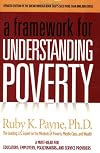
I think this should be a must-read for educators, and it looks like my school district has embraced all of the tips that have been suggested: the after-school homework period built into the day, the social skills workshops, the programs offered by the guidance department, the organization remediation, etc.
This will affect my teaching immediately, as so many of the pitfalls I've encountered have been explained here--the way I handled certain behavior problems and why they weren't effective, show more when calling home will be effective and when it won't, etc.
The most unexpected things I learned from reading this has been figuring out some people close to me in my life. The book has been so eye-opening! It also explains why I, middle-classed, couldn't be in a room with people of generational wealth for 1 minute without seeming crude, base, or "low-class." When Payne explained the "rules of poverty" in terms that I could understand such as how the "rules of middle class" differ from those of the "upper class", it all made perfect sense. So much of this information was just dead-on. I'm seeing that many people find this to be too stereotypical, but I couldn't care less. It's made me take a much deeper look into my own ideas and misconceptions and has given me the resources to have an even deeper respect for people in poverty. (I tended to believe, deep down, that it's their own fault they "choose" to reject the government's attempts at giving them an education.) This is probably the most important book I've read in a few years, as its impact will reach into both my professional and personal life. show less
This will affect my teaching immediately, as so many of the pitfalls I've encountered have been explained here--the way I handled certain behavior problems and why they weren't effective, show more when calling home will be effective and when it won't, etc.
The most unexpected things I learned from reading this has been figuring out some people close to me in my life. The book has been so eye-opening! It also explains why I, middle-classed, couldn't be in a room with people of generational wealth for 1 minute without seeming crude, base, or "low-class." When Payne explained the "rules of poverty" in terms that I could understand such as how the "rules of middle class" differ from those of the "upper class", it all made perfect sense. So much of this information was just dead-on. I'm seeing that many people find this to be too stereotypical, but I couldn't care less. It's made me take a much deeper look into my own ideas and misconceptions and has given me the resources to have an even deeper respect for people in poverty. (I tended to believe, deep down, that it's their own fault they "choose" to reject the government's attempts at giving them an education.) This is probably the most important book I've read in a few years, as its impact will reach into both my professional and personal life. show less
Payne's book is a perfect example of what is wrong with the conservative approach to education. In this book, sold to districts all over the country, Payne peddles soft racism and discredited social theory, based on her anecdotal observations, rather than real research.It’s a pretty appealing formula: rather than address the root causes of poverty in this country or community, demonize the poor through condescension and disapproval rather than outright hostility. I had the misfortune of show more going to a professional development opportunity presented by one of Payne's lackeys. She chose exactly this approach, regaling our teachers with increasingly improbable stories about the sexual and economic (often linked) immorality of the poor, ostensibly to illustrate the need for more structured lesson plans to suit the poor. The poor, in Payne’s work, are “spiritually deficient,” and in desperate need of the values of the middle class.This argument is troubling on a number of levels, but most importantly, for how it essentializes the experience of poverty. For those who would fix education by fixing the value structure of the poor, poverty is not only inevitably marked by experience with substance abuse, laziness, crime, and sexual abuse; they are inherent characteristics. Valorizing the middle class as emblematic of virtue, these critics ignore a country that has a class independent problem with morality. To argue, in the country with the greatest wealth and greatest debt per person in the world, that the poor lack the structure to save money is an unbelievably simplistic and empirically incorrect argument. show less
I'm giving this book my highest rating, not because it is perfect, not because its theories are air-tight, but simply for the effect the book had on me as an educator. I've never had a book open my eyes the way this one does. So much misunderstanding between middle-class teachers and their students raised in poverty can be undone by this book. This book helped me understand why students make some choices they make - they are working off a different set of assumptions about what life has to show more offer them. I have always believed that people in similar circumstances will make similar choices, it is the rare individual who swims against the current. This book helped me understand the current that students swim in, which helped me tremendously when I taught at-risk students. show less
A book that describes the reality of poverty and its attendant worldview lucidly. It helps for those in middle and wealthy classes understand why those in poverty think and act as they do. The book does not justify or condemn them, but strives to provide ways of understanding and cooperation to assist people in poverty get beyond their present circumstances.
It takes one until the appendix, however, to see an appreciation for the "rules of poverty" as the means by which those in poverty have show more managed to survive, and the concept that the best way forward for those in poverty is to "add" to these rules those of the middle class to achieve. The work recognizes the need to cut off relationships in order to achieve, and gets a bit bloodless about it. Middle-class values are honored a bit too uncritically; there's much that the middle class could learn from the poor about the value of community and one another.
Nevertheless, to understand more about the rules of poverty and the middle class, a good resource. show less
It takes one until the appendix, however, to see an appreciation for the "rules of poverty" as the means by which those in poverty have show more managed to survive, and the concept that the best way forward for those in poverty is to "add" to these rules those of the middle class to achieve. The work recognizes the need to cut off relationships in order to achieve, and gets a bit bloodless about it. Middle-class values are honored a bit too uncritically; there's much that the middle class could learn from the poor about the value of community and one another.
Nevertheless, to understand more about the rules of poverty and the middle class, a good resource. show less
Lists
Awards

You May Also Like


Associated Authors
Statistics
- Works
- 37
- Members
- 2,373
- Popularity
- #10,817
- Rating
- 3.8
- Reviews
- 33
- ISBNs
- 85
- Languages
- 1