
Adam Tanner (1)
Author of Our Bodies, Our Data: How Companies Make Billions Selling Our Medical Records
For other authors named Adam Tanner, see the disambiguation page.
About the Author
Adam Tanner is a leading expert on the business of personal data and privacy. He was a fellow at Harvard University's Institute for Quantitative Social Science from 2GI2 to 2D17 and the 2016-I7 Snedden Chair in Journalism at the University of Alaska, Fairbanks. He is the author of What Stays in show more Vegas: The World of Personal Data-Lifeblood of Big Business-and the End of Privacy as We Know It. show less
Works by Adam Tanner
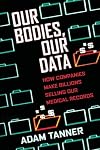
Our Bodies, Our Data: How Companies Make Billions Selling Our Medical Records (2017) 68 copies, 22 reviews
What Stays in Vegas: The World of Personal Data—Lifeblood of Big Business—and the End of Privacy as We Know It (2014) 51 copies, 3 reviews
Tagged
Common Knowledge
- Gender
- male
Members
Reviews
A thoroughly-researched investigation into the ways our medical information has been exploited for profit in ways that threaten personal privacy and distort the ways we are treated. One of the fascinating points the author makes is that this has been going on for a long time. He traces the history of pharmaceutical companies getting information from pharmacies about what kinds of prescriptions they fill so that they can fine-tune and target marketing to doctors in the area. All that long show more before computers and Big Data came along. Americans may think HIPAA protects their medical privacy, but the monetization of "anonymized" data is massive and troubling - and it's not all that difficult to piece together data to reveal the subject. The author tackles the topic in the tone of an investigative journalist and has conducted a lot of face-to-face research. Fortunately he also includes a comprehensive list of references which helps readers assess his conclusions.
Some of the reviews here suggest the author is hyperbolic and prone to scare-mongering. I think we have plenty to be scared about. Here's an example, chosen at random:
"You may not realize data brokers harvest names from patient forums [online] and hospital sites to add to lists of people with a particular disease. The largest data brokers assemble elaborate profiles that list wealth, real estate holdings, employment, religion, ethnic background, sexual orientation, hobbies, and many other categories, which may include health. Since some niche brokers focus on producing named lists of individuals according to ailments, social media can enhance the details they can obtain." And none of that is protected by HIPAA.
I thought it was a fascinating if admittedly alarming book that would appeal to those interested in the uses of data, the impact of technology on society, or (especially) those interested in medicine and social policy. show less
Some of the reviews here suggest the author is hyperbolic and prone to scare-mongering. I think we have plenty to be scared about. Here's an example, chosen at random:
"You may not realize data brokers harvest names from patient forums [online] and hospital sites to add to lists of people with a particular disease. The largest data brokers assemble elaborate profiles that list wealth, real estate holdings, employment, religion, ethnic background, sexual orientation, hobbies, and many other categories, which may include health. Since some niche brokers focus on producing named lists of individuals according to ailments, social media can enhance the details they can obtain." And none of that is protected by HIPAA.
I thought it was a fascinating if admittedly alarming book that would appeal to those interested in the uses of data, the impact of technology on society, or (especially) those interested in medicine and social policy. show less
 This review was written for LibraryThing Early Reviewers.
When it comes to privacy issues, many people think their healthcare information is a sacred trust shared only between themselves and their doctor. After all, we have a government act, HIPAA, that protects us, right?
Well, not so much. Our Bodies, Our Data is a history of the collecting and selling of sensitive medical data. This is not a new thing borne from the Internet Age (although it's experienced a boom in recent years), but has roots as far back as the 1960's. HIPAA does allow show more collecting and selling on certain kinds of anonymized data, but with modern techniques, this data can be re-identified, often by entities not beholden to the restrictions of HIPAA. If you ever wonder why you are seeing so many ads regarding treatment or meds after searching such things on WenMD, for example, this is partially why.
To be fair, there has not yet been an instance where re-identified data has been used for truly nefarious purposes. However; the data and means are there and we might not be too far from the day when a prospective employer can not only see what conditions you might have, but also a profile of what you may be susceptible to. Or worse, insurance companies tailoring their rates in light of such specific information. That the medical data industry is not always forthright in their disclosures nor willing to discuss openly suggests they really don't want people to know what is happening with their data. Some of the data can be used for good, steering the development of new drugs or providing data mining opportunities to discover correlating factors that might lead to certain conditions. If such data were collected by medical people and used solely for this purpose, many would not object. But there are billion dollar companies now brokering this information - and it is driven by sales and advertising, not by clinical research. As more try to profit from this information, the prognosis is not good for the patient. Which is all of us. show less
Well, not so much. Our Bodies, Our Data is a history of the collecting and selling of sensitive medical data. This is not a new thing borne from the Internet Age (although it's experienced a boom in recent years), but has roots as far back as the 1960's. HIPAA does allow show more collecting and selling on certain kinds of anonymized data, but with modern techniques, this data can be re-identified, often by entities not beholden to the restrictions of HIPAA. If you ever wonder why you are seeing so many ads regarding treatment or meds after searching such things on WenMD, for example, this is partially why.
To be fair, there has not yet been an instance where re-identified data has been used for truly nefarious purposes. However; the data and means are there and we might not be too far from the day when a prospective employer can not only see what conditions you might have, but also a profile of what you may be susceptible to. Or worse, insurance companies tailoring their rates in light of such specific information. That the medical data industry is not always forthright in their disclosures nor willing to discuss openly suggests they really don't want people to know what is happening with their data. Some of the data can be used for good, steering the development of new drugs or providing data mining opportunities to discover correlating factors that might lead to certain conditions. If such data were collected by medical people and used solely for this purpose, many would not object. But there are billion dollar companies now brokering this information - and it is driven by sales and advertising, not by clinical research. As more try to profit from this information, the prognosis is not good for the patient. Which is all of us. show less
This review was written for LibraryThing Early Reviewers.Adam Tanner is a talented author, and having finished Our Bodies, Our Data I will be reading his earlier books. He takes a complex subject--the process by which pharmaceutical companies, doctors, and other entities--collect, buy, and sell medical data and explains it in clear, direct prose. He lays out a strong case that safeguards have not kept pace with companies' abilities to obtain and aggregate data or other actors in possession of that data to connect it to the individuals it show more describes, and how such "re-identification" poses a strong risk to those individuals' privacy and well-being.
Although Tanner's clear preference is for more transparency from aggregators and greater ability for individuals to control their own data, he refrains from hyperbole or scaremongering, which is both refreshing and makes his case stronger. He states clearly at multiple points that neither side can marshal damning evidence against the other: privacy advocates do not have examples of how an individual was catastrophically re-identified with their anonymized medical history, and advocates of commercial data aggregation have produced no evidence that their work has led to any medical breakthroughs (though it is incredibly lucrative for them).
That said, Tanner is at times maddeningly objective, most noticeably when he quotes multiple former employees of data aggregators stating that they find the industry alarming and potentially a great risk to those whose data are being harvested, but never asks a single one why, then, they worked for the industry in the first place. Perhaps that was the price of the interview, but if so, it would have been nice if Tanner had stated so outright.
That said, Our Bodies, Our Data is well-written, informative, and even-handed in its approach. I recommend it to anyone with an interest in the topic. show less
Although Tanner's clear preference is for more transparency from aggregators and greater ability for individuals to control their own data, he refrains from hyperbole or scaremongering, which is both refreshing and makes his case stronger. He states clearly at multiple points that neither side can marshal damning evidence against the other: privacy advocates do not have examples of how an individual was catastrophically re-identified with their anonymized medical history, and advocates of commercial data aggregation have produced no evidence that their work has led to any medical breakthroughs (though it is incredibly lucrative for them).
That said, Tanner is at times maddeningly objective, most noticeably when he quotes multiple former employees of data aggregators stating that they find the industry alarming and potentially a great risk to those whose data are being harvested, but never asks a single one why, then, they worked for the industry in the first place. Perhaps that was the price of the interview, but if so, it would have been nice if Tanner had stated so outright.
That said, Our Bodies, Our Data is well-written, informative, and even-handed in its approach. I recommend it to anyone with an interest in the topic. show less
This review was written for LibraryThing Early Reviewers.I received a free copy of this book in exchange for a fair review.
This book provides a history of the collection of private medical data and the of way it had been used, and a discussion of the potential benefits and potential problems of such data collection. It also gives some examples of the ways other countries collect and disseminate private medical data.
I found this book to be a very interesting and even-handed discussion of the topic of private medical data. The author solicited show more opinions from privacy advocates, data miners, researchers, statisticians, and researchers. The promise of big data collection for major health advances is huge, but the reality is that so far, most of this data collection has been used primarily for various kinds of marketing.
I agree with the conclusions of the book, that patients should own their own medical data, and be asked to opt in or out of data collection and dissemination programs. I think most people would be happy to donate their data for medical research, and if they don't want their personal information sold to marketers, it is reasonable that they should be able to opt out of that activity. It is telling that even people who work in the data mining industry can have qualms about their own data being used, and they have a full understanding of the business.
I learned a lot about the way medical data is gathered in the United States, and am very grateful to the author for gathering so much well-documented information in one place. show less
This book provides a history of the collection of private medical data and the of way it had been used, and a discussion of the potential benefits and potential problems of such data collection. It also gives some examples of the ways other countries collect and disseminate private medical data.
I found this book to be a very interesting and even-handed discussion of the topic of private medical data. The author solicited show more opinions from privacy advocates, data miners, researchers, statisticians, and researchers. The promise of big data collection for major health advances is huge, but the reality is that so far, most of this data collection has been used primarily for various kinds of marketing.
I agree with the conclusions of the book, that patients should own their own medical data, and be asked to opt in or out of data collection and dissemination programs. I think most people would be happy to donate their data for medical research, and if they don't want their personal information sold to marketers, it is reasonable that they should be able to opt out of that activity. It is telling that even people who work in the data mining industry can have qualms about their own data being used, and they have a full understanding of the business.
I learned a lot about the way medical data is gathered in the United States, and am very grateful to the author for gathering so much well-documented information in one place. show less
This review was written for LibraryThing Early Reviewers.Statistics
- Works
- 2
- Members
- 119
- Popularity
- #166,387
- Rating
- 3.5
- Reviews
- 25
- ISBNs
- 11
