
Paul R. Daugherty
Author of Human + Machine: Reimagining Work in the Age of AI
Works by Paul R. Daugherty
Tagged
Common Knowledge
There is no Common Knowledge data for this author yet. You can help.
Members
Reviews
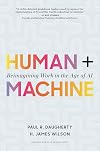
A comprehensive survey of Artificial Intelligence (AI) and robotics in businesses around the world is presented. Basic principles are drawn from those observations including a mapping of functions and processes best done by machines and those best done by humans. In a departure from more traditional thinking about AI where the application is to augment or replace human participation, the authors discuss the growing trend toward a symbiotic or collaborative relationship between man and show more machine. The book breaks new ground in that respect.
The usefulness of the book is to prick the interest of business leaders to employ AI algorithms by citing examples of economic successes in many applications. While doing so, Daugherty and Wilson persistently caution against the potential violation of ethical and regulatory limits. Privacy of data gleaned from unwitting sources to build data bases is one example. They also attempt to counter the assertion that applying AI will have an adverse economic impact by reducing workforce requirements by defining functions newly created. Their argument is somewhat hollow in that specific skill sets are softly defined and do not track the skill sets of workers apt to be displaced.
While applying AI is covered, the inner workings—algorithms and data sets—are not; those details are proprietary and not germane—the target reader is executive management and not designer or programmer. That does not preclude these observations and questions:
1. Machine functions are digital—computers work with ones and zeroes. Human brains are analog devices. That is a fundamental difference and may constitute an AI limiting factor unless
a. Computers based on biological neural circuitry are developed or
b. Pseudo analog algorithms using digital data are developed. (It is probable that this has been accomplished.)
2. Digital data suggests that AI logic is restricted to deductive with only limited utilization of inductive logic. Does that define the border between what can best be done by either machine or human? Metrics are in the domain of deductive logic and probability and intuition in the inductive domain. Sensory stimulation is more deductive and perceptiveness is more inductive. The ability to assess stress in the voice of complaint callers to help desks might seem to be perception but actually be an integration of sensor measurement of pitch, tremor, rate of speech, word choice or some other quantifiable information.
3. It seems likely that a successful AI application depends on an existing data set which implies that truly creative results are beyond the scope of AI. Data sets must exist to provide determinants, metrics or models against which differences or similarities can be assessed. Countering this concern is the fact that over the course of history few if any at all advances in technology have been creative—all have been the emulation of natural processes or adaptations of more rudimentary devices or processes.
4. Although this book is restricted to business application, application to other fields seems possible and could go far in the advancement and acceptability of AI. An example that comes to mind is the criminal justice system. Can AI replace or augment juries? Incorrect decisions—acquittal of a guilty defendant or conviction of an innocent defendant could be reduced if, for example, crime scenes are modeled, suspect behavior measured, trial presentations tailored, etc. AI techniques to assess witness veracity might be an extension of the algorithms used to assess stress in help desk callers mentioned above. But the administration of justice goes beyond determining culpability so humans must have the ability to intercede.
5. The growing acceptance and usage of AI is apt to go beyond developing software algorithms and apps. As mentioned above, computers or processors based on principles other than digital technology might be developed—voltages to define ones and zeroes are crude determinants—blending analog and digital approaches is enticing. The development of quantum computer technology is underway and promises to be a game changer. Development of new sensors is another possibility—wireless encephalography, remote DNA analyses, et al.
The best measure of a book’s worth is its ability to provoke the reader into delving deeper into the subject matter. This book accomplishes that. show less
The usefulness of the book is to prick the interest of business leaders to employ AI algorithms by citing examples of economic successes in many applications. While doing so, Daugherty and Wilson persistently caution against the potential violation of ethical and regulatory limits. Privacy of data gleaned from unwitting sources to build data bases is one example. They also attempt to counter the assertion that applying AI will have an adverse economic impact by reducing workforce requirements by defining functions newly created. Their argument is somewhat hollow in that specific skill sets are softly defined and do not track the skill sets of workers apt to be displaced.
While applying AI is covered, the inner workings—algorithms and data sets—are not; those details are proprietary and not germane—the target reader is executive management and not designer or programmer. That does not preclude these observations and questions:
1. Machine functions are digital—computers work with ones and zeroes. Human brains are analog devices. That is a fundamental difference and may constitute an AI limiting factor unless
a. Computers based on biological neural circuitry are developed or
b. Pseudo analog algorithms using digital data are developed. (It is probable that this has been accomplished.)
2. Digital data suggests that AI logic is restricted to deductive with only limited utilization of inductive logic. Does that define the border between what can best be done by either machine or human? Metrics are in the domain of deductive logic and probability and intuition in the inductive domain. Sensory stimulation is more deductive and perceptiveness is more inductive. The ability to assess stress in the voice of complaint callers to help desks might seem to be perception but actually be an integration of sensor measurement of pitch, tremor, rate of speech, word choice or some other quantifiable information.
3. It seems likely that a successful AI application depends on an existing data set which implies that truly creative results are beyond the scope of AI. Data sets must exist to provide determinants, metrics or models against which differences or similarities can be assessed. Countering this concern is the fact that over the course of history few if any at all advances in technology have been creative—all have been the emulation of natural processes or adaptations of more rudimentary devices or processes.
4. Although this book is restricted to business application, application to other fields seems possible and could go far in the advancement and acceptability of AI. An example that comes to mind is the criminal justice system. Can AI replace or augment juries? Incorrect decisions—acquittal of a guilty defendant or conviction of an innocent defendant could be reduced if, for example, crime scenes are modeled, suspect behavior measured, trial presentations tailored, etc. AI techniques to assess witness veracity might be an extension of the algorithms used to assess stress in help desk callers mentioned above. But the administration of justice goes beyond determining culpability so humans must have the ability to intercede.
5. The growing acceptance and usage of AI is apt to go beyond developing software algorithms and apps. As mentioned above, computers or processors based on principles other than digital technology might be developed—voltages to define ones and zeroes are crude determinants—blending analog and digital approaches is enticing. The development of quantum computer technology is underway and promises to be a game changer. Development of new sensors is another possibility—wireless encephalography, remote DNA analyses, et al.
The best measure of a book’s worth is its ability to provoke the reader into delving deeper into the subject matter. This book accomplishes that. show less
I grabbed this book from my Little Free Library, thinking it might help me think through how to further automate and modernize my workplace. H & M provides a very broad framework for thinking through artificial intelligence and the changes it is ushering in. It may not help you think through your specific challenges, but its optimism, that AI should be viewed as a groundbreaking opportunity that will enhance and enable humans, allowing them to perform more creative and human work with show more superhuman powers, rather than putting them out of jobs, is reassuring. H & M reads like many of the freebies given away at industry conferences: clear, concise, and molded around a theoretical framework, in this case MELDS (mindset, experimentation, leadership, data, and skills) and the "missing middle." It is filled with case studies and examples, none of which gets more than a page or two, and some figures, many of which add very little to your understanding. They conducted a massive survey for their research but I only learned this in the last chapter, because the book is highly qualitative and seems not to refer to the survey all that much. Like many of these conference give-aways, the book is a bit of SWAG that may be worth the read. If for no other reason than to allay the fear that the machines are taking over the world. Now that this review is written I am ready to put the book back in my Little Free Library for the next reader. show less
This book has a summary feel, like an executive summary. Still it is fairly encompassing and interesting enough to be worth reading on the topic of AI, including its current impact and possible future directions. AI is here to stay and will only become more common and pervasive.
Throughout the book, the authors return to two ideas:
1. The concept of the "Missing Middle," which is the class of jobs that sits between the jobs that only machines can do and the jobs that only humans can do. In show more the missing middle, humans and machines cooperate to be more effective than either could be individually, with humans providing judgment and creativity and machines providing processing power, memory, and excellence at automation. The vast majority of jobs in the future will come from the missing middle, and it is only blindness to the existence of the missing middle that causes doomsayers to predict widespread unemployment as a result of AI. There are also examples of successes and real-world instances of human-AI collaboration in this area. Largely it seems to come from greater interpretation of nuance and application of manual dexterity. Also, this space is where robots move from job killers to enablers and human-directed tools.
2. To help elucidate the missing middle to corporate leaders, to whom this text seems directed, the authors provide their original MELDS framework, which stands for Mindset, Experimentation, Leadership, Data, and Skills. They try to demonstrate how this framework can help corporate leaders make wise decisions so their companies can leverage artificial intelligence effectively.
Here is a summary of interesting points I abstracted from another's review
How can humans help machines?
- Page 106: Humans can help machines in situations where there is little or no data.
- Page 107: Humans can train machines to perform tasks.
- Page 117: Empathy trainers can teach AI systems how to display compassion.
- Page 118: Personality trainers can help AI systems become more humanlike.
- Page 119: Worldview and localization trainers help chatbots become more sensitive to different ways of thinking and communicating across the globe.
- Page 129: AI safety engineers anticipate unintended consequences of AI systems and address any harmful occurrences with the appropriate strategy.
- Page 129: Ethics and compliance managers uphold generally accepted norms of human values and morals.
- Pages 154-157: Reimagine processes / how things are done. Often, identifying opportunities for process reimagination is an iterative process. Important is understanding the current business context, making observations to get knowledge and identifying potential value of reimagining processes.
- Page 172: Giving users some control over the algorithm makes them more likely to continue to use the AI system.
- Page 174: Today, about 90% of the time of people, who train AI applications, is spent on data preparation and feature engineering, rather than on writing algorithms.
How can machines help humans?
- Page 2: Robots are becoming smaller, more flexible as well as better able to sense their environment, understand, act and learn.
- Page 5: Machines are good at doing repetitive, routine work and analyzing large data sets.
- Page 35: Precision agriculture requires a vast network of Internet of Things sensors. This information might include images by satelites or drones, sensors in the field and sensors on farm equipment.
- Page 36: Artificial intelligence (AI) is enabling vertical farming in which plants can be grown in city warehouses in 10 meter stacks of trays. Such vertical farms require less water and fertilizer than traditional farms.
- Page 69: AI will disrupt every phase of the scientific process: 1. Ask questions and make observations. 2. Devise hypotheses. 3. Design experiment and test predictions based on hypotheses. 4. Run tests and collect data. 5. Develop generalized theories.
- Page 74: Nike 3D prints AI-designed prototypes and tests them, and repeats the cycle until it finds the premier design.
- Page 85: To manage Coca-cola cooler cabinets in stores and other places, the app Einstein was developed which uses artificial intelligence (AI). A person can take a photo of a Coca-Cola cooler cabinet and upload it to the app. The app will predict and recommend restocking order - using customer relationship management data, weather forecasts, promotional levels, inventory levels and historical data.
- Page 87: Philips smart lighting uses AI to predict when light bulbs will lose their efficiency., which ties into the company's recycling and replacement service.
- Page 93: 98% of online customers would be likely or very likely to make another purchase if they have a good experience.
- Page 151: Drones can deliver healthcare to remote places.
- Page 197: Robots can help surgeons reach hard to access organs, perform precise cuts, and suture at angles with previously impossible dexterity. show less
Throughout the book, the authors return to two ideas:
1. The concept of the "Missing Middle," which is the class of jobs that sits between the jobs that only machines can do and the jobs that only humans can do. In show more the missing middle, humans and machines cooperate to be more effective than either could be individually, with humans providing judgment and creativity and machines providing processing power, memory, and excellence at automation. The vast majority of jobs in the future will come from the missing middle, and it is only blindness to the existence of the missing middle that causes doomsayers to predict widespread unemployment as a result of AI. There are also examples of successes and real-world instances of human-AI collaboration in this area. Largely it seems to come from greater interpretation of nuance and application of manual dexterity. Also, this space is where robots move from job killers to enablers and human-directed tools.
2. To help elucidate the missing middle to corporate leaders, to whom this text seems directed, the authors provide their original MELDS framework, which stands for Mindset, Experimentation, Leadership, Data, and Skills. They try to demonstrate how this framework can help corporate leaders make wise decisions so their companies can leverage artificial intelligence effectively.
Here is a summary of interesting points I abstracted from another's review
How can humans help machines?
- Page 106: Humans can help machines in situations where there is little or no data.
- Page 107: Humans can train machines to perform tasks.
- Page 117: Empathy trainers can teach AI systems how to display compassion.
- Page 118: Personality trainers can help AI systems become more humanlike.
- Page 119: Worldview and localization trainers help chatbots become more sensitive to different ways of thinking and communicating across the globe.
- Page 129: AI safety engineers anticipate unintended consequences of AI systems and address any harmful occurrences with the appropriate strategy.
- Page 129: Ethics and compliance managers uphold generally accepted norms of human values and morals.
- Pages 154-157: Reimagine processes / how things are done. Often, identifying opportunities for process reimagination is an iterative process. Important is understanding the current business context, making observations to get knowledge and identifying potential value of reimagining processes.
- Page 172: Giving users some control over the algorithm makes them more likely to continue to use the AI system.
- Page 174: Today, about 90% of the time of people, who train AI applications, is spent on data preparation and feature engineering, rather than on writing algorithms.
How can machines help humans?
- Page 2: Robots are becoming smaller, more flexible as well as better able to sense their environment, understand, act and learn.
- Page 5: Machines are good at doing repetitive, routine work and analyzing large data sets.
- Page 35: Precision agriculture requires a vast network of Internet of Things sensors. This information might include images by satelites or drones, sensors in the field and sensors on farm equipment.
- Page 36: Artificial intelligence (AI) is enabling vertical farming in which plants can be grown in city warehouses in 10 meter stacks of trays. Such vertical farms require less water and fertilizer than traditional farms.
- Page 69: AI will disrupt every phase of the scientific process: 1. Ask questions and make observations. 2. Devise hypotheses. 3. Design experiment and test predictions based on hypotheses. 4. Run tests and collect data. 5. Develop generalized theories.
- Page 74: Nike 3D prints AI-designed prototypes and tests them, and repeats the cycle until it finds the premier design.
- Page 85: To manage Coca-cola cooler cabinets in stores and other places, the app Einstein was developed which uses artificial intelligence (AI). A person can take a photo of a Coca-Cola cooler cabinet and upload it to the app. The app will predict and recommend restocking order - using customer relationship management data, weather forecasts, promotional levels, inventory levels and historical data.
- Page 87: Philips smart lighting uses AI to predict when light bulbs will lose their efficiency., which ties into the company's recycling and replacement service.
- Page 93: 98% of online customers would be likely or very likely to make another purchase if they have a good experience.
- Page 151: Drones can deliver healthcare to remote places.
- Page 197: Robots can help surgeons reach hard to access organs, perform precise cuts, and suture at angles with previously impossible dexterity. show less
You May Also Like
Associated Authors
Statistics
- Works
- 1
- Members
- 127
- Popularity
- #158,247
- Rating
- 3.3
- Reviews
- 3
- ISBNs
- 8
- Languages
- 2