
George Billions
Author of Buying Illegal Bugs with Bitcoin
Works by George Billions
Tagged
Common Knowledge
There is no Common Knowledge data for this author yet. You can help.
Members
Reviews

Firstly, this is an uncomfortable yet compelling read. This is due to the point of view being exclusively from the excruciating place that is the protagonist Karen’s mind. Not a pleasant place to be stuck at all. Severely dissatisfied with the life she’s chosen the sourness of her thoughts infect every judgment she makes in all aspects of her life. To increasingly delusional and worrying levels she sees herself as victimised from everywhere. Her bruised inflated egotism places her at the show more centre of a world out to get her from all angles, when anyone with even half a mind knows that indifference is baseline. We’ve all known people like this, who talk themselves into importance via persecution. Even if a small percentage of what Karen accuses the world of turned out to be true, her reaction to these slights and disappointments still wouldn’t be anything but misguided. The feeling of being trapped in the psyche of someone consumed by paranoia and bitterness has a strange effect, and whilst reading the detached humour of having to endure this fragmented mind snowballs.
At the beginning of the novella Karen’s husband and daughter bond by fidgetspinning. Soon they are popular online, making goofy videos. Karen views the fidget spinners in her family’s life as a further reason for the dysfunction she sees. For most of the book she’s in heartbreaking denial about the real problems her family faces, and it’s very frustrating to witness her misplace her energies so badly. Her relationship with her husband is particularly strained, where it seems she demands nothing less than absolute reassurance at all times, despite acting as if she has nothing but contempt for the man. Her insecurities regarding their marriage surface in a couple of scenes in particular that are achingly cringemaking to read, and, unable to do the white knuckling essential for any respectful relationship, she only manages to make matters oh so much worse. The final section of the book is very believable in conveying the fractured existence of someone overwhelmed by life, incapable of the clarity needed to navigate a way out of circuitously self sabotaging thinking, and the misremembered and half-truths of heavy reliance on alcohol. For a short book, I found it exhausting.
So yeah, successful in portraying a dissatisfied mind and the progression of that mind unravelling. Enough distanced humour in the writing to save the drudge that is the experience of being in the presence of someone so dreadfully wilfully demanding. And fidget spinners. show less
At the beginning of the novella Karen’s husband and daughter bond by fidgetspinning. Soon they are popular online, making goofy videos. Karen views the fidget spinners in her family’s life as a further reason for the dysfunction she sees. For most of the book she’s in heartbreaking denial about the real problems her family faces, and it’s very frustrating to witness her misplace her energies so badly. Her relationship with her husband is particularly strained, where it seems she demands nothing less than absolute reassurance at all times, despite acting as if she has nothing but contempt for the man. Her insecurities regarding their marriage surface in a couple of scenes in particular that are achingly cringemaking to read, and, unable to do the white knuckling essential for any respectful relationship, she only manages to make matters oh so much worse. The final section of the book is very believable in conveying the fractured existence of someone overwhelmed by life, incapable of the clarity needed to navigate a way out of circuitously self sabotaging thinking, and the misremembered and half-truths of heavy reliance on alcohol. For a short book, I found it exhausting.
So yeah, successful in portraying a dissatisfied mind and the progression of that mind unravelling. Enough distanced humour in the writing to save the drudge that is the experience of being in the presence of someone so dreadfully wilfully demanding. And fidget spinners. show less
Firstly, this is an uncomfortable yet compelling read. This is due to the point of view being exclusively from the excruciating place that is the protagonist Karen’s mind. Not a pleasant place to be stuck at all. Severely dissatisfied with the life she’s chosen the sourness of her thoughts infect every judgment she makes in all aspects of her life. To increasingly delusional and worrying levels she sees herself as victimised from everywhere. Her bruised inflated egotism places her at the show more centre of a world out to get her from all angles, when anyone with even half a mind knows that indifference is baseline. We’ve all known people like this, who talk themselves into importance via persecution. Even if a small percentage of what Karen accuses the world of turned out to be true, her reaction to these slights and disappointments still wouldn’t be anything but misguided. The feeling of being trapped in the psyche of someone consumed by paranoia and bitterness has a strange effect, and whilst reading the detached humour of having to endure this fragmented mind snowballs. At the beginning of the novella Karen’s husband and daughter bond by fidgetspinning. Soon they are popular online, making goofy videos. Karen views the fidget spinners in her family’s life as a further reason for the dysfunction she sees. For most of the book she’s in heartbreaking denial about the real problems her family faces, and it’s very frustrating to witness her misplace her energies so badly. Her relationship with her husband is particularly strained, where it seems she demands nothing less than absolute reassurance at all times, despite acting as if she has nothing but contempt for the man. Her insecurities regarding their marriage surface in a couple of scenes in particular that are achingly cringemaking to read, and, unable to do the white knuckling essential for any respectful relationship, she only manages to make matters oh so much worse. The final section of the book is very believable in conveying the fractured existence of someone overwhelmed by life, incapable of the clarity needed to navigate a way out of circuitously self sabotaging thinking, and the misremembered and half-truths of heavy reliance on alcohol. For a short book, I found it exhausting. So yeah, successful in portraying a dissatisfied mind and the progression of that mind unravelling. Enough distanced humour in the writing to save the drudge that is the experience of being in the presence of someone so dreadfully wilfully demanding. And fidget spinners. show less
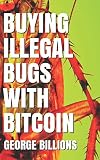
Buying Illegal Bugs with Bitcoin is a total blast of weirditty. This book begins and spends a lot of time exploring the leaf litter of some crumb-ball’s bedsit and then twirls you around, sucks you down society’s grimy plug hole and then builds into mind-expanding metamorphosis and symbiosis with a bug. Yep, a bug. It’s a real bug, not just a metaphor for waking up with a no-manners mistake of a date. It comes from the personification of the unknown, the place where ideas like gremlins show more or The Monkey’s Claw originated, where some stranger from a barely understood place (the internet) sends you something that will upturn and flip your world. It’s the extraordinary rising from ordinariness, where you have to hatch a dragon’s egg or plant the tooth in the soil anyway, even though what you are unleashing will inevitable grow beyond your capacity to control. As a second area of interest, his book also provides a snapshot of what it was like to be a player in the early days of Bitcoin, a completely unsecured currency that could collapse at any moment (before you say you don’t take risks, that’s the same as the Euro, Dollar and the Swiss Franc. The only difference is, no government controls the ledger). Symbiosis or parasite? I’m referring to the bug, not those governments, but may as well be sometimes. The bug’s nature is kept uncertain until nearer the end and certainly the human subject, I won’t use the word hero, sees it differently to the readers until the end. He’s got nothing to lose, so this is just another way to chase the dragon. Like an HG Wells short story or Peter Cook’s Bedazzled, the character always gets a disappointing or cynical version of his wishes but that deepens the atmosphere of excruciating, creepy brilliance that pervades the middle to closing stages. There’s no poetry to this novel, just the imagery of creeping, low-life humanity going squirmingly, cinematically dribbling into the play-pit of madness. The bug loves being with you and blocks your pain receptors, then causes acquaintances to fetch what you need, no matter at what cost to themselves. Then there’s a sense that the whole splitting biomass could move into exponential growth, through Bitcoin and the regular postal service. There’s a sense of repulsion and then the surprising realisation that the main character feels no repulsion at all at what is happening in his life. What is this life form doing to him? It’s got a drug dealer and some low-brow racists in it, which is ugly, but they do get their come uppance and I can see every knight needs his monsters. The low life is needed though because who else goes shopping on the dark net? This is written at the interface between known and unknown, or more accurately world and underworld in the Greek sense, so of course the author chose a character who circles on the bottom level boundary between world/underworld and has then eased apart the veil separating them to let something through. So, now there’s a creature in Eden that shouldn’t be there, or maybe it should and the celestial designer knows about it because there’s a bigger scheme that we are not aware of. The worm in the bud feeds on the damask cheek, yin in the yang, always and everywhere. I liked this book very much, even if it was closer to a dot of yang in the yang – painful experiences happen to the kind of people who invite the pain in. It was creepy cool, tarnished purity, bitterly dark with no salvation in places and pet-care friendly in others but it was original and represented an uncharming approach to the fantasy of buying some unique, fey thing, letting it into your home, your life and watching it build a nest, incrementally changing both of you. If you only like to read stories that stay under control, this isn’t one of those. If you want something unusual, shocking, yet also colourful and stimulating in its blatant and fascinating weirdness, you’ve found it. I recommend the book but please don’t post any prosperity bugs to me. show less
This story, which seems like quite a simple and straight forward tale on the surface, is brutally clever, and I recommend you don’t read this review or others before reading the book yourself. So… what are you doing still reading this? I can’t recommend Fidget Spinners Destroyed My Family enough, so stop wasting you time reading my version of the truth about this book and instead spend your time reading George Billions’ highly entertaining story.
So, I guess this is the point where show more I’m supposed to use those words: “Spoiler Alert”.
First off, I’d never heard of Fidget Spinners, despite the toys apparently being the latest hugely-popular craze, but I’m behind the times, so I had to Google them to find out what they were. Also, upon reading the blurb of this book, I had presumed it wasn’t actually a literal representation of the dangers of Fidget Spinners, but then I read an interview with the author where he was talking about the very real dangers of these toys, so I started thinking, ‘Oh – this book is more serious than I had been led to believe’, having originally thought there was a tongue-in-cheekness comic undertone to the dangers of the toys. And then I read the book, and came to completely different conclusions.
Damn, this is a clever story.
It begins with this paragraph: “What follows is a true account of how fidget spinners ultimately brought about the complete destruction of a family. Though names and faces have been changed, every effort has been made to present the story to you in as accurate a way as possible.
May this serve as a cautionary tale.” And the afterword tells you more about how the protagonist Karen first emailed the author of this book, and how he chose to write her story.
I’m guessing that George Billions is a fan of the film Fargo, which begins with the statement: “This is a true story...”
And when you read Billions’ author biography and discover he writes under many pseudonyms and that: “He's written everything from fake product reviews to unqualified fitness advice, steamy romance novels to straight-up keyword spam” and you also discover he’s stated: “If you ask Google who invented the spatula, you get an article I wrote a few years ago about a guy named John Spaduala”, not to mention that his first novel was called ‘Tony the Liar’, you start to get an understanding of what George Billions is all about; and, to me, it makes him feel more like a concept artist like Bob and Roberta Smith, than a mere author.
‘Hey, Harry,’ I hear you cry, ‘enough about the author and perceptions of truth already! What did you think of the story?’ Well, if I’ve heard you correctly, you haven’t been paying attention, ‘cos I’m telling you about the book, and if you don’t pay attention to the book when you read it, you’ll be coming to different conclusions yourself.
It’s perhaps quite challenging for a male author to write a female first-person narrative; at least, it’s challenging to write it extremely well, and Billions succeeds hands down. I marvelled at all the little details he’s added which could easily be overlooked when it’s such an ‘easy read’. It’s also very challenging for a writer to succeed at telling a story from a delusional perspective, where the truth of the story can be found in what the protagonist isn’t saying. That’s why it may be easy for readers to overlook just how accomplished Billions’ writing is. If you don’t pause to think about the undercurrent of this novel, it could just come across as an easy-read and a simplistic story. Dig a little bit deeper and you’ll discover it’s a hell of a lot more.
I’m looking forward to reading more by this author – although seeing as he writes under various pseudonyms, maybe I’ve already read more by him and don’t know it.
4.5 stars. show less
So, I guess this is the point where show more I’m supposed to use those words: “Spoiler Alert”.
First off, I’d never heard of Fidget Spinners, despite the toys apparently being the latest hugely-popular craze, but I’m behind the times, so I had to Google them to find out what they were. Also, upon reading the blurb of this book, I had presumed it wasn’t actually a literal representation of the dangers of Fidget Spinners, but then I read an interview with the author where he was talking about the very real dangers of these toys, so I started thinking, ‘Oh – this book is more serious than I had been led to believe’, having originally thought there was a tongue-in-cheekness comic undertone to the dangers of the toys. And then I read the book, and came to completely different conclusions.
Damn, this is a clever story.
It begins with this paragraph: “What follows is a true account of how fidget spinners ultimately brought about the complete destruction of a family. Though names and faces have been changed, every effort has been made to present the story to you in as accurate a way as possible.
May this serve as a cautionary tale.” And the afterword tells you more about how the protagonist Karen first emailed the author of this book, and how he chose to write her story.
I’m guessing that George Billions is a fan of the film Fargo, which begins with the statement: “This is a true story...”
And when you read Billions’ author biography and discover he writes under many pseudonyms and that: “He's written everything from fake product reviews to unqualified fitness advice, steamy romance novels to straight-up keyword spam” and you also discover he’s stated: “If you ask Google who invented the spatula, you get an article I wrote a few years ago about a guy named John Spaduala”, not to mention that his first novel was called ‘Tony the Liar’, you start to get an understanding of what George Billions is all about; and, to me, it makes him feel more like a concept artist like Bob and Roberta Smith, than a mere author.
‘Hey, Harry,’ I hear you cry, ‘enough about the author and perceptions of truth already! What did you think of the story?’ Well, if I’ve heard you correctly, you haven’t been paying attention, ‘cos I’m telling you about the book, and if you don’t pay attention to the book when you read it, you’ll be coming to different conclusions yourself.
It’s perhaps quite challenging for a male author to write a female first-person narrative; at least, it’s challenging to write it extremely well, and Billions succeeds hands down. I marvelled at all the little details he’s added which could easily be overlooked when it’s such an ‘easy read’. It’s also very challenging for a writer to succeed at telling a story from a delusional perspective, where the truth of the story can be found in what the protagonist isn’t saying. That’s why it may be easy for readers to overlook just how accomplished Billions’ writing is. If you don’t pause to think about the undercurrent of this novel, it could just come across as an easy-read and a simplistic story. Dig a little bit deeper and you’ll discover it’s a hell of a lot more.
I’m looking forward to reading more by this author – although seeing as he writes under various pseudonyms, maybe I’ve already read more by him and don’t know it.
4.5 stars. show less
Statistics
- Works
- 4
- Members
- 9
- Popularity
- #968,586
- Rating
- 4.5
- Reviews
- 8
- ISBNs
- 2