
Alejandra Oliva
Author of Rivermouth: A Chronicle of Language, Faith, and Migration
Series
Works by Alejandra Oliva
Associated Works
Tagged
Common Knowledge
Members
Reviews
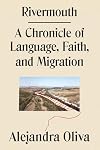
Alejandra Oliva recounts her work in translation and activism for asylum seekers applying to stay in the U.S. The book is divided non-chronologically in three sections: Part 1 in Tijuana in 2019 when the migrant band that made the news was attempting to enter the U.S.; Part 2 in New York City, 2017 working as a translator for a pro se asylum application clinic that met weekly in a church basement; and Part 3 again in 2019, this time primarily in Boston when she would go to immigration court show more and later that same year visited a detention center in the southeastern U.S.
The publisher describes this as "a polemic arguing for porous borders, a decriminalization of immigration, a more open sense of what we owe one another, and a willingness to extend radical empathy." I question whether "polemic" is accurate, since that brings to mind an argumentative tone and a controversial opinion. Instead, Oliva is extremely reflective as she attempts to translate for us between an asylum seeker's experience and our own. She is the daughter of immigrants, but acknowledges her own privilege since they were a higher class and education, and she herself was born in the U.S. She delves into theories of translation and wrestles with her own biases quite openly throughout the text, giving readers a lot to reflect on in turn. And that idea of a river commingles with language:
It is well worth trying to meet Oliva at the rivermouth and engage with her experiences and the translations she attempts of the stories of the people she meets. show less
The publisher describes this as "a polemic arguing for porous borders, a decriminalization of immigration, a more open sense of what we owe one another, and a willingness to extend radical empathy." I question whether "polemic" is accurate, since that brings to mind an argumentative tone and a controversial opinion. Instead, Oliva is extremely reflective as she attempts to translate for us between an asylum seeker's experience and our own. She is the daughter of immigrants, but acknowledges her own privilege since they were a higher class and education, and she herself was born in the U.S. She delves into theories of translation and wrestles with her own biases quite openly throughout the text, giving readers a lot to reflect on in turn. And that idea of a river commingles with language:
Language is something we construct together - across a continent and centuries as much as within communities and conversations. There is no expression, no understanding without the other, to express or to understand. With the other also comes uncertainties, comes gaps and expectations, comes the spaces where language can slip through your fingers into misunderstanding. But this is the thing you have to risk to make yourself understood, to understand another. By widening your language, you widen your community, make eye contact with someone downstream and wave.
It is well worth trying to meet Oliva at the rivermouth and engage with her experiences and the translations she attempts of the stories of the people she meets. show less
Awards

Statistics
- Works
- 2
- Also by
- 1
- Members
- 42
- Popularity
- #357,756
- Rating
- 3.7
- Reviews
- 1
- ISBNs
- 4