
Michelle Boule
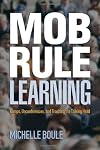
Author of Mob Rule Learning: Camps, Unconferences, and Trashing the Talking Head
Works by Michelle Boule
Changing the way we work 1 copy
Tagged
Common Knowledge
- Other names
- Jane
- Birthdate
- 1978-10-06
- Gender
- female
- Education
- Texas Woman's University (MLS)
Texas A&M University (BA|English) - Occupations
- librarian
freelance writer
consultant - Awards and honors
- Library Journal Mover and Shaker (2008)
- Nationality
- USA
- Places of residence
- Houston, Texas, USA
- Associated Place (for map)
- Texas, USA
Members
Reviews
I was very much looking forward to this book but when I got to the end of it, I felt disappointed. This really seems like a case where the content would have made for a number of very interesting blog posts instead of a printed book, with links to the discussed tools and explanations on facilitation and teaching techniques for "Mob Learning." Indeed, the strength of this book is that it points people to resources that will help them adapt to new learning systems.
Unfortunately, to fill out a show more book of 200 pages, there seems to be a bit of fluff and redundancy added in to pad it out to a proper length (as well as what appears to be full double-spaced lines of text). There were times when I had wondered if I have inadvertently flipped back 10 or 20 pages because the paragraph I was reading in a later chapter was discussing exactly the same concept as I had read in a previous chapter, often with very similar wording.
Another example of the added filler is the unnecessary interview at the end of the chapter on Learning Management Systems (LMS). After doing a semi-decent job of going over some of the options, an interview with a PhD student is appended which just seems to repeat everything previously written. It seemed pretty pointless.
I hate to be harsh because I am a big fan of unconferences and new methods of sharing knowledge and while this book is good at pointing the reader to resources for mob learning, doing so didn't require a 200 page book. show less
Unfortunately, to fill out a show more book of 200 pages, there seems to be a bit of fluff and redundancy added in to pad it out to a proper length (as well as what appears to be full double-spaced lines of text). There were times when I had wondered if I have inadvertently flipped back 10 or 20 pages because the paragraph I was reading in a later chapter was discussing exactly the same concept as I had read in a previous chapter, often with very similar wording.
Another example of the added filler is the unnecessary interview at the end of the chapter on Learning Management Systems (LMS). After doing a semi-decent job of going over some of the options, an interview with a PhD student is appended which just seems to repeat everything previously written. It seemed pretty pointless.
I hate to be harsh because I am a big fan of unconferences and new methods of sharing knowledge and while this book is good at pointing the reader to resources for mob learning, doing so didn't require a 200 page book. show less
 This review was written for LibraryThing Early Reviewers.
I was chosen as an early reviewer for this book. I did not get it for a few months and then it shows up on my doorsteps. I am pretty glad it did. The book, while not perfect, holds the distinction as being the one that introduced me to the formalized mob learning concept.
Michelle Boule is kind of a pioneer since this is the first book that I know of which covers the subject. She does so in a very comprehensive way. Even so, it left me hanging for a few things, partly my fault though. I will show more explain.
The author comes from the library science area, as such the people she deals with are much more likely to accept these ideas of having unstructured conferences and I guess are much more eager to try out some of these more adventurous ideas. I am an engineer, as such I had a very hard time trying to get something concrete from the book. Again, not the author's fault, I am just not the usual audience that would read this kind of book. She did convey, quite brilliantly, the excitement of discovering new ways to communicate and problem solve. I think she was able to convey a necessarily amorphous concept in a very strong way to the audience. In essence the idea is to let people come up with a way to learn and communicate and come to decisions organically, something that is very hard for people to do. i think the author did a very good job of making her points and relating her own excitement to the readers.
The book is ordered in a very logical way, her emphasis is actually on the practical aspects of utilizing the mob rule methods. Her examples are all very practical and goal oriented. The methods she listed were all very interesting and sounds like they will be very useful. BUT, this is not a how-to book, and I think that is by design. The author's intent is to allow those who read the book to experiment and come to the right ways of accomplishing things by reaching for the solutions ourselves.
I am still grasping with some of the concepts, but this is a challenge that is very interesting and allows me to really think about how we can best convey information AND create a space for productive and innovative discussions, I am planning a conference for 2013 and the book has been a very interesting read, it certainly has sparked many discussions amongst those who are on my organizing committee. I believe we will be using some of the concepts introduced in the book. More importantly, we will follow the spirit of the book and come up with our own way of doing mob rule learning, by using mob rule learning.
I would recommend this book for a variety of reasons, I found it most helpful though in dealing with my own conference planning task. show less
Michelle Boule is kind of a pioneer since this is the first book that I know of which covers the subject. She does so in a very comprehensive way. Even so, it left me hanging for a few things, partly my fault though. I will show more explain.
The author comes from the library science area, as such the people she deals with are much more likely to accept these ideas of having unstructured conferences and I guess are much more eager to try out some of these more adventurous ideas. I am an engineer, as such I had a very hard time trying to get something concrete from the book. Again, not the author's fault, I am just not the usual audience that would read this kind of book. She did convey, quite brilliantly, the excitement of discovering new ways to communicate and problem solve. I think she was able to convey a necessarily amorphous concept in a very strong way to the audience. In essence the idea is to let people come up with a way to learn and communicate and come to decisions organically, something that is very hard for people to do. i think the author did a very good job of making her points and relating her own excitement to the readers.
The book is ordered in a very logical way, her emphasis is actually on the practical aspects of utilizing the mob rule methods. Her examples are all very practical and goal oriented. The methods she listed were all very interesting and sounds like they will be very useful. BUT, this is not a how-to book, and I think that is by design. The author's intent is to allow those who read the book to experiment and come to the right ways of accomplishing things by reaching for the solutions ourselves.
I am still grasping with some of the concepts, but this is a challenge that is very interesting and allows me to really think about how we can best convey information AND create a space for productive and innovative discussions, I am planning a conference for 2013 and the book has been a very interesting read, it certainly has sparked many discussions amongst those who are on my organizing committee. I believe we will be using some of the concepts introduced in the book. More importantly, we will follow the spirit of the book and come up with our own way of doing mob rule learning, by using mob rule learning.
I would recommend this book for a variety of reasons, I found it most helpful though in dealing with my own conference planning task. show less
This review was written for LibraryThing Early Reviewers.Despite the title, Mob Rule Learning is really two 100-page books on related subjects. Part One is about camps and unconferences, as the title suggests, while Part Two is about using social software to make classrooms (both traditional and online) more participatory. (Note that coverage of MOOCs is completely missing from Part Two, though that's understandable given that their popularity is relatively recent.) Boule also seems unsure whether she's writing an academic book or a how-to guide, show more making the book less useful for those who are looking for something at one or the other extreme. Overall, my impression is that the material in this book might make a few good shorter books or articles, but that it's a bit of a muddle as it stands. I also found reading it tedious: Boule spends a lot of time repeating herself or stating the obvious.
Nevertheless, this book may be worth skimming if you're interested in the topic(s). Each chapter includes endnotes that point to useful resources and the appendix lists many useful resources worth exploring. show less
Nevertheless, this book may be worth skimming if you're interested in the topic(s). Each chapter includes endnotes that point to useful resources and the appendix lists many useful resources worth exploring. show less
This review was written for LibraryThing Early Reviewers.
Michelle Boule has written a good introductory guide to learning communities. Her over-arching theme is that the distributed knowledge of crowds is an untapped resource for professional development and learning.
As someone who both attends and helps plan conferences on a regular basis I came away with a number of new ideas for tapping into participants' interests and passions and will be putting these ideas to use in the near future. Anyone who has an interest in professional development and show more learning will come away with something from "Mob Rule Learning." show less
As someone who both attends and helps plan conferences on a regular basis I came away with a number of new ideas for tapping into participants' interests and passions and will be putting these ideas to use in the near future. Anyone who has an interest in professional development and show more learning will come away with something from "Mob Rule Learning." show less
This review was written for LibraryThing Early Reviewers.Statistics
- Works
- 5
- Members
- 41
- Popularity
- #363,651
- Rating
- 3.6
- Reviews
- 11
- ISBNs
- 12
