
Mary Austin (1) (1868–1934)
Author of The Land of Little Rain
For other authors named Mary Austin, see the disambiguation page.
Mary Austin (1) has been aliased into Mary Hunter Austin.
About the Author
Image credit: Charles Fletcher Lummis
Works by Mary Austin
Works have been aliased into Mary Hunter Austin.
Outland 4 copies
The Readjustment 2 copies
Papago Wedding 1 copy
Feminism 1 copy
The Lands of the Sun 1 copy
Associated Works
Works have been aliased into Mary Hunter Austin.
American Poetry: The Twentieth Century, Volume One: Henry Adams to Dorothy Parker (2000) — Contributor — 479 copies, 1 review
Sisters of the Earth: Women's Prose and Poetry About Nature (1991) — Contributor — 441 copies, 6 reviews
The Penguin Book of Ghost Stories: From Elizabeth Gaskell to Ambrose Bierce (2010) — Contributor — 186 copies, 4 reviews
What Did Miss Darrington See? An Anthology of Feminist Supernatural Fiction (1989) — Contributor — 126 copies
The Glorious American Essay: One Hundred Essays from Colonial Times to the Present (2020) — Contributor — 116 copies
Weird Women: Classic Supernatural Fiction by Groundbreaking Female Writers: 1852-1923 (2020) — Contributor — 108 copies, 2 reviews
Great American Short Stories: O. Henry Memorial Prize Winning Stories, 1919-1934 (1935) — Contributor — 11 copies, 1 review
A Modern Galaxy — Contributor — 2 copies
American Indian Love Lyrics and Other Verse from the Songs of the North American Indians — Foreword, some editions — 2 copies
The Ethnic Image in Modern American Literature, 1900-1950, Volumes 1-2 (1984) — Contributor — 1 copy
Tagged
Common Knowledge
- Canonical name
- Austin, Mary
- Other names
- Austin, Mary Hunter
- Birthdate
- 1868-09-09
- Date of death
- 1934-08-13
- Gender
- female
- Education
- Blackburn College (B.A. 1888)
- Occupations
- writer
- Relationships
- Austin, Stafford Wallace (husband)
- Short biography
- Mary Hunter Austin (1868-1934) was a well-known and prolific writer best known for her portrayals of life in California and New Mexico. She published 33 books, including Land of Little Rain, 3 plays and well over 125 short stories, articles, and poems before her death on August 13, 1934. During her lifetime, Austin befriended many important figures including Jimmy Hopper, Herbert Hoover, Jack London, Charles Fletcher Lummis, George Bernard Shaw, George Sterling, and H.G. Wells, among many others represented in the collection. There is little correspondence with her immediate family, though she was close to her brother Jim's daughter, Mary Hunter Sullivan Wolf, and numerous correspondence between the two exist. Austin lived in Carmel, California, New York, London, and Rome. Santa Fe, New Mexico, became her final residence and she erected a house there, which she named "Casa Querida." Once in Santa Fe, her lifelong interest in American Indians became more pronounced, and she lobbied vigorously and frequently on their behalf. Much of her later writing dealt with Indians as well as mysticism and religions. With the help of Arthur Leon Campa of the University of New Mexico, Austin collected Spanish folklore, which had existed as oral tradition until they transcribed it. Austin's writings also focused on the financial, intellectual, and social independence of women.
- Cause of death
- heart attack
- Nationality
- USA
- Birthplace
- Carlinville, Illinois, USA
- Places of residence
- Independence, California, USA
Carmel-by-the-Sea, California, USA
Sante Fe, New Mexico, USA - Place of death
- Santa Fe, New Mexico, USA
- Associated Place (for map)
- USA
Members
Reviews
If you can, choose to read the 1950 edition of The Land of Little Rain. It has 48 photographs taken by Ansel Adams.
California’s sparsely populated Owens Valley is the geographic heart of this volume, a place familiar to seekers of high-altitude trips in the eastern Sierra Nevada or access to the state’s northernmost desert lands. Mary Hunter Austin lived there during the late 19th and early 20th centuries but the valley she wrote about in 1903 isn’t the same as ours. After diversion show more of much of its water supply to Los Angeles it couldn’t be. This gives her book even more interest, and there’s plenty to enjoy and consider, in the valley or elsewhere, as she writes of Indians, long-time Mexican residents, miners, wildlife, and natural wonders all about.
Austin’s prose has a disposition:
“Somehow the rawness of the land favors the sense of personal relations to the supernatural…All this begets…a state that passes explanation unless you will accept an explanation that passes belief…it represents the courage to sheer off what is not worth while. Beyond that it endures without sniveling, renounces without self-pity, fears no death, rates itself not too great in the scheme of things; so do beasts, so did St. Jerome in the desert, so also in the elder day did gods. Life, its performance, cessation, is no new thing to gape and wonder at.”
And while she doesn’t strain after poetic effects, sometimes it can’t be helped: “If the fine vibrations which are the golden-violet glow of spring twilights were to tremble into sound, it would be just that mellow double note [of the burrowing owl] breaking along the blossom tops.” She must enjoy her thoughts too, to write this: “Very likely if he knew how hawk and crow dog him for dinners, he would resent it. But the badger is not very well contrived for looking up or far to either side.”
Each short chapter is an individual undertaking, aware of the others but its own self entire. One or more will be a favorite, and if you’re like me each will seem to have said something new, even if just in a passing observation. show less
California’s sparsely populated Owens Valley is the geographic heart of this volume, a place familiar to seekers of high-altitude trips in the eastern Sierra Nevada or access to the state’s northernmost desert lands. Mary Hunter Austin lived there during the late 19th and early 20th centuries but the valley she wrote about in 1903 isn’t the same as ours. After diversion show more of much of its water supply to Los Angeles it couldn’t be. This gives her book even more interest, and there’s plenty to enjoy and consider, in the valley or elsewhere, as she writes of Indians, long-time Mexican residents, miners, wildlife, and natural wonders all about.
Austin’s prose has a disposition:
“Somehow the rawness of the land favors the sense of personal relations to the supernatural…All this begets…a state that passes explanation unless you will accept an explanation that passes belief…it represents the courage to sheer off what is not worth while. Beyond that it endures without sniveling, renounces without self-pity, fears no death, rates itself not too great in the scheme of things; so do beasts, so did St. Jerome in the desert, so also in the elder day did gods. Life, its performance, cessation, is no new thing to gape and wonder at.”
And while she doesn’t strain after poetic effects, sometimes it can’t be helped: “If the fine vibrations which are the golden-violet glow of spring twilights were to tremble into sound, it would be just that mellow double note [of the burrowing owl] breaking along the blossom tops.” She must enjoy her thoughts too, to write this: “Very likely if he knew how hawk and crow dog him for dinners, he would resent it. But the badger is not very well contrived for looking up or far to either side.”
Each short chapter is an individual undertaking, aware of the others but its own self entire. One or more will be a favorite, and if you’re like me each will seem to have said something new, even if just in a passing observation. show less
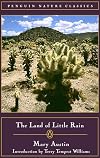
This is the first Penguin Nature Classic that I have read, and it sets a high standard for the others to meet.
Mary Austin was an early 20th century naturalist, described by Terry Tempest Williams in the Introduction to this edition: “… a woman, candid and direct, who was utterly focused on her vision, and her vision was focused on the arid lands of the American West”. Tempest describes her as cantankerous, but then goes on to say that Austin’s writing conveys “… an abiding and show more enduring compassion and humility that came through the rigors of her disciplined eye toward nature.”
I found Austin’s narrative anecdotal; more travelogue than natural science essay. She conveyed wonderfully the contrast between sparseness and abundance in the turn of the desert seasons. Tempest ascribed to Austin “… a Victorian diction written through the perceptions of a radical spirit.” For me, Austin’s prose, while not simple, does not suffer from the weight of Victorian complexity. For me, her prose sings: It tiptoes the edge of poetry from time to time; it is gorgeous. It has the rhythm, song and repetitions of traditional storytelling. I fell in love with it, starting with the third paragraph in the first essay, the one that begins: “This is the nature of that country. There are hills, rounded, blunt, burned, squeezed up out of chaos, chrome and vermillion painted, aspiring to the snow line.”
Passionate about the desert, Austin was also clear-eyed about the realities of the life and lives she loved. While she referred to animals as if they were another kind of person and members of her larger family, she did so with the respect you might expect of a St. Francis and not with the cutesy fantasy of a Disney. She was also reassuringly clear that sheep are breathtakingly dim. Sadly, she was also prescient about the impact of western migration on the health and wellbeing of her desert and its denizens.
I loved it and will reread it with pleasure. show less
Mary Austin was an early 20th century naturalist, described by Terry Tempest Williams in the Introduction to this edition: “… a woman, candid and direct, who was utterly focused on her vision, and her vision was focused on the arid lands of the American West”. Tempest describes her as cantankerous, but then goes on to say that Austin’s writing conveys “… an abiding and show more enduring compassion and humility that came through the rigors of her disciplined eye toward nature.”
I found Austin’s narrative anecdotal; more travelogue than natural science essay. She conveyed wonderfully the contrast between sparseness and abundance in the turn of the desert seasons. Tempest ascribed to Austin “… a Victorian diction written through the perceptions of a radical spirit.” For me, Austin’s prose, while not simple, does not suffer from the weight of Victorian complexity. For me, her prose sings: It tiptoes the edge of poetry from time to time; it is gorgeous. It has the rhythm, song and repetitions of traditional storytelling. I fell in love with it, starting with the third paragraph in the first essay, the one that begins: “This is the nature of that country. There are hills, rounded, blunt, burned, squeezed up out of chaos, chrome and vermillion painted, aspiring to the snow line.”
Passionate about the desert, Austin was also clear-eyed about the realities of the life and lives she loved. While she referred to animals as if they were another kind of person and members of her larger family, she did so with the respect you might expect of a St. Francis and not with the cutesy fantasy of a Disney. She was also reassuringly clear that sheep are breathtakingly dim. Sadly, she was also prescient about the impact of western migration on the health and wellbeing of her desert and its denizens.
I loved it and will reread it with pleasure. show less
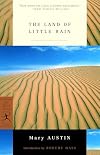
Originally published in 1903, these essays vary in location from Fort Tejon up through the Owens Valley. She originally moved to the southern San Joaquin Valley unwillingly, with her mother and two brothers, sometime before 1889. This book, her first book-length work, describes and examines residents, flora, and climate of this area before Los Angeles's aqueduct took water from Owens Lake (it was built 1908-1913), and in fact before Los Angeles was barely a city at all (the city had just show more over 100,000 people in 1900).
I especially liked the essays that included details about the flora of the areas. However, all of these essays are interesting in that they represent places and ways of life that no longer exist--but they did still exist when she was writing these pieces.
The introduction is copyright 2003 by Robert Hass, former poet laureate, a chancellor of the American Academy of Poets, and professor as Cal. This introduction is...problematic. Interestingly he calls out Austin's 1923 works as trying to appropriate Native American oral traditions. I cannot comment on the validity of that, but in this introduction he calls her daughter a "damaged child" (she was born mentally disabled as explained in the author-less author bio). He also twice calls the southern San Joaquin Valley the San Fernando Valley (pages xiii and xviii)--how this made it into print is mind-boggling to me.
This is the second nonfiction classic I had read in the last few years that has an introduction written by a poet--and both have egregious, sloppy, embarrassing errors. show less
I especially liked the essays that included details about the flora of the areas. However, all of these essays are interesting in that they represent places and ways of life that no longer exist--but they did still exist when she was writing these pieces.
The introduction is copyright 2003 by Robert Hass, former poet laureate, a chancellor of the American Academy of Poets, and professor as Cal. This introduction is...problematic. Interestingly he calls out Austin's 1923 works as trying to appropriate Native American oral traditions. I cannot comment on the validity of that, but in this introduction he calls her daughter a "damaged child" (she was born mentally disabled as explained in the author-less author bio). He also twice calls the southern San Joaquin Valley the San Fernando Valley (pages xiii and xviii)--how this made it into print is mind-boggling to me.
This is the second nonfiction classic I had read in the last few years that has an introduction written by a poet--and both have egregious, sloppy, embarrassing errors. show less

This was my grandmother's book. Lovely writing about the deserts and southern Sierras of California, along with some of the people who were there in the very early 1900s. Austin writes a beautiful picture of things one may have noticed in nature before, but never really "seen." She noticed the secret things and wrote about them in such a way that it moves our spirits as we see them through her eyes.
Lists
Awards


You May Also Like
Associated Authors
Statistics
- Works
- 33
- Also by
- 24
- Members
- 998
- Popularity
- #25,828
- Rating
- 3.9
- Reviews
- 18
- ISBNs
- 168
- Languages
- 3
- Favorited
- 1