
About the Author
Janelle Shane holds a PhD in engineering and a MS in physics. At AI Weirdness, she writes about artificial intelligence and the amusing and sometimes unsettling ways that algorithms get human things wrong. She has been featured on the main TED stage; in the New York limes. The Atlantic, Wired, show more Popular Science, and more; and on NPR's All Things Considered, Science Friday, and Marketplace. She was named one of Fast Company's 100 Most Creative People in Business and an Adweek Young Influential. show less
Works by Janelle Shane
You Look Like a Thing and I Love You: How Artificial Intelligence Works and Why It's Making the World a Weirder Place (2019) 443 copies, 20 reviews
Commercial Classics 1 copy
Tagged
Common Knowledge
- Birthdate
- c. 1985
- Gender
- female
- Education
- University of California, San Diego (graduate student|2008)
Michigan State University (electrical engineering|2007)
St Andrew's University (masters|physics) - Occupations
- research scientist (artificial intelligence)
- Organizations
- Boulder Nonlinear Systems
- Short biography
- Janelle Shane has a PhD in electrical engineering and a master's in physics. At aiweirdness.com, she writes about artificial intelligence and the hilarious and sometimes unsettling ways that algorithms get human things wrong. She was named one of Fast Company's 100 Most Creative People in Business and is a 2019 TED Talks speaker. Her work has appeared in the New York Times, Slate, The Atlantic, Popular Science, and more. She is almost certainly not a robot.
- Nationality
- USA
- Associated Place (for map)
- USA
Members
Reviews
You look like a thing and i love you : how artificial intelligence works and why it's making the world a weirder place by Janelle Shane

If you’ve ever wondered about how artificial intelligence works, this is the book you want to read. It’s a funny, accessible introduction to the field, explaining the different types of artificial intelligence and how they work—or how they don’t. Artificial intelligence does exactly what you tell it to and has no understanding of context or bias. It will amplify bias in existing datasets and reveal surprising connections between other bits of data, so it requires care and show more maintenance, and a clear understanding of its limitations, in order to be used effectively.
I really, really enjoyed this book. The cartoons were great—I want a T-shirt with the little AI on it!—and the examples of AI output had me snorting out loud frequently. It was in fact Shane’s Twitter feed, with a thread of AI-generated 1970s recipes, that drew me to this book, so if you like her Twitter or her blog (AI Weirdness), you’ll like this book. It explains concepts clearly, uses bolding to highlight key terms, and employs visible endnotes so you can follow the sources.
Recommended for anyone who uses anything dependent on algorithms—and this includes cat-ear filters on Instagram. show less
I really, really enjoyed this book. The cartoons were great—I want a T-shirt with the little AI on it!—and the examples of AI output had me snorting out loud frequently. It was in fact Shane’s Twitter feed, with a thread of AI-generated 1970s recipes, that drew me to this book, so if you like her Twitter or her blog (AI Weirdness), you’ll like this book. It explains concepts clearly, uses bolding to highlight key terms, and employs visible endnotes so you can follow the sources.
Recommended for anyone who uses anything dependent on algorithms—and this includes cat-ear filters on Instagram. show less
You Look Like a Thing and I Love You: How Artificial Intelligence Works and Why It's Making the World a Weirder Place by Janelle Shane
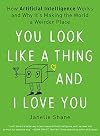
The "artificial intelligence" referred to in the subtitle is, specifically, machine learning. That is, computer algorithms that are trained on specific sets of data and learn to do things with that data through trial and error, for instance, identifying images or generating intelligible (or maybe semi-intelligible) text. Janelle Shane covers how these programs work, what they're used for, what they're good at, what they're bad at, and the various ways -- some hilarious, some disturbing, some show more just plain weird -- in which they can go wrong.
It's all extremely readable, even fun. Shane, I think, gives readers a very good sense of how this stuff works without ever getting dry or technical, and keeps a charming sense of humor throughout. The little cartoon illustrations she uses are extremely cute, and sometimes genuinely illuminating. I found it fascinating, thought-provoking, entertaining, and more than a little bit worrying. Definitely recommended for anyone at all curious about this strange new technology and where it's taking us. show less
It's all extremely readable, even fun. Shane, I think, gives readers a very good sense of how this stuff works without ever getting dry or technical, and keeps a charming sense of humor throughout. The little cartoon illustrations she uses are extremely cute, and sometimes genuinely illuminating. I found it fascinating, thought-provoking, entertaining, and more than a little bit worrying. Definitely recommended for anyone at all curious about this strange new technology and where it's taking us. show less
You Look Like a Thing and I Love You: How Artificial Intelligence Works and Why It's Making the World a Weirder Place by Janelle Shane
This is a layman’s introduction to how AI works and what it can and cannot do. It’s a really fun read - it’s full of really silly examples of AI’s messing up in hilarious ways (such as an AI that was told to move from point A to point B, and it decided the best way to get there was to make itself as tall as the distance between the two points and then fall over).
The big takeaways for me were (1) that even AI researchers don’t always understand how AI works, and (2) that AI is show more nowhere near as magical and capable as AI companies would have you think.
AI is already a big part of our daily lives, and is going to continue to be more and more important. It's also important that we understand what AI is and what it can and cannot do - right now a lot of tech companies are making a lot of money by selling us an AI-driven future where everything is easy and computers can solve all of our problems, but this book makes it very (hilariously) clear that an AI-driven future is going to be weird and buggy, and that AI has the potential to be very problematic if not used correctly. show less
The big takeaways for me were (1) that even AI researchers don’t always understand how AI works, and (2) that AI is show more nowhere near as magical and capable as AI companies would have you think.
AI is already a big part of our daily lives, and is going to continue to be more and more important. It's also important that we understand what AI is and what it can and cannot do - right now a lot of tech companies are making a lot of money by selling us an AI-driven future where everything is easy and computers can solve all of our problems, but this book makes it very (hilariously) clear that an AI-driven future is going to be weird and buggy, and that AI has the potential to be very problematic if not used correctly. show less
You Look Like a Thing and I Love You: How Artificial Intelligence Works and Why It's Making the World a Weirder Place by Janelle Shane

This came out in 2019, after OpenAI released GPT-2 but well before ChatGPT's release. While I'd love to read an updated work by Shane (no amount of checking has made it poof into existence, alas), as far as I could tell this was still a really useful introduction to how artificial intelligence works and what its strengths and weakness are. Shane lays out what AI is and isn't, how it learns, the various ways it can run into trouble, the instances of disconnect between what humans ask AI to do show more and what it actually does, and more.
I first became aware of this work after stumbling on some of Shane's hilarious machine learning blog posts on Twitter (way back when Twitter was Twitter). In fact, the title of this book comes from one such post on AI-generated pickup lines. Still, it sat on my TBR pile for years until ChatGPT came out and became a hot enough topic in academia to be mentioned several times during a Q&A session with a library job candidate.
While I appreciated Shane's humor and adorable little AI illustrations throughout, this also contained plenty of useful information written in a way that was relatively easy for someone without much of a technical background to understand. I'd have liked to see slightly more technical information than Shane provided (for example, I feel like I got a good general understanding of how AI training works, but I still can't picture what actually doing it looks like), but overall Shane's explanations were really clear and made good use of examples. One real-world example that stuck with me that illustrated AI's reliance on its training data and difficulties when asked to do a broader task than it was trained for (because AI does better with narrower tasks) was a self-driving car that had only been trained for highway driving. Its human driver had it take over while it was still in the city and it ended up hitting the side of a semi - it had only ever been trained to recognize semis from the back, so when it saw one from the side it interpreted it as best it could, decided it was an overhead sign, and didn't slow down for it.
I've already recommended this book to several of my fellow librarians as an accessible way to learn about AI and maybe get some ideas for how to talk about it to faculty and students.
(Original review posted on A Library Girl's Familiar Diversions.) show less
I first became aware of this work after stumbling on some of Shane's hilarious machine learning blog posts on Twitter (way back when Twitter was Twitter). In fact, the title of this book comes from one such post on AI-generated pickup lines. Still, it sat on my TBR pile for years until ChatGPT came out and became a hot enough topic in academia to be mentioned several times during a Q&A session with a library job candidate.
While I appreciated Shane's humor and adorable little AI illustrations throughout, this also contained plenty of useful information written in a way that was relatively easy for someone without much of a technical background to understand. I'd have liked to see slightly more technical information than Shane provided (for example, I feel like I got a good general understanding of how AI training works, but I still can't picture what actually doing it looks like), but overall Shane's explanations were really clear and made good use of examples. One real-world example that stuck with me that illustrated AI's reliance on its training data and difficulties when asked to do a broader task than it was trained for (because AI does better with narrower tasks) was a self-driving car that had only been trained for highway driving. Its human driver had it take over while it was still in the city and it ended up hitting the side of a semi - it had only ever been trained to recognize semis from the back, so when it saw one from the side it interpreted it as best it could, decided it was an overhead sign, and didn't slow down for it.
I've already recommended this book to several of my fellow librarians as an accessible way to learn about AI and maybe get some ideas for how to talk about it to faculty and students.
(Original review posted on A Library Girl's Familiar Diversions.) show less
Lists
Awards


You May Also Like


Associated Authors
Statistics
- Works
- 2
- Members
- 444
- Popularity
- #55,178
- Rating
- 4.3
- Reviews
- 20
- ISBNs
- 12