
Mark R. Glanville
Author of Refuge Reimagined: Biblical Kinship in Global Politics
About the Author
Mark H. Glanville is associate professor of pastoral theology at Regent College in Vancouver, British Columbia, and author of Adopting the Stranger as Kindred in Deuteronomy. He pastored for over a decade in Canada and Australia.
Works by Mark R. Glanville
Preaching in a New Key: Crafting Expository Sermons in Post-Christian Communities (2025) 19 copies, 2 reviews
Tagged
Common Knowledge
There is no Common Knowledge data for this author yet. You can help.
Members
Reviews

Summary: A case for welcoming refugees based on the biblical ethic of kinship, and the responsibility of kin to provide a home for those who have none, with applications to the church, the nation, and the international community.
In 2019, 79.5 million people in the world had been forcibly displaced from their homes. Causes range from political and religious persecution, conflict, violence, human rights violations, and the breakdown of the rule of law. In 2020, the United States admitted just show more 11,814 of these people, less than the 18,000 places allotted. Similar numerical disparities exist in many countries while poorer neighbors often absorb higher numbers, many in refugee camps.
Faced with these great needs and the reality that sending many people back to their homes is a sentence to a quick or slow death, many countries are closing their borders to refugees, claiming they have more than enough to do caring for their own people. Many church communities support these restrictive policies, citing scriptures supporting the rule of law and even the idea that the passages about welcoming the alien and stranger apply only to “legal” immigrants.
The authors of this work are involved in a community, Kinbrace, in Vancouver providing refugee housing and support. Out of their careful reading of scripture and their experience, they argue that the biblical idea of providing kinship hospitality runs through scripture as God provides a home for Israel as slave-refugees and enjoins this hospitality with others, exemplified beautifully in the story of Ruth. In the New Testament, the story is one of reconciliation both to God and across all human boundaries. The shared table, feasting together as the family of God is a prominent symbol of that reality.
They then build on their biblical study to address three areas where kinship may be practiced. First is the church and they explore a variety of ways churches can practice this ethic in worship and welcome. Then they turn to nations. They consider what it is for nations to practice justice with refugees, and address the objections of maintaining national identity and the argument that scripture only requires care for those who enter the country “legally.” They show that no such biblical warrant exists. Finally, they address the climate of fear that tinges these discussions, reminding us in the words of Marilynne Robinson: “Fear is not a Christian habit of mind.” Finally they argue for an ethic of kinship in the global community, challenging the approach of political realism.
I found myself in full agreement with the biblical arguments of kinship, and particularly, their relevance to believing people who are called to “…welcome one another as Christ has welcomed you, for the glory of God” (Romans 15:7, ESV). I was more troubled by the way in which it seemed they were calling on Christians to advocate with national governments and international bodies to do this. I would have liked to see more of the book devoted to addressing how churches and other organizations can fully prepare to become refugee welcoming communities. Instead of saying to governmental leaders, “we want you to open the borders to more refugees,” with the inference that federal, state, and local governments would bear the weight of this effort, imagine the reaction if church leaders came to government and said, “we have mobilized a network of 10,000 churches and organizations, who are trained and prepared according to best practices to welcome 100,000 refugees and integrate them into our local communities. We’re asking you to work with us to make that possible.”
There’s a lot of heavy lifting with this idea. But I don’t hear the authors discussing the heavy lifting we are asking governments to do, often against the political grain of their populace, to embrace a kinship ethic. I wonder if more hearts may be won by local communities across the country who are becoming known for their generous hospitality, in which others around them see how much fun they are having doing this, and how their communities are enriched by those they welcome, as they fill needed jobs, start businesses, and add the richness of their cultures to our towns and cities.
That said, the appeal to kinship, to expanding our boundaries of “neighbor,” and to trade our fears for the joy of the festive table is compelling. I suspect the beginning in many places are for groups to study and discuss this book, begin learning about groups like Kinbrace, who are involved in refugee work, and pray, dream, and work to mobilize the resources needed in their community. What I hope will arise are supporting structures without bureaucracy to amplify the efforts of these local groups through advocacy, training, and networking. It seems to me, given the magnitude of the crisis, which is likely to grow, that this kind of mobilization is key if we would extend the wings of refuge to more than just a token few.
____________________________
Disclosure of Material Connection: I received a complimentary review copy of this book from the publisher in exchange for an honest review. The opinions I have expressed are my own. show less
In 2019, 79.5 million people in the world had been forcibly displaced from their homes. Causes range from political and religious persecution, conflict, violence, human rights violations, and the breakdown of the rule of law. In 2020, the United States admitted just show more 11,814 of these people, less than the 18,000 places allotted. Similar numerical disparities exist in many countries while poorer neighbors often absorb higher numbers, many in refugee camps.
Faced with these great needs and the reality that sending many people back to their homes is a sentence to a quick or slow death, many countries are closing their borders to refugees, claiming they have more than enough to do caring for their own people. Many church communities support these restrictive policies, citing scriptures supporting the rule of law and even the idea that the passages about welcoming the alien and stranger apply only to “legal” immigrants.
The authors of this work are involved in a community, Kinbrace, in Vancouver providing refugee housing and support. Out of their careful reading of scripture and their experience, they argue that the biblical idea of providing kinship hospitality runs through scripture as God provides a home for Israel as slave-refugees and enjoins this hospitality with others, exemplified beautifully in the story of Ruth. In the New Testament, the story is one of reconciliation both to God and across all human boundaries. The shared table, feasting together as the family of God is a prominent symbol of that reality.
They then build on their biblical study to address three areas where kinship may be practiced. First is the church and they explore a variety of ways churches can practice this ethic in worship and welcome. Then they turn to nations. They consider what it is for nations to practice justice with refugees, and address the objections of maintaining national identity and the argument that scripture only requires care for those who enter the country “legally.” They show that no such biblical warrant exists. Finally, they address the climate of fear that tinges these discussions, reminding us in the words of Marilynne Robinson: “Fear is not a Christian habit of mind.” Finally they argue for an ethic of kinship in the global community, challenging the approach of political realism.
I found myself in full agreement with the biblical arguments of kinship, and particularly, their relevance to believing people who are called to “…welcome one another as Christ has welcomed you, for the glory of God” (Romans 15:7, ESV). I was more troubled by the way in which it seemed they were calling on Christians to advocate with national governments and international bodies to do this. I would have liked to see more of the book devoted to addressing how churches and other organizations can fully prepare to become refugee welcoming communities. Instead of saying to governmental leaders, “we want you to open the borders to more refugees,” with the inference that federal, state, and local governments would bear the weight of this effort, imagine the reaction if church leaders came to government and said, “we have mobilized a network of 10,000 churches and organizations, who are trained and prepared according to best practices to welcome 100,000 refugees and integrate them into our local communities. We’re asking you to work with us to make that possible.”
There’s a lot of heavy lifting with this idea. But I don’t hear the authors discussing the heavy lifting we are asking governments to do, often against the political grain of their populace, to embrace a kinship ethic. I wonder if more hearts may be won by local communities across the country who are becoming known for their generous hospitality, in which others around them see how much fun they are having doing this, and how their communities are enriched by those they welcome, as they fill needed jobs, start businesses, and add the richness of their cultures to our towns and cities.
That said, the appeal to kinship, to expanding our boundaries of “neighbor,” and to trade our fears for the joy of the festive table is compelling. I suspect the beginning in many places are for groups to study and discuss this book, begin learning about groups like Kinbrace, who are involved in refugee work, and pray, dream, and work to mobilize the resources needed in their community. What I hope will arise are supporting structures without bureaucracy to amplify the efforts of these local groups through advocacy, training, and networking. It seems to me, given the magnitude of the crisis, which is likely to grow, that this kind of mobilization is key if we would extend the wings of refuge to more than just a token few.
____________________________
Disclosure of Material Connection: I received a complimentary review copy of this book from the publisher in exchange for an honest review. The opinions I have expressed are my own. show less
Preaching in a New Key: Crafting Expository Sermons in Post-Christian Communities by Mark R. Glanville
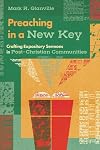
The Gospel has been proclaimed for thousands of years, but the work of presenting the Gospel in an effective way in any given culture and society is ever new and ever transformative. Resources to help encourage preachers to well preach in their contexts are always appreciated.
Mark Glanville’s Preaching in a New Key: Crafting Expository Sermons in Post-Christian Communities (galley received as part of early review program, but full book read) provides a refreshing and important update to show more the standard collection of books regarding preaching.
The author is a preacher and also a jazz musician, and throughout will use the language and metaphors of jazz to present his exhortations (hence, the “new key”). The author begins by encouraging the preacher to first consider himself and his condition, an appropriate and wise place to begin. He also encourages consideration of what preaching in the church is about in terms of nourishing shared life in community. He would also have the preacher consider the context in which he is preaching, one in which preachers do not have as much intrinsic credibility as in the past, and an environment in which one will have to be more patient and help people work through doubt and other challenges.
He then explored the craft of preaching and the skills involved in composing sermons, how they can be crafted, how the material can be presented, and even the mechanics of sketching out passages and sermons.
The author also considers the great tradition of the faith, and how preachers do well to learn about the tradition, trust it, and exegete according to it. Even if one is not inclined to put a lot of trust in tradition, one should still do well to honor and respect it and remain in conversation with it.
The author encourages the preacher to go beyond the basics and also consider how to preach well and beautifully, to infuse the proclamation of the message with creativity, the tone and posture the preacher should maintain, how to encourage the church to represent a community with contrastive values in well reflecting Jesus to its neighborhood, and how to well uphold justice but also addressing some of the less than pleasant aspects of Scripture. The author also provides appendices with guides to preaching on themes, shorter texts, and encouraging people to see their regular lives as vocations for God.
Some challenges do attend to the work. The author strongly promotes exegetical preaching, as the subheading suggests. There’s certainly nothing wrong with exegetical preaching; I will do it myself often. But it’s not the only form of preaching, and claims to the contrary should always be treated with extreme skepticism and prejudice. At times the author can get (seemingly strangely) rather dogmatic, especially as he would relate to the passages of violence in the Old Testament. Alas, we all have our points of dogmatism, for better and/or for worse.
Nevertheless, this is one of the first preaching resources I have come across which I have felt well addresses the challenges of the modern world in terms of grappling with the self and one’s own issues, being at least somewhat trauma informed, and appropriately culturally sensitive in ways which glorifies God and upholds the authority and integrity of Scripture. To that end I heartily endorse the work for all preachers. show less
Mark Glanville’s Preaching in a New Key: Crafting Expository Sermons in Post-Christian Communities (galley received as part of early review program, but full book read) provides a refreshing and important update to show more the standard collection of books regarding preaching.
The author is a preacher and also a jazz musician, and throughout will use the language and metaphors of jazz to present his exhortations (hence, the “new key”). The author begins by encouraging the preacher to first consider himself and his condition, an appropriate and wise place to begin. He also encourages consideration of what preaching in the church is about in terms of nourishing shared life in community. He would also have the preacher consider the context in which he is preaching, one in which preachers do not have as much intrinsic credibility as in the past, and an environment in which one will have to be more patient and help people work through doubt and other challenges.
He then explored the craft of preaching and the skills involved in composing sermons, how they can be crafted, how the material can be presented, and even the mechanics of sketching out passages and sermons.
The author also considers the great tradition of the faith, and how preachers do well to learn about the tradition, trust it, and exegete according to it. Even if one is not inclined to put a lot of trust in tradition, one should still do well to honor and respect it and remain in conversation with it.
The author encourages the preacher to go beyond the basics and also consider how to preach well and beautifully, to infuse the proclamation of the message with creativity, the tone and posture the preacher should maintain, how to encourage the church to represent a community with contrastive values in well reflecting Jesus to its neighborhood, and how to well uphold justice but also addressing some of the less than pleasant aspects of Scripture. The author also provides appendices with guides to preaching on themes, shorter texts, and encouraging people to see their regular lives as vocations for God.
Some challenges do attend to the work. The author strongly promotes exegetical preaching, as the subheading suggests. There’s certainly nothing wrong with exegetical preaching; I will do it myself often. But it’s not the only form of preaching, and claims to the contrary should always be treated with extreme skepticism and prejudice. At times the author can get (seemingly strangely) rather dogmatic, especially as he would relate to the passages of violence in the Old Testament. Alas, we all have our points of dogmatism, for better and/or for worse.
Nevertheless, this is one of the first preaching resources I have come across which I have felt well addresses the challenges of the modern world in terms of grappling with the self and one’s own issues, being at least somewhat trauma informed, and appropriately culturally sensitive in ways which glorifies God and upholds the authority and integrity of Scripture. To that end I heartily endorse the work for all preachers. show less
Preaching in a New Key: Crafting Expository Sermons in Post-Christian Communities by Mark R. Glanville
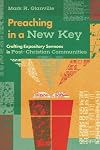
Summary: A guide to engaging in Christ-centered expository preaching that is culturally resonant in Post-Christian settings.
Mark R. Glanville believes in expository preaching. But he argues that our practice needs to shift in two key ways. First, we need to understand the complexities of believing for people in our culture and communicate both sensitively and effectively. Second, our preaching should focus on nourishing “communities of hope” that extend the healing ministry of Jesus in show more our neighborhoods. He recognizes that something has shifted in the culture and that preaching needs to be cognizant of that shift. Rather than making authoritative pronouncements from scripture, he argues for the “ironic authority of scripture.” That is, as we exposit the lack of cultural plausibility of the text, it breaks through as a word from God, and not just more Christian culture. In this book, Glanville unpacks approaches that he’s found resonate in Post-Christian settings.
After a prologue studying the nature of preaching in the Bible, he explores the personal awareness preachers need to cultivate in a section titled “Deeper.” This begins with self-awareness and emotional health. We communicate with our whole selves, healthily or not. He then focuses on knowing one’s church, shaping a community pursuing life and the love of Jesus together. Finally, he invites contextually aware preaching–particularly of the doubts and questions people bring. He argues for “reversing the flow.” That is, recognizing these doubts and questions as one opens the scripture and displays the wisdom and beauty of Christ.
Then Glanville gets down to “Craft” in Part Two. He begins with composing, following the structure of the text. He emphasizes identifying the “through line.” Derived from one’s exegetical summary, it is the idea running through the text. He describes artisan skills consisting of eight practices and eight “licks” (Glanville’s a jazz musician) that make an exposition come to life. “Playing with Heart” speaks to the appropriate appeal to emotion–from the heart to the heart. This chapter also includes a very practical schedule for preparation. Glanville concludes the section by explaining his preaching sketchpad, which integrates the various elements he has been unpacking. The sketchpad is available for free download at: https://www.ivpress.com/Media/Default...
Part Three turns to “Tradition.” By this, Glanville is referring to representing scripture accurately in all its richness. “Learning the Tradition” focuses on knowing the story, being clear on the gospel, understanding the nature of witness, and what is biblical ethics. “Trusting the Tradition” returns to the idea of authority, and the centrality of Jesus. Finally, “Exegeting the Tradition” offers guidelines for the exegetical work basic to developing a message.
The final part of the book turns from the mechanics of preparation to the artistry of preaching. “Creativity” focuses on how we weave beauty into sermons through the use of imagination and the arts. Then “Posture” creates space for people to explore and consider in safety. This includes intercultural sensitivity and awareness of traumas experienced in the community. Turning to the “Church,” Glanville explores how one weaves together rhythms of scripture, the local congregation, the neighborhood and the wider church. However, beauty doesn’t preclude addressing violence in scripture and texts that teach about justice in society. This is the focus of the final chapter in this section.
In addition, the book includes three appendices on preaching on a theme, preaching a short text, and connecting to the Monday through Saturday vocations of people. Throughout, Glanville uses graphics to explain points, offers a number of lists of practical suggestions, and relates all this to his own work.
In conclusion, Granville offers an approach to expository teaching that exegetes not only the text but the listening community and that moves from head to heart while remaining faithful to the biblical text. Practical considerations are balanced by attention to the health and heart of the preacher, so crucial in a time prizing authenticity. This book distills so much wisdom about preaching that one might call it a shop manual for preachers. This book will not only be read once and set aside. You will find yourself referencing it in different seasons of your preaching life.
_______________________
Disclosure of Material Connection: I received a complimentary copy of this book from the publisher for review. show less
Mark R. Glanville believes in expository preaching. But he argues that our practice needs to shift in two key ways. First, we need to understand the complexities of believing for people in our culture and communicate both sensitively and effectively. Second, our preaching should focus on nourishing “communities of hope” that extend the healing ministry of Jesus in show more our neighborhoods. He recognizes that something has shifted in the culture and that preaching needs to be cognizant of that shift. Rather than making authoritative pronouncements from scripture, he argues for the “ironic authority of scripture.” That is, as we exposit the lack of cultural plausibility of the text, it breaks through as a word from God, and not just more Christian culture. In this book, Glanville unpacks approaches that he’s found resonate in Post-Christian settings.
After a prologue studying the nature of preaching in the Bible, he explores the personal awareness preachers need to cultivate in a section titled “Deeper.” This begins with self-awareness and emotional health. We communicate with our whole selves, healthily or not. He then focuses on knowing one’s church, shaping a community pursuing life and the love of Jesus together. Finally, he invites contextually aware preaching–particularly of the doubts and questions people bring. He argues for “reversing the flow.” That is, recognizing these doubts and questions as one opens the scripture and displays the wisdom and beauty of Christ.
Then Glanville gets down to “Craft” in Part Two. He begins with composing, following the structure of the text. He emphasizes identifying the “through line.” Derived from one’s exegetical summary, it is the idea running through the text. He describes artisan skills consisting of eight practices and eight “licks” (Glanville’s a jazz musician) that make an exposition come to life. “Playing with Heart” speaks to the appropriate appeal to emotion–from the heart to the heart. This chapter also includes a very practical schedule for preparation. Glanville concludes the section by explaining his preaching sketchpad, which integrates the various elements he has been unpacking. The sketchpad is available for free download at: https://www.ivpress.com/Media/Default...
Part Three turns to “Tradition.” By this, Glanville is referring to representing scripture accurately in all its richness. “Learning the Tradition” focuses on knowing the story, being clear on the gospel, understanding the nature of witness, and what is biblical ethics. “Trusting the Tradition” returns to the idea of authority, and the centrality of Jesus. Finally, “Exegeting the Tradition” offers guidelines for the exegetical work basic to developing a message.
The final part of the book turns from the mechanics of preparation to the artistry of preaching. “Creativity” focuses on how we weave beauty into sermons through the use of imagination and the arts. Then “Posture” creates space for people to explore and consider in safety. This includes intercultural sensitivity and awareness of traumas experienced in the community. Turning to the “Church,” Glanville explores how one weaves together rhythms of scripture, the local congregation, the neighborhood and the wider church. However, beauty doesn’t preclude addressing violence in scripture and texts that teach about justice in society. This is the focus of the final chapter in this section.
In addition, the book includes three appendices on preaching on a theme, preaching a short text, and connecting to the Monday through Saturday vocations of people. Throughout, Glanville uses graphics to explain points, offers a number of lists of practical suggestions, and relates all this to his own work.
In conclusion, Granville offers an approach to expository teaching that exegetes not only the text but the listening community and that moves from head to heart while remaining faithful to the biblical text. Practical considerations are balanced by attention to the health and heart of the preacher, so crucial in a time prizing authenticity. This book distills so much wisdom about preaching that one might call it a shop manual for preachers. This book will not only be read once and set aside. You will find yourself referencing it in different seasons of your preaching life.
_______________________
Disclosure of Material Connection: I received a complimentary copy of this book from the publisher for review. show less
Statistics
- Works
- 5
- Members
- 75
- Popularity
- #235,803
- Rating
- 4.0
- Reviews
- 3
- ISBNs
- 11