
Hadley Wickham (1)
Author of R for Data Science: Import, Tidy, Transform, Visualize, and Model Data
For other authors named Hadley Wickham, see the disambiguation page.
About the Author
Hadley Wickham is Chief Scientist at RStudio, an Adjunct Professor at Stanford University and the University of Auckland, and a member of the R Foundation. He is the lead developer of the tidyverse, a collection of R packages, including ggplot2 and dplyr, designed to support data science. He is show more also the author of R for Data Science (with Garrett Grolemund), R Packages, and ggpiot2: Elegant Graphics for Data Analysis. show less
Image credit: From Prof. Hadley Wickham's Homepage. Copyright © Prof. Hadley Wickham. All rights reserved.
Works by Hadley Wickham
R for Data Science: Import, Tidy, Transform, Visualize, and Model Data (2017) — Author — 291 copies, 5 reviews
Associated Works
Beautiful Data: The Stories Behind Elegant Data Solutions (2009) — Contributor — 276 copies, 3 reviews
Tagged
Common Knowledge
- Gender
- male
- Nationality
- New Zealand
- Associated Place (for map)
- New Zealand
Members
Reviews
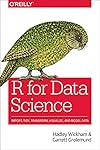
If the above quote is the mission of this book, consider the task accomplished. Where most books in computer science fall down in trying to be cute while communicating an educational message, this book addresses the task of education about R squarely, and it does so in a manner that engages the mind with interesting problems.
Usually, I skip the exercises sections of most computer books because, well, they offer challenges that are underwhelming. Recall is all that is required to answer them. show more Usually, I can figure them out in the confines of my mind so that I don't have to waste my time looking up the answers or coding example code to check whether I'm right or where I err.
Not so for Hadley Wickham. Many of his questions were awakened my curiosity and had me applying me new knowledge in R Studio immediately. In fact, the only way I could answer my burning curiosity was to write code in order to test my hypotheses.
Rare is the computer book that is a page turner. This book qualifies as just that if one has the aptitude in statistics to embrace the challenges. R is an ideal language to handles these challenges in statistics, and Wickham and Grodemund fill the role of ideal apostles/evangelists to share this free fruit.
The fun part about R is that it is free, creative, and well-supplied with packages to solve interesting statistical problems. This book carries that message squarely to my lap (and then to my brain) in an engaging manner. show less
Usually, I skip the exercises sections of most computer books because, well, they offer challenges that are underwhelming. Recall is all that is required to answer them. show more Usually, I can figure them out in the confines of my mind so that I don't have to waste my time looking up the answers or coding example code to check whether I'm right or where I err.
Not so for Hadley Wickham. Many of his questions were awakened my curiosity and had me applying me new knowledge in R Studio immediately. In fact, the only way I could answer my burning curiosity was to write code in order to test my hypotheses.
Rare is the computer book that is a page turner. This book qualifies as just that if one has the aptitude in statistics to embrace the challenges. R is an ideal language to handles these challenges in statistics, and Wickham and Grodemund fill the role of ideal apostles/evangelists to share this free fruit.
The fun part about R is that it is free, creative, and well-supplied with packages to solve interesting statistical problems. This book carries that message squarely to my lap (and then to my brain) in an engaging manner. show less
This is one of the best O'Reilly books I've read. For context, I'm a graphics programmer that fell into sci vis, e.g., visualizing fluid simualtions, and is now pivoting into info vis.
Part I: Explore gives an overview of using R+ggplot2+some tidyverse to do exploratory data analysis. It is one of the best intro overview dives I've come across for any type of programming. Most dives of this sort have at least one or two gaps in material or unclear motivation or try to do too much. This was show more perfectly crafted to lead someone into the tidyverse.
Part II: Wrangle is a more thorough look at the tidyverse. I recommend supplementing this by reading Wickham's original paper on tidy data.
Part III: Program was a little tedious because I already have decades of programming experience, though the coverage of purrr is interesting.
Part IV: Model covers building linear and non- models. I don't have a statistics background but even so found this easy to follow and very clear.
Part V: Communicate is a smorgasbord of R Markdown and options building on top of it. I thought this section had a bit of a conflicting message to end on, because after 400 some pages of doing work in RStudio with .R script files, the authors all of a sudden seem to say to forget all that and do everything as R Markdown. Which is fine, but if that's their recommendation I think introducing that earlier would have been better.
There are some copy editing issues, luckily Wickham has an updated online edition with corrections. Some of the exercises weren't entirely clear as to intent, but that could entirely be do to my lacking stats background. (Plenty of people have posted solutions online if you get stuck.) show less
Part I: Explore gives an overview of using R+ggplot2+some tidyverse to do exploratory data analysis. It is one of the best intro overview dives I've come across for any type of programming. Most dives of this sort have at least one or two gaps in material or unclear motivation or try to do too much. This was show more perfectly crafted to lead someone into the tidyverse.
Part II: Wrangle is a more thorough look at the tidyverse. I recommend supplementing this by reading Wickham's original paper on tidy data.
Part III: Program was a little tedious because I already have decades of programming experience, though the coverage of purrr is interesting.
Part IV: Model covers building linear and non- models. I don't have a statistics background but even so found this easy to follow and very clear.
Part V: Communicate is a smorgasbord of R Markdown and options building on top of it. I thought this section had a bit of a conflicting message to end on, because after 400 some pages of doing work in RStudio with .R script files, the authors all of a sudden seem to say to forget all that and do everything as R Markdown. Which is fine, but if that's their recommendation I think introducing that earlier would have been better.
There are some copy editing issues, luckily Wickham has an updated online edition with corrections. Some of the exercises weren't entirely clear as to intent, but that could entirely be do to my lacking stats background. (Plenty of people have posted solutions online if you get stuck.) show less
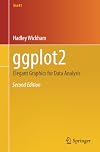
Having a "grammar of graphics" is such a useful and appealing concept. After years of hacking at the inconsistencies between various versions of the industry's dominant tool, I was quickly drawn to ggplot2. This guide by the package's creator is necessary and sufficient. The concepts are concise but thorough. Wickham often includes external examples to push the reader's thinking about what makes for an effective visualization. Working my way through the theory and the practice examples show more quickly accelerated my skills. More importantly, it's given me a framework for thinking about visualization in general. show less

This is another book that applies to one of my nascent passions: Statistical programming with R. This book brings forth the central visualization package in ggplot by its author Hadley Wickham. Like most of Hadley's works, the book is meticulously researched and extremely clear. It is a winner in accomplishing its goals of introducing visualization in R. It even contains a short section on modeling in R.
For those who don't know what R is, it is a statistical programming language. It helps show more statisticians (or programmers like myself) do statistical work efficiently. Hadley is a strong exponent in the community, and this work tells advanced users of R how to do visualization work. It is not meant as an introduction to R (i.e., R for beginners), but as a follow-up book, much like two of Hadley's other works, Advanced R or R Packages.
Hadley uses Leland Wilkinson's The Grammar of Graphics to dissect how graphing works. Data is abstracted from an aesthetic mapping which controls how the data is communicated (e.g., through bar graphs, line graphs, pie graphs). Then these are combined together to give the programmer more control of the graph.
By existing within a programming language (R), this method gives the programmer/user much more control over the final product. Thus, high quality visualizations become a reality with ggplot. Unfortunately, one has to spend time reading a book in order to learn how to do that, but that is a small price to pay for enhanced quality and control. This book is worth the time. show less
For those who don't know what R is, it is a statistical programming language. It helps show more statisticians (or programmers like myself) do statistical work efficiently. Hadley is a strong exponent in the community, and this work tells advanced users of R how to do visualization work. It is not meant as an introduction to R (i.e., R for beginners), but as a follow-up book, much like two of Hadley's other works, Advanced R or R Packages.
Hadley uses Leland Wilkinson's The Grammar of Graphics to dissect how graphing works. Data is abstracted from an aesthetic mapping which controls how the data is communicated (e.g., through bar graphs, line graphs, pie graphs). Then these are combined together to give the programmer more control of the graph.
By existing within a programming language (R), this method gives the programmer/user much more control over the final product. Thus, high quality visualizations become a reality with ggplot. Unfortunately, one has to spend time reading a book in order to learn how to do that, but that is a small price to pay for enhanced quality and control. This book is worth the time. show less
You May Also Like


Associated Authors
Statistics
- Works
- 6
- Also by
- 1
- Members
- 532
- Popularity
- #46,803
- Rating
- 4.1
- Reviews
- 9
- ISBNs
- 42
- Languages
- 3