
Reuven Hammer (1933–2019)
Author of Entering Jewish Prayer: A Guide to Personal Devotion and the Worship Service
About the Author
Image credit: via Gefen Publishing House
Works by Reuven Hammer
Entering Jewish Prayer: A Guide to Personal Devotion and the Worship Service (1994) 284 copies, 1 review
The Classic Midrash: Tannaitic Commentaries on the Bible (Classics of Western Spirituality) (1995) 119 copies, 1 review
Tagged
Common Knowledge
- Canonical name
- Hammer, Reuven
- Legal name
- Hammer, Reuven
- Other names
- HAMMER, Reuven
- Birthdate
- 1933
- Date of death
- 2019-08-12
- Gender
- male
- Occupations
- rabbi
professor - Organizations
- New London Synagogue
Va'ad Halakhah
The Rabbinical Council - Awards and honors
- Simon Greenburg Award for Lifetime Acheivement
- Cause of death
- brain tumour
- Nationality
- UK
- Places of residence
- London, England, UK
Jerusalem, Israel - Associated Place (for map)
- UK
Members
Reviews
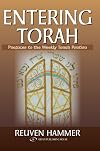
From the foreword” Studying the weekly Torah portion-Parashat hashavua- is an ancient Jewish practice that is in enshrined in codes of Jewish Law”. Whether you are a devote follower of the Jewish faith or someone like me who is not Jewish but wishes to learn more about the faith and the Torah Entering Torah is a truly remarkable book.
Three years ago I took a college class that was supposed to be a survey of world religion but ended up being a personal quest to learn more about Judaism. show more The history of the people, culture and religion appeals to me on a deeply spiritual level. I have read several books on Judaism and the Torah but this is the first book that explains what the Torah meant to those who wrote it and what it means to those who follow its laws today. Entering Torah is meant to be a study guide for the Torah and oh what a guide it is! Rabbi Hammer takes the reader on a journey through the Torah explaining in easy to understand terms the meaning behind the stories.
I had always wondered why G-d had to rest on the seventh day so imagine my delight when I read Rabbi Hammer’s explanation as to why this was written. G-d does not need to rest he explains but we do. For the workaholic this story illustrates the point that if G-d could take a day of rest so should man. I thought I understood the story of Cain and Abel as a lesson on anger and envy, yet Rabbi Hammer shows us there is much more to the story. “Every murder, says the Torah, is the murder of a brother. Every victim is an Abel, every killer a Cain. And the answer to the famous question ‘Am I brother’s keeper’? Is an emphatic yes” (Hammer, pg. 9). The book is 310 pages of lessons on the words of the Torah. The book brings the stories of the Torah to life and had me opening my copy of the Torah to re- read the stories with a better understanding and appreciation for them. This is the highest compliment I can give Rabbi Hammer, through his book I have learned to appreciate the Torah and what it teaches more than I had before I read his book.
This is a must have book for those who want to seek a better appreciation for the lessons found in the Torah. I would even encourage those Christians who understand the origins of what they call the Old Testament to read this book. I started the book one evening thinking it might take me a while to read, but found myself so lost in it that I finished it in three days. Rabbi Hammer is an excellent writer, his voice jumps from the pages. I felt as if he was sitting next to me engaged in a weekly lesson.
At the end of the book Rabbi Hammer says “Reading the Torah is a lifelong task, on that never ends. We no sooner finish the last book than on the very same day we begin the first one again, over and over”. I have to add that the same can be said of Entering Torah, I will read this book again and again finding new meaning in the Rabbi’s words. show less
Three years ago I took a college class that was supposed to be a survey of world religion but ended up being a personal quest to learn more about Judaism. show more The history of the people, culture and religion appeals to me on a deeply spiritual level. I have read several books on Judaism and the Torah but this is the first book that explains what the Torah meant to those who wrote it and what it means to those who follow its laws today. Entering Torah is meant to be a study guide for the Torah and oh what a guide it is! Rabbi Hammer takes the reader on a journey through the Torah explaining in easy to understand terms the meaning behind the stories.
I had always wondered why G-d had to rest on the seventh day so imagine my delight when I read Rabbi Hammer’s explanation as to why this was written. G-d does not need to rest he explains but we do. For the workaholic this story illustrates the point that if G-d could take a day of rest so should man. I thought I understood the story of Cain and Abel as a lesson on anger and envy, yet Rabbi Hammer shows us there is much more to the story. “Every murder, says the Torah, is the murder of a brother. Every victim is an Abel, every killer a Cain. And the answer to the famous question ‘Am I brother’s keeper’? Is an emphatic yes” (Hammer, pg. 9). The book is 310 pages of lessons on the words of the Torah. The book brings the stories of the Torah to life and had me opening my copy of the Torah to re- read the stories with a better understanding and appreciation for them. This is the highest compliment I can give Rabbi Hammer, through his book I have learned to appreciate the Torah and what it teaches more than I had before I read his book.
This is a must have book for those who want to seek a better appreciation for the lessons found in the Torah. I would even encourage those Christians who understand the origins of what they call the Old Testament to read this book. I started the book one evening thinking it might take me a while to read, but found myself so lost in it that I finished it in three days. Rabbi Hammer is an excellent writer, his voice jumps from the pages. I felt as if he was sitting next to me engaged in a weekly lesson.
At the end of the book Rabbi Hammer says “Reading the Torah is a lifelong task, on that never ends. We no sooner finish the last book than on the very same day we begin the first one again, over and over”. I have to add that the same can be said of Entering Torah, I will read this book again and again finding new meaning in the Rabbi’s words. show less
 This review was written for LibraryThing Early Reviewers.
I generally agree with the following part of Nuadu's review, below: "Reuven Hammer's _Entering Torah_ is precisely what the book claims to be, an introductory text dedicated to teaching about basic ways to read Torah passages. As such it is a fairly simple text, both in language and in thought making it very accessible and though it is geared towards the observant Jew it is readable by anyone who has an interest in Jewish ways of interpreting Jewish scripture. _Entering Torah_ makes use of show more various Mishna in order to give a wide ranging interpretive view, though traditional kabbalistic interpretations are noticeably lacking." However, I would give this book much higher marks than he/she does.
First of all, what this volume "claims to be" is an INTRODUCTION to the parshas [weekly Torah portion] that are read by Jews worldwide on Shabbat and the Holidays. In that respect, it is excellent. The author attempts to at least mention most of the major interpretations of the themes of each parsha, while adopting one or more as his own. This is in the mainline of the Jewish tradition of continually sifting and resifting what the Torah has to say to us – that is, acknowledging what has been said before by knowledgeable people and adding to it.
The lack of kabbalistic interpretations is not a defect, since only the well grounded Jew who had attained a mastery of the Talmud was traditionally to be exposed to kabbala. You don't put tensor calculus in a text on addition and subtraction. Further, the interpretations Reuven Hammer offers are not just from the Mishna, but range over the tractates of the Talmud and into more modern sources.
The perspective of this book is Conservative, with the somewhat more Orthodox overtones characteristic of the Masorti movement in Britain and Israel. It is, therefore, somewhat surprising that the essays comprising the book apparently appeared in an earlier form as columns in the rightwing Jerusalem Post. Certainly, there is nothing in the present volume that would reflect such an origin.
This is NOT a theological text. It is intended to be, and it is, an easy reading [if sometimes profound] commentary on the Torah of which there have been hundreds in the past and will be hundreds in the future. This volume is, however, exceptionally well written and often insightful.
Entering Torah could be read with profit by the "average Jew in the pew" or to a Gentile trying to get a feel for what Judaism and Jewish reasoning are all about. It does not, however, contain the elaborate scholarly apparatus of footnotes and bibliography that surrounds a scholarly text. With that caveat, however, I recommend it highly to the appropriate reader. show less
First of all, what this volume "claims to be" is an INTRODUCTION to the parshas [weekly Torah portion] that are read by Jews worldwide on Shabbat and the Holidays. In that respect, it is excellent. The author attempts to at least mention most of the major interpretations of the themes of each parsha, while adopting one or more as his own. This is in the mainline of the Jewish tradition of continually sifting and resifting what the Torah has to say to us – that is, acknowledging what has been said before by knowledgeable people and adding to it.
The lack of kabbalistic interpretations is not a defect, since only the well grounded Jew who had attained a mastery of the Talmud was traditionally to be exposed to kabbala. You don't put tensor calculus in a text on addition and subtraction. Further, the interpretations Reuven Hammer offers are not just from the Mishna, but range over the tractates of the Talmud and into more modern sources.
The perspective of this book is Conservative, with the somewhat more Orthodox overtones characteristic of the Masorti movement in Britain and Israel. It is, therefore, somewhat surprising that the essays comprising the book apparently appeared in an earlier form as columns in the rightwing Jerusalem Post. Certainly, there is nothing in the present volume that would reflect such an origin.
This is NOT a theological text. It is intended to be, and it is, an easy reading [if sometimes profound] commentary on the Torah of which there have been hundreds in the past and will be hundreds in the future. This volume is, however, exceptionally well written and often insightful.
Entering Torah could be read with profit by the "average Jew in the pew" or to a Gentile trying to get a feel for what Judaism and Jewish reasoning are all about. It does not, however, contain the elaborate scholarly apparatus of footnotes and bibliography that surrounds a scholarly text. With that caveat, however, I recommend it highly to the appropriate reader. show less
This review was written for LibraryThing Early Reviewers.Hammer's reverence for the text of the Torah and his concern for compassion and honesty shows through in /Entering Torah/. He is able to artfully, not artificially, draw the reader into the text by asking insightful and meaningful questions of the text. The overall feel is one of awe and dialogue rather than dogmatism and catechism - a refreshment for those raised in non-Jewish traditions.
This review was written for LibraryThing Early Reviewers.This book takes each Torah portion and overviews the subject matter. The points it choses to explore in each portion and the point of view it takes both seem to be fairly traditionalist/orthodox in my estimation, so much that I seem to disagree with almost every view presented in the book, or at least I feel that way as I read it. This isn't all bad, because it remains thought provoking and the controversy becomes a useful thing in itself.
The book seems to take the view that the Torah is show more pure revelation from God, with no precursor material upon which it was based. This actually becomes humorous in some cases, for example, when the author points out similarities between the story of Noach with the equivalent ancient Assyrian/Babylonian myth of the Flood, and hails the virtues of the Divine pattern because of the foundation of the story in morality (the fact that Noach was described to be a righteous man) over that of the older story, where the person who survived was merely an arbitrary favorite of the Deity. In my opinion, the realistic position is that the author of the Torah added comments about Noach in order to justify some of the reasoning behind the myth that he was transcribing, or in other words, that the point about Noach's righteousness was invented by the scribe, and not part of the original myth. I found that by going so far in the other direction while still referencing the preexisting materials, the author of this book has actually served to underscore the ridiculous nature of the "traditional" view. Because of this pattern, this book would serve as a good starting point for either viewpoint, as long as one is open to utilizing ideas that disagree with one's own ideas as a springboard for further study.
This book was printed on nice white paper, but the typesetting was unimpressive compared to other, more carefully produced volumes that I've seen from Gefen. show less
The book seems to take the view that the Torah is show more pure revelation from God, with no precursor material upon which it was based. This actually becomes humorous in some cases, for example, when the author points out similarities between the story of Noach with the equivalent ancient Assyrian/Babylonian myth of the Flood, and hails the virtues of the Divine pattern because of the foundation of the story in morality (the fact that Noach was described to be a righteous man) over that of the older story, where the person who survived was merely an arbitrary favorite of the Deity. In my opinion, the realistic position is that the author of the Torah added comments about Noach in order to justify some of the reasoning behind the myth that he was transcribing, or in other words, that the point about Noach's righteousness was invented by the scribe, and not part of the original myth. I found that by going so far in the other direction while still referencing the preexisting materials, the author of this book has actually served to underscore the ridiculous nature of the "traditional" view. Because of this pattern, this book would serve as a good starting point for either viewpoint, as long as one is open to utilizing ideas that disagree with one's own ideas as a springboard for further study.
This book was printed on nice white paper, but the typesetting was unimpressive compared to other, more carefully produced volumes that I've seen from Gefen. show less
This review was written for LibraryThing Early Reviewers.Awards

You May Also Like


Associated Authors
Statistics
- Works
- 13
- Members
- 808
- Popularity
- #31,570
- Rating
- 3.9
- Reviews
- 15
- ISBNs
- 29
- Languages
- 1
- Favorited
- 1
