
James R. Hansen
Author of First Man: The Life of Neil A. Armstrong
About the Author
James R. Hansen is a professor emeritus of history at Auburn University. A former historian for NASA, Hansen is the author of eleven books on the history of aerospace. He lives in Auburn, Alabama.
Image credit: James R. Hansen [credit: Auburn University]
Works by James R. Hansen
Completely Mad: Tom McClean, John Fairfax, and the Epic Race to Row Solo Across the Atlantic (2023) 30 copies
The Wind and Beyond: A Documentary Journey Into the History of Aerodynamics in America. Volume 1: The Ascent of the Airplane in America (2003) 11 copies, 1 review
Enchanted Rendezvous : John C. Houbolt and the Genesis of the Lunar-Orbit Rendezvous Concept (1999) 6 copies
The Wind and Beyond: A Documentary Journey Into the History of Aerodynamics in America. Volume 2: Reinventing the Airplane (2009) 5 copies
Associated Works
Tagged
Common Knowledge
- Canonical name
- Hansen, James R.
- Legal name
- Hansen, James Roger
- Birthdate
- 1952-06-12
- Gender
- male
- Education
- Ohio State University
Indiana University - Occupations
- historian
- Organizations
- Auburn University
National Aeronautics and Space Administration
Virginia Air and Space Museum - Nationality
- USA
- Birthplace
- Fort Wayne, Indiana, USA
- Places of residence
- Auburn, Alabama, USA
- Associated Place (for map)
- USA
Members
Reviews
The Wind and Beyond: A Documentary Journey into the History of Aerodynamics in America by James R. Hansen

I honestly was not sure what to expect when I borrowed this book from the library. I just knew the title seemed pretty interesting, and I was looking forward to finding out more about how we came to what we know now about aerodynamics and aviation.
This book (and apparently there are other volumes as well) takes several dozen important papers, essays, or other documents related to the important milestones in aviation and reprints them, but also includes commentary on each of the documents to show more put them in context. Some of the papers are short or easy reads. Others are really in-depth technical papers with enough calculus to make even my eyes start to water. (I definitely did not read all of the papers.)
I found the context to be the most interesting, and while I started to read all of the papers, I certainly did not finish reading all of them. So I don't think this book is really meant to be a book that you read all the way through necessarily. Having those papers and documents is important but makes this book a real drag at times. (Pun totally intended.)
Okay, now that I've explained how this book is structured... the best part about this book is getting to see that progression from an aeroplane being literally a plane (2-dimensional surface) that is placed in the air to something that we understand and are trying to make better, and also call an airplane.
What really floored me was the stuff people understood at the very beginning: stability (especially about the lateral axis), mechanical turbulence, aspect ratio... I guess I had no idea where folks like the Wright brothers started from, knowledge-wise. Technology never comes from a vacuum, there's always a critical mass of preceding knowledge, but what was present (mechanical turbulence!) and what was lacking (angle of attack!) I found to be kind of surprising.
There were definitely papers where people talked about surprising loss of lift during encounters with gusts, and a modern reader is like "the airplane stalled!" and the author of the paper in 1908 or whatever clearly doesn't understand the phenomenon yet. Or they'll talk about an airplane being able to fly, but only close to the ground. And the modern reader wants to take them gently by the shoulders and say "it's called ground effect!" Or when they'd discuss the amount an airplane would fly forward vs. vertically and I wanted to say "yeah L/D!"
And as I read this book, I saw this evolution in papers. The term angle of attack started to be used. The term stall was used. Eventually you hear about L over D ratios. So that evolution was really neat. Without naming it, somebody starts to discuss the phenomena of floating that occurs close to a runway and how it affects landing distance. You start to hear about the development of flaps and slots and variable-pitch props.
Even the terminology evolves. Aeroplanes become airplanes. Screw-type thrust devices become propellers. And so on.
This book, covering roughly late 1800s to 1930ish, also talks about how to measure things. How do we quantify aircraft performance? What instruments do we use? How do they work? How do we measure aerodynamic forces and moments in wind tunnels? I think we take for granted how easy it is to measure things nowadays. My watch has more sophisticated measuring sensors than an early 20th century state-of-the-art lab. So reading about how people measured things that, these days, would be trivial, was really cool as well. And on the other hand: WE STILL USE PITOT TUBES!
So I think from a history of technology perspective, this book consistently impressed me and kept me going through the nearly 700 pages. If you're into aviation, there's bound to be some nuggets in here that you find worth it as well. If the length of the book intimidates you, I'd suggest reading the introduction to each chapter, and all of the commentary, and skip the actual historical documents themselves. It makes for a fascinating book either way. show less
This book (and apparently there are other volumes as well) takes several dozen important papers, essays, or other documents related to the important milestones in aviation and reprints them, but also includes commentary on each of the documents to show more put them in context. Some of the papers are short or easy reads. Others are really in-depth technical papers with enough calculus to make even my eyes start to water. (I definitely did not read all of the papers.)
I found the context to be the most interesting, and while I started to read all of the papers, I certainly did not finish reading all of them. So I don't think this book is really meant to be a book that you read all the way through necessarily. Having those papers and documents is important but makes this book a real drag at times. (Pun totally intended.)
Okay, now that I've explained how this book is structured... the best part about this book is getting to see that progression from an aeroplane being literally a plane (2-dimensional surface) that is placed in the air to something that we understand and are trying to make better, and also call an airplane.
What really floored me was the stuff people understood at the very beginning: stability (especially about the lateral axis), mechanical turbulence, aspect ratio... I guess I had no idea where folks like the Wright brothers started from, knowledge-wise. Technology never comes from a vacuum, there's always a critical mass of preceding knowledge, but what was present (mechanical turbulence!) and what was lacking (angle of attack!) I found to be kind of surprising.
There were definitely papers where people talked about surprising loss of lift during encounters with gusts, and a modern reader is like "the airplane stalled!" and the author of the paper in 1908 or whatever clearly doesn't understand the phenomenon yet. Or they'll talk about an airplane being able to fly, but only close to the ground. And the modern reader wants to take them gently by the shoulders and say "it's called ground effect!" Or when they'd discuss the amount an airplane would fly forward vs. vertically and I wanted to say "yeah L/D!"
And as I read this book, I saw this evolution in papers. The term angle of attack started to be used. The term stall was used. Eventually you hear about L over D ratios. So that evolution was really neat. Without naming it, somebody starts to discuss the phenomena of floating that occurs close to a runway and how it affects landing distance. You start to hear about the development of flaps and slots and variable-pitch props.
Even the terminology evolves. Aeroplanes become airplanes. Screw-type thrust devices become propellers. And so on.
This book, covering roughly late 1800s to 1930ish, also talks about how to measure things. How do we quantify aircraft performance? What instruments do we use? How do they work? How do we measure aerodynamic forces and moments in wind tunnels? I think we take for granted how easy it is to measure things nowadays. My watch has more sophisticated measuring sensors than an early 20th century state-of-the-art lab. So reading about how people measured things that, these days, would be trivial, was really cool as well. And on the other hand: WE STILL USE PITOT TUBES!
So I think from a history of technology perspective, this book consistently impressed me and kept me going through the nearly 700 pages. If you're into aviation, there's bound to be some nuggets in here that you find worth it as well. If the length of the book intimidates you, I'd suggest reading the introduction to each chapter, and all of the commentary, and skip the actual historical documents themselves. It makes for a fascinating book either way. show less

As the authorized biography of Neil Armstrong, this book has the usual faults and virtues of such an exercise. On one hand, due to access to private materials, significant myths are debunked about the subject. On the other, one can sometimes wonder how forthright the author is about what he is thinking about his subject. In between tracking the choices that led to Armstrong becoming the first man to step onto the Moon, and the technology that was involved, the point that crystallized the show more book for me came late, when Armstrong admitted that while his flying was not very intuitive, he made up for this with more precision. This admission could describe much of the rest of Armstrong’s life, as he seemed to function best in structured environments where problems could be dealt with in isolation. Unfortunately, this was not an approach that served Armstrong well either in his first marriage, where he seems to have given too little back in terms of emotional support and time, or in post-astronaut life in general, where the man’s iconic status (and generally closed personality) seemed to lead to, at best, general awkwardness.
This also offers some insight into the resentment that the community of military test pilots seemed to have for the man (a running topic in this book), in that Armstrong’s desire to keep his own counsel and avoid personal conflict could be seen as arrogance and his flying style might be seen as awkward by men who were more intuitive fliers. This, of course, discounts the Darwinian drive for prestige and advancement between the American military and civilian aerospace efforts, which the civilian side was probably always going to win, with Armstrong probably being the leading civilian test pilot in the NACA/NASA complex (not to mention being a good organization man). Hansen, being a NASA man himself, might not best placed to comment on this issue. I might be unfair in this instance, as Hansen does seem to deal forthrightly with how the crew of Apollo 11 was anything but a band of brothers (which was seen as unusual at the time); possibly a comment on Armstrong's leadership skills. show less
This also offers some insight into the resentment that the community of military test pilots seemed to have for the man (a running topic in this book), in that Armstrong’s desire to keep his own counsel and avoid personal conflict could be seen as arrogance and his flying style might be seen as awkward by men who were more intuitive fliers. This, of course, discounts the Darwinian drive for prestige and advancement between the American military and civilian aerospace efforts, which the civilian side was probably always going to win, with Armstrong probably being the leading civilian test pilot in the NACA/NASA complex (not to mention being a good organization man). Hansen, being a NASA man himself, might not best placed to comment on this issue. I might be unfair in this instance, as Hansen does seem to deal forthrightly with how the crew of Apollo 11 was anything but a band of brothers (which was seen as unusual at the time); possibly a comment on Armstrong's leadership skills. show less
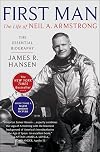
A boy from Ohio fascinated by planes and how they are engineered one day becomes the most famous man on the planet by stepping onto the Moon. First Man: The Life of Neil A. Armstrong is the authorized biography of the Apollo 11 commander by James R. Hansen.
Hansen centers the biography on the Apollo 11 mission, which from the decision to name Neil Armstrong commander to his return home. The first quarter and the final quarter of the biography literally bookends those approximately eight show more months with the former detailing Armstrong’s childhood passion for flight that led to his career as a test pilot then astronaut and the later detailing how the modest Armstrong adjusted—or did not—to worldwide fame that only lessened in everyday life as he grew older. Given the number of pages that Hansen concentrated on Armstrong’s time with NASA, there are a lot of vehicle abbreviations that need to be negotiated when reading but Hansen does a good job in make sure readers learn the terms however if one doesn’t pay attention, you can miss something and get confused. Yet this book is a fantastic read thanks to Hansen’s interviews of Armstrong and his extensive research into the Apollo 11 logs which flesh out those momentous July days for those not alive to experience them.
First Man is a very well written biography that blends NASA archived logs, author interviews of Armstrong, and interviews of fellow Gemini and Apollo astronauts. show less
Hansen centers the biography on the Apollo 11 mission, which from the decision to name Neil Armstrong commander to his return home. The first quarter and the final quarter of the biography literally bookends those approximately eight show more months with the former detailing Armstrong’s childhood passion for flight that led to his career as a test pilot then astronaut and the later detailing how the modest Armstrong adjusted—or did not—to worldwide fame that only lessened in everyday life as he grew older. Given the number of pages that Hansen concentrated on Armstrong’s time with NASA, there are a lot of vehicle abbreviations that need to be negotiated when reading but Hansen does a good job in make sure readers learn the terms however if one doesn’t pay attention, you can miss something and get confused. Yet this book is a fantastic read thanks to Hansen’s interviews of Armstrong and his extensive research into the Apollo 11 logs which flesh out those momentous July days for those not alive to experience them.
First Man is a very well written biography that blends NASA archived logs, author interviews of Armstrong, and interviews of fellow Gemini and Apollo astronauts. show less

This is a biography of the first man to walk on the Moon, which inspired the recent film of the same name (which I watched while reading this, and enjoyed). Armstrong was wary of potential chroniclers of his life, due to negative experiences at the hands of some journalists and other unscrupulous people in the heady immediate post-Apollo XI period, so steered clear of potential interviewers or biographers until James Hansen was able to persuade him to be interviewed extensively for this show more biography in 2005. Hansen says that Armstrong did not seek to influence his writing or conclusions, thus this is quite a rounded biography of the great astronaut, an authorised biography in the sense that it had access to family details and personal accounts from family members, but also maintains some critical distance from his subject.
It is quite a long biography, and also quite dry in a few places for most readers, with many technical details of various aircraft and early spacecraft in which he flew; though Armstrong would have welcomed this as he saw himself primarily as an engineer whose life was about resolving problems in this field. That said, much research has been done on his family background, which has been traced back ten generations to the first Armstrongs to emigrate from Scotland to America in the early 18th century. Neil was born in a small town in Ohio in 1930. He was fascinated by flying from an early age, and is quoted as saying that even in elementary school his intention was to be an aircraft designer. He gained a student pilot's license when he turned 16. He became a naval aviator and was taking part in the Korean War (including nearly parachuting into a minefield) in his very early 20s. He then became a test pilot, testing increasingly sophisticated aircraft that could fly higher and faster than ever before. This was a very dangerous business - far more test pilots died in flight than ever have in the whole history of spaceflight from the 1960s to date.
Neil applied for astronaut selection in 1962, shortly after the tragic death of his two year old daughter Karen from a brain tumour. Before the Apollo programme, he was command pilot in 1966 for Gemini VIII, in which, on the way back from performing the first docking of two spacecraft in orbit, he and co-pilot David Scott, went tumbling away end to end, potentially disastrously, before regaining control. This wasn't the end of Neil's brushes with death; while flying a lunar landing research vehicle in 1968, he had to parachute out seconds before it blew up. The story of Apollo XI is too well known to need recounting in this review, but suffice it to say that Armstrong's personal unflappability and resourcefulness demonstrated why he was absolutely the right person to command this first and successful attempt to land on the moon and return safely to Earth.
(As an aside on the Apollo programme, I have often thought that Apollo 8, that flew at Christmas 1968, should be better known, as its astronauts - including Jim Lovell who later commanded the ill-fated Apollo 13 in 1970 - were the first humans to leave Earth’s gravitational field and actually travel to the moon's vicinity, and orbit it successfully).
After the storming success of Apollo XI, the rest of Armstrong's life was, in a sense, perforce an anti-climax. After a brief period as a NASA administrator, he spent a decade in academia and was headhunted for the boards of many companies. He spread himself too thinly, and in the end this told on his marriage, he and his wife Janet splitting in 1990 after 34 years together. He kept up his support for the space programme, such as it was, and objected, albeit politely and in a restrained manner, to the Obama administration's regrettable decision to cancel NASA's plans to return men to the Moon by 2020. Astronauts, being resilient and in peak physical condition, tend to lead long lives and Armstrong was generally in fine condition until his death from complications after heart surgery in August 2012 (slightly mysteriously, after he had been expecting to make a full recovery). His place as a giant in the history of exploration and engineering is assured, and even those who know nothing about spaceflight would recognise his famous words as he stepped onto the Moon's surface. But he never considered himself an explorer: “What I attended to was the progressive development of flight machinery. My exploration came totally as a by-product of that. I flew to the Moon not so much to go there, but as part of developing the systems that would allow it to happen.” He did that, of course, but so much more. show less
It is quite a long biography, and also quite dry in a few places for most readers, with many technical details of various aircraft and early spacecraft in which he flew; though Armstrong would have welcomed this as he saw himself primarily as an engineer whose life was about resolving problems in this field. That said, much research has been done on his family background, which has been traced back ten generations to the first Armstrongs to emigrate from Scotland to America in the early 18th century. Neil was born in a small town in Ohio in 1930. He was fascinated by flying from an early age, and is quoted as saying that even in elementary school his intention was to be an aircraft designer. He gained a student pilot's license when he turned 16. He became a naval aviator and was taking part in the Korean War (including nearly parachuting into a minefield) in his very early 20s. He then became a test pilot, testing increasingly sophisticated aircraft that could fly higher and faster than ever before. This was a very dangerous business - far more test pilots died in flight than ever have in the whole history of spaceflight from the 1960s to date.
Neil applied for astronaut selection in 1962, shortly after the tragic death of his two year old daughter Karen from a brain tumour. Before the Apollo programme, he was command pilot in 1966 for Gemini VIII, in which, on the way back from performing the first docking of two spacecraft in orbit, he and co-pilot David Scott, went tumbling away end to end, potentially disastrously, before regaining control. This wasn't the end of Neil's brushes with death; while flying a lunar landing research vehicle in 1968, he had to parachute out seconds before it blew up. The story of Apollo XI is too well known to need recounting in this review, but suffice it to say that Armstrong's personal unflappability and resourcefulness demonstrated why he was absolutely the right person to command this first and successful attempt to land on the moon and return safely to Earth.
(As an aside on the Apollo programme, I have often thought that Apollo 8, that flew at Christmas 1968, should be better known, as its astronauts - including Jim Lovell who later commanded the ill-fated Apollo 13 in 1970 - were the first humans to leave Earth’s gravitational field and actually travel to the moon's vicinity, and orbit it successfully).
After the storming success of Apollo XI, the rest of Armstrong's life was, in a sense, perforce an anti-climax. After a brief period as a NASA administrator, he spent a decade in academia and was headhunted for the boards of many companies. He spread himself too thinly, and in the end this told on his marriage, he and his wife Janet splitting in 1990 after 34 years together. He kept up his support for the space programme, such as it was, and objected, albeit politely and in a restrained manner, to the Obama administration's regrettable decision to cancel NASA's plans to return men to the Moon by 2020. Astronauts, being resilient and in peak physical condition, tend to lead long lives and Armstrong was generally in fine condition until his death from complications after heart surgery in August 2012 (slightly mysteriously, after he had been expecting to make a full recovery). His place as a giant in the history of exploration and engineering is assured, and even those who know nothing about spaceflight would recognise his famous words as he stepped onto the Moon's surface. But he never considered himself an explorer: “What I attended to was the progressive development of flight machinery. My exploration came totally as a by-product of that. I flew to the Moon not so much to go there, but as part of developing the systems that would allow it to happen.” He did that, of course, but so much more. show less
Lists
Awards


You May Also Like


Associated Authors
Statistics
- Works
- 13
- Also by
- 1
- Members
- 1,264
- Popularity
- #20,302
- Rating
- 3.9
- Reviews
- 25
- ISBNs
- 72
- Languages
- 7


