
Flavius Josephus (–0100)
Author of The Works of Josephus
About the Author
A member of a wealthy priestly family in Judea, Josephus was a Pharisee originally named Joseph ben Matthias. An active supporter of anti-Roman activity, he became governor of Galilee, a post he held with honor and valor until Galilee was taken by the Romans in a.d. 67. He won the favor of the show more Roman general Vespasian, whose name---Flavius---he took as his own and through whose patronage he later became a Roman citizen. Although often criticized for becoming a supporter of Rome, in his work Against Apion he passionately defends Jewish religion and culture. Josephus wrote both in Greek and in Hebrew. His writings are neither remarkably fine representatives of classical culture nor the product of deep learning in Jewish literature and history. They do, however, tell the reader a great deal not known from other sources. The Jewish War (75--79), based to a great extent on what Josephus himself saw, heard, and experienced, describes the tragic events of the Jewish revolt against Rome. Antiquities of the Jews (93) covers the history of the Jews from creation to the war with Rome, with special attention given to the Maccabees and the dynasty of Herod. (Bowker Author Biography) show less
Image credit: Roman bust supposed to represent Flavius Josephus (identification is unsure though)
Series
Works by Flavius Josephus
The Complete Works of Flavius Josephus - Legendary Jewish Historian and His Chronicle of Ancient History (1999) 150 copies
Josephus Flavius: Complete Works and Historical Background (Annotated and Illustrated) (Annotated Classics) (1839) 33 copies
The second Jewish Commonwealth;: From the Maccabaean Rebellion to the outbreak of the Judaeo-Roman War (Schocken paperbacks) (1971) 27 copies
La Guerra De Los Judios (Coleccion Sepan Cuantos # 374) (Spanish Edition) (1998) 17 copies, 1 review
Jewish Antiquities, Books 8-13 16 copies
History of the Jews (The Works of Flavius Josephus Complete in Three Volumes, Volume 3 of 3) (1908) 13 copies
Jewish Antiquities, Books 14-20 13 copies
The works of Flavius Josephus :VOL. III 12 copies
Complete Works of Josephus, Vol. 2 of 4: Antiquities of the Jews; The Wars of the Jews Against Apion, Etc., Etc (Classic Reprint) (2015) 9 copies
The Works of Flavius Josephus: Comprising the Antiquities of the Jews: A History of the Jewish Wars (With Explanatory Notes) (1911) 9 copies
Complete Works of Josephus. Antiquities of the Jews; The Wars of the Jews Against Apion, Etc., .. Volume 4 (2013) 8 copies
Complete Works of Josephus, Vol. 1 of 4: Antiquities of the Jews; The Wars of the Jews Against Apion, Etc., Etc (Classic Reprint) (2015) 7 copies
Josephus, Complete Works of 4 Vols 6 copies
Complete Works of Josephus, Vol. 3 of 4: Antiquities of the Jews; The Wars of the Jews Against Apion, Etc (Classic Reprint) (2015) 5 copies
La guerra jueva, vol. I (llibre I) (Bernat Metge) (Catalan and Ancient Greek Edition) (2011) 5 copies, 2 reviews
Tranen over Jeruzalem : grepen uit Flavius Josephus' De oude geschiedenis van de joden (1996) 5 copies
Uma Testemunha do Tempo dos Apóstolos - Coleção Documentos do Mundo da Bíblia (Em Portuguese do Brasil) (2001) 4 copies
Oeuvres complètes de Flavius Josèphe. Antiquités judaïques. Tome 1 (Religion) (French Edition) (2013) 4 copies
Autobiografía. Sobre la antigüedad de los judíos (El libro de bolsillo - Clásicos de Grecia y Roma) (Spanish Edition) (2015) 3 copies
La guerra de los judíos. Libros IV-VII (Biblioteca Clásica Gredos) (Spanish Edition) (2016) 3 copies
Jewish Antiquities. Books XV-XVII. With an English Translation by Ralph Marcus. Completed and edited by Allen Wikgren. (1990) 3 copies
Jewish Antiquities, Books 14-16 3 copies
The Complete Works of Flavius Josephus. Illustrated: War of the Jews, Antiquities of the Jews, Against Apio and others (2021) 2 copies
Loeb: Josephus, Vol. IX: Jewish Antiquities, Books XVIII-XX, General Index to Volumes I-IX] (1965) 2 copies
The Jewish Antiquities XVIII-XX 2 copies
The Life Against Apion. The Jewish War. Jewish Antiquities. [stated complete in 9 volumes] (The Loeb Classical Library) (1927) 2 copies
Antiquities of the Jews 2 copies
Oeuvres complètes 2 copies
The Life of Woodrow Wilson 2 copies
The famous and memorable works of Josephus, a man of much honour and learning among the Jews 2 copies
The Life of Flavius Josephus [Paperback] Flavius Josephus [Paperback] Flavius Josephus (2023) 2 copies
La guerra giudaica, Vol. II 2 copies
La prise de Jérusalem 2 copies
The Works: Comprising the Antiquities of the Jews; a History of the Jewish Wars, and Life of Flavius Josephus (2011) 2 copies
The new complete works of Josephus 2 copies
The Essenes 2 copies
Josephus. With an English Translation. In Eight Volumes. I: The Life, Against Apion (Loeb Classical Library) (1926) 2 copies
Complete Works of Josephus in Ten Volumes, Volume 6: Antiquities of the Jews, Books XVII-XX 2 copies
FLAVIUS-JOSEPHUS 2 copies
Works of Josephus, Vol. 3 1 copy
Works of Josephus, Vol. 2 1 copy
Works of Josephus, Vol. 1 1 copy
The Jewish War: Books 1–7 1 copy
Иудейские древности 1 copy
Ἰώσηπος: Κατ' Ἀπίωνος 1 copy
Κατ' απίωνος 1 copy
Antiquitates Judaicai 1 copy
Jewish Antiquities, Bks.XII-XIV v. 7 (Loeb Classical Library) by Josephus (1998-10-23) (1618) 1 copy
Works of Josephus, Vol. 4 1 copy
liefde is 1 copy
Historia dos Hebreus v.3 1 copy
Historia dos Hebreus v.1 1 copy
ユダヤ古代誌〈11〉 (1984年) 1 copy
ユダヤ古代誌〈3~4〉 (1983年) 1 copy
ユダヤ古代誌〈1~2〉 (1982年) 1 copy
ユダヤ古代誌〈20〉 (1981年) 1 copy
ユダヤ古代誌〈16~17〉 (1980年) 1 copy
Guerra de los judíos I 1 copy
Guerra de los judíos II 1 copy
La guerra giudaica 2 1 copy
La guerra giudaica 1 1 copy
La guerra giudaica. 1 1 copy
ユダヤ古代誌〈12~13〉 (1979年) 1 copy
ユダヤ古代誌〈5~6〉 (1984年) 1 copy
Historia dos Hebreus v.5 1 copy
Historia dos Hebreus v.6 1 copy
Historia dos Hebreus v.7 1 copy
Historia dos Hebreus v.8 1 copy
Historia dos Hebreus v.9 1 copy
Histoire de Fl. Iosèphe 1 copy
ユダヤ古代誌〈9~10〉 (1984年) 1 copy
Dell'antichità de' giudei di Flavio Giuseppe libri XX / tradotti nuovamente per Francesco Baldelli 1 copy
ユダヤ古代誌〈7~8〉 (1984年) 1 copy
Antithesis 1 copy
Des Flavius Josephus Kleinere Schriften (Selbstbiographie - Gegen Apion - Über die Makkabäer) 1 copy
The Jewish War, Books 1-3 1 copy
Aus Meinem Leben (Vita): Kritische Ausgabe, Ubersetzung und Kommentar (German Edition) (2012) 1 copy
The Genuine and Complete Works of Flavius Josephus, The Celebrated Warlike, Learned and Authentic Jewish Historian (1828) 1 copy
Der Jüdische Krieg und Kleinere Schriften: Mit der Paragraphenzählung nach Benedict Niese (2012) 1 copy
"Jerusalem and Rome, Etc." 1 copy
De bello Judaico - der Jüdische Krieg. Griechisch und Deutsch / Band III, Ergänzungen und register (2015) 1 copy
Antichitati Iudaice 1 copy
Guerre Des Juifs, vol. 3 1 copy
Josephus 1 copy
Guerre Des Juifs, vol. 2 1 copy
Josephus (2 vols.) 1 copy
Wojna żydowska 1 copy
Dissertations I-III 1 copy
A Zsdó háború 1 copy
The Life and Works of Falvius Josephus...to Which are Added Seven Disseratatins...with an Introductory Essay By H. Stebbing (1940) 1 copy
Historical works 1 copy
Works of Flavius Josephus, the learned and authentic Jewish historian, and celebrated warrior 1 copy
A zsidó háború 1 copy
Associated Works
The Jewish caravan : great stories of twenty-five centuries (1965) — Contributor, some editions — 141 copies
The Dedalus Book of Roman Decadence: Emperors of Debauchery (Decadence from Dedalus) (1994) — Contributor — 53 copies
Women in Power: Classical Myths and Stories, from the Amazons to Cleopatra (2024) — Contributor — 34 copies
The Delphian Course : Part Three : Greek Drama, Philiosopy and Literature, the Story of Rome (1913) — Contributor — 8 copies
Bible Explorer — Contributor — 1 copy
Tagged
Common Knowledge
- Canonical name
- Josephus, Flavius
- Legal name
- Titus Flavius Josephus
- Other names
- Yosef Ben Matityahu (Joseph ∙ son of Matthias)
Josephus - Birthdate
- 37 AD
- Date of death
- 0100 (c.)
- Gender
- male
- Education
- Temple of Jerusalem
- Occupations
- priest
general
historian
author
philosopher - Organizations
- Priest at the Temple of Jerusalem
- Awards and honors
- Commander of the Great Jewish Rebellion in Galilee in 70 AD
Commander of the Fortress of Jotapata, Galilee for the Rebellion
Given an Imperial Pension by Titus and made a Roman Citizen - Nationality
- Judea
Roman Empire - Birthplace
- Jerusalem, Judea
- Places of residence
- Jerusalem, Judea
Jotapata, Galilee
Rome, Roman Empire - Place of death
- Rome
- Burial location
- Rome
- Map Location
- Israel
Members
Discussions
Folio Archives 320: Life of Herod by Josephus 2007 in Folio Society Devotees (May 2023)
Three cheers for Josephus in Ancient History (November 2011)
Reviews

I read the book, not the audio edition, but this is the only entry I could find. Josephus may not be as prone to hyperbole as Herodotus, but it must be close. This edition is based on Josephus' expurgated version, removing all the Jesus references but leaving the impossible facts in. Well, they are included in the appendix. My favoriate part is the exasperated editor's footnotes in increasing disbelief at Josephus' incredulity as the book progresses.
Josephus’ account of a war marked by treachery and atrocity is a superbly detailed and evocative record of the Jewish rebellion against Rome between AD 66 and 70. Originally a rebel leader, Josephus changed sides after he was captured to become a Rome-appointed negotiator, and so was uniquely placed to observe these turbulent events, from the siege of Jerusalem to the final heroic resistance and mass suicides at Masada. His account provides much of what we know about the history of the show more Jews under Roman rule, with vivid portraits of such key figures as the Emperor Vespasian and Herod the Great. Often self-justifying and divided in its loyalties, The Jewish War nevertheless remains one of the most immediate accounts of war, its heroism and its horrors, ever written. show less

An intimidatingly long book that I enjoyed very much, once I had worked out which parts I could skip and skim.
In the first half, which runs from the creation of the universe to the Exile, Josephus takes the narrative parts of the Torah and the Former Prophets and retells them in such a way as to remove all the subtlety and depth. It’s stultifyingly dull. But all is not quite as it seems. In his account of Moses, for example, where we would expect to read an account of the murder of the show more Egyptian and Moses’ flight into Midian, Josephus tells us how Moses was appointed General of the Egyptian forces and invaded Ethiopia. This accounts for his Ethiopian wife. He then flees to Midian to escape the jealousy of the other Egyptian generals. Yet Josephus stresses multiple times throughout the whole work that he is simply recounting what he has read in the Jewish sacred books. Apparently there is a medieval Jewish text that recounts a very similar story of Moses. Did such a text exist at the time, or has he taken the story from an oral tradition? Was this alternative story widely believed at the time? If it existed as a text was it considered canon? Personally I’m not convinced that Josephus is entirely trustworthy. I think he may have been a bit of a scoundrel. He wrote this book in Greek for Hellenised peoples and, by extension, educated Romans. I think his deviation in the story is politically motivated. Thinking it might make a bad impression if the founder of Judaism made himself a murderer on account of a slave, I believe Josephus has cleaned things up and put a bit of spin on the story. There are quite a few instances of this sort of thing in the book and there’s probably a thesis or two to be made out of them if anyone can bear to trawl through. But I pity the person who undertakes it because these points of interest are few and far between and on the whole this first half is so boring it made me want to die. I skipped and skimmed through most of it. If you want to know the story, read the Old Testament where it’s told with infinitely more brevity and wit.
The second half of the book, from the Exile to the 60s AD is very different and really fascinating. Again, not everything Josephus says is true. Take, for instance, his account of Alexander’s deferential attitude to the Jews when he conquers Jerusalem and his reverence when the priests show how his coming was foretold in the Book of Daniel. An incredible story – literally – as Daniel wasn’t written until 164BC. Obviously, Josephus has a political agenda here. Following this there is a long political/military history of a Hellenising world. You get a real idea of what it would be like to live at the confluence of three major empires, all jostling for power in the region. Total carnage. It can get quite confusing as often the kings in a dynasty alternate between only two names and the accounts of each are brief. I wouldn’t want to lengthen this section but I could have done with more information on Queen Alexandra, who seems very interesting. Over all is the lengthening shadow of Rome and their attack, when it comes, is shockingly quick. You might note how Pompey’s desecration of the Temple is downplayed. The Roman’s bring the aqueduct, and peace. And let’s be honest, they’re the only ones who could in a place like that. They might bring peace, but they also bring Herod. Jopsephus’s account of Herod is detailed, exciting and at times really disturbing. I used to work with people who suffered from mental ill health and know a bit about the subject. Josephus is obviously biased and says as much himself, but I’m inclined to largely trust his account because even though my concept of poor mental health differs greatly from the concepts of the ancient world I could still clearly identify a number of the conditions with which Herod suffered. I understand there is a recent biography by a psychiatrist which analyses Herod using psycho-analytical theory. I’m going to track drown a copy.
So, very much a game of two halves and for my star rating I’ve taken the average. Certainly worth popping your nose in and taking a look even if you don’t read the whole thing. And it’s not without humour. At XIII:375-6 Josephus describes the later career of some petty warlord:
“From thence he fled to Jerusalem, where, on account of ill-success, the nation insulted him, and he fought against them for six years, and slew no fewer than fifty thousand of them.-And when he desired that they would desist from their ill-will to him, they hated him so much the more, on account of what had already happened; and when he had asked them what he ought to do? they all cried out, that ‘he ought to kill himself.’” show less
In the first half, which runs from the creation of the universe to the Exile, Josephus takes the narrative parts of the Torah and the Former Prophets and retells them in such a way as to remove all the subtlety and depth. It’s stultifyingly dull. But all is not quite as it seems. In his account of Moses, for example, where we would expect to read an account of the murder of the show more Egyptian and Moses’ flight into Midian, Josephus tells us how Moses was appointed General of the Egyptian forces and invaded Ethiopia. This accounts for his Ethiopian wife. He then flees to Midian to escape the jealousy of the other Egyptian generals. Yet Josephus stresses multiple times throughout the whole work that he is simply recounting what he has read in the Jewish sacred books. Apparently there is a medieval Jewish text that recounts a very similar story of Moses. Did such a text exist at the time, or has he taken the story from an oral tradition? Was this alternative story widely believed at the time? If it existed as a text was it considered canon? Personally I’m not convinced that Josephus is entirely trustworthy. I think he may have been a bit of a scoundrel. He wrote this book in Greek for Hellenised peoples and, by extension, educated Romans. I think his deviation in the story is politically motivated. Thinking it might make a bad impression if the founder of Judaism made himself a murderer on account of a slave, I believe Josephus has cleaned things up and put a bit of spin on the story. There are quite a few instances of this sort of thing in the book and there’s probably a thesis or two to be made out of them if anyone can bear to trawl through. But I pity the person who undertakes it because these points of interest are few and far between and on the whole this first half is so boring it made me want to die. I skipped and skimmed through most of it. If you want to know the story, read the Old Testament where it’s told with infinitely more brevity and wit.
The second half of the book, from the Exile to the 60s AD is very different and really fascinating. Again, not everything Josephus says is true. Take, for instance, his account of Alexander’s deferential attitude to the Jews when he conquers Jerusalem and his reverence when the priests show how his coming was foretold in the Book of Daniel. An incredible story – literally – as Daniel wasn’t written until 164BC. Obviously, Josephus has a political agenda here. Following this there is a long political/military history of a Hellenising world. You get a real idea of what it would be like to live at the confluence of three major empires, all jostling for power in the region. Total carnage. It can get quite confusing as often the kings in a dynasty alternate between only two names and the accounts of each are brief. I wouldn’t want to lengthen this section but I could have done with more information on Queen Alexandra, who seems very interesting. Over all is the lengthening shadow of Rome and their attack, when it comes, is shockingly quick. You might note how Pompey’s desecration of the Temple is downplayed. The Roman’s bring the aqueduct, and peace. And let’s be honest, they’re the only ones who could in a place like that. They might bring peace, but they also bring Herod. Jopsephus’s account of Herod is detailed, exciting and at times really disturbing. I used to work with people who suffered from mental ill health and know a bit about the subject. Josephus is obviously biased and says as much himself, but I’m inclined to largely trust his account because even though my concept of poor mental health differs greatly from the concepts of the ancient world I could still clearly identify a number of the conditions with which Herod suffered. I understand there is a recent biography by a psychiatrist which analyses Herod using psycho-analytical theory. I’m going to track drown a copy.
So, very much a game of two halves and for my star rating I’ve taken the average. Certainly worth popping your nose in and taking a look even if you don’t read the whole thing. And it’s not without humour. At XIII:375-6 Josephus describes the later career of some petty warlord:
“From thence he fled to Jerusalem, where, on account of ill-success, the nation insulted him, and he fought against them for six years, and slew no fewer than fifty thousand of them.-And when he desired that they would desist from their ill-will to him, they hated him so much the more, on account of what had already happened; and when he had asked them what he ought to do? they all cried out, that ‘he ought to kill himself.’” show less
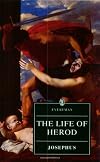
Many of the ancient historians are absolute musts. I wasn't much interested in a Roman-Jew's account of Romanised Judea, but I found it in a 2nd hand shop, a fabulous folio edition in pristine condition so of course I made love to it on the bookshop floor and then ran home screaming joy.
The reward was unexpected.
If you've seen "I, Claudius" (BBC) or read the book (Robert Graves), then there's your comparison; Life of Herod reads like 'I, Herod' in that it too is a culminating tangle of show more Sopranos-like family intrigues.
"Friends, I'm hitting the road but if anything happens to me, don't forget to put my beloved wife and mother in law to the sword. Oh and don't tell me wife I left you these instructions, she'll be really mad..."
There's nothing much about battles, details wise, but enough about Mark Antony, Cleopatra (who comes on to Herod at one point, probably because he had an appendage and a pulse. And power). Also Agrippa, the Caesars and of course, all kinds of zealots at cross purposes. Ancient history is old school fun. show less
The reward was unexpected.
If you've seen "I, Claudius" (BBC) or read the book (Robert Graves), then there's your comparison; Life of Herod reads like 'I, Herod' in that it too is a culminating tangle of show more Sopranos-like family intrigues.
"Friends, I'm hitting the road but if anything happens to me, don't forget to put my beloved wife and mother in law to the sword. Oh and don't tell me wife I left you these instructions, she'll be really mad..."
There's nothing much about battles, details wise, but enough about Mark Antony, Cleopatra (who comes on to Herod at one point, probably because he had an appendage and a pulse. And power). Also Agrippa, the Caesars and of course, all kinds of zealots at cross purposes. Ancient history is old school fun. show less
Lists
You May Also Like


Associated Authors
Statistics
- Works
- 454
- Also by
- 11
- Members
- 13,671
- Popularity
- #1,696
- Rating
- 3.9
- Reviews
- 78
- ISBNs
- 470
- Languages
- 21
- Favorited
- 6
