
H. W. Fowler (1858–1933)
Author of A Dictionary of Modern English Usage
About the Author
Disambiguation Notice:
A Dictionary of Modern English Usage, originally written by H. W. Fowler, has been the subject of two revisions: a light revision by Sir Ernest Gowers and a far more extensive revision by R. W. Burchfield. This latter revision should not be considered the same work as the original, or the Gowers revision. Combiners of the two will be tarred and feathered.
Note also that The King's English was co-written by Henry Watson Fowler and his brother Francis.
Works by H. W. Fowler
The Shorter Oxford English Dictionary on Historical Principles (1933) — Contributor, some editions; Editor; Editor — 611 copies, 7 reviews
If wishes were horses 2 copies
THE CONCISE OXFORD DICTIONARY OF CURRENT ENGLISH. FIFTH EDITION. REVISED AND COMPLETELY RESET. (1954) 1 copy
Some comparative values 1 copy
Associated Works
Oxford Universal English Dictionary on Historical Principles, Vol. IV: Fit-Ice — Editor — 2 copies
Tagged
Common Knowledge
- Canonical name
- Fowler, H. W.
- Legal name
- Fowler, Henry Watson
- Birthdate
- 1858-03-10
- Date of death
- 1933-12-26
- Gender
- male
- Education
- Balliol College, Oxford (BA|1886)
Rugby School - Occupations
- schoolmaster
lexicographer - Organizations
- Sedbergh School
- Relationships
- Fowler, F. G. (brother)
- Nationality
- UK
- Birthplace
- Tonbridge, Kent, England, UK
- Places of residence
- Guernsey, Bailiwick of Guernsey
Rugby, Warwickshire, England, UK
London, Middlesex, England, UK - Place of death
- Hinton St George, Somerset, England, UK
- Map Location
- England, UK
- Disambiguation notice
- A Dictionary of Modern English Usage, originally written by H. W. Fowler, has been the subject of two revisions: a light revision by Sir Ernest Gowers and a far more extensive revision by R. W. Burchfield. This latter revision should not be considered the same work as the original, or the Gowers revision. Combiners of the two will be tarred and feathered.
Note also that The King's English was co-written by Henry Watson Fowler and his brother Francis.
Members
Reviews
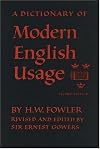
I have to agree with the more erudite reviews already posted: in some ways, this is a 5-star work. In others, it's a write-off.
As a writer myself, I find Fowler to be one of the pre-eminent reference texts. He covers a vast range of words and phrases - from the regularly misused to archaisms which, when they are used, need clarifying - with a wit that often borders on scathing. It's great fun to be searching for a simple definition or clarification, and end up having a good giggle at the show more same time. Because the book was written in the 'glory days' of the early 20th century, Fowler takes time to explain his stance, without resorting to dumbing down the information.
On the other hand, as other commentators have noted, one of the joys of the English language is its evolution. I believe that the history of a word is vitally important, that being more than simply competent in your language is a great gift, and thus am I against these dimwitted arguments to simplify our spelling, or limit our general vocabulary in academic institutions or the media. However, language is in a state of constant flux, and to argue that there is only ever one correct usage of a word or term is ridiculous. Something that was correct in 1926 for Fowler may be ludicrous for us in 2012, and may have been equally so for Elizabeth I, or Samuel Johnson, or Jane Austen. Beyond this, Fowler seems to be confused about the distinction between formal and informal language use. Is idomatic English to be held to the same standards as formal documents? Isn't one of the joys of being proficient in your language, that you can stretch the boundaries of meaning and definition - both in a parodic, conversational manner, and in a serious way? As with anyone who grows passionate about a subject that is steeped in tradition, I always feel torn in these situations: to revere Fowler for his wit, intelligence, and passion? Or bemoan him for being a pedant?
The question lingers... show less
As a writer myself, I find Fowler to be one of the pre-eminent reference texts. He covers a vast range of words and phrases - from the regularly misused to archaisms which, when they are used, need clarifying - with a wit that often borders on scathing. It's great fun to be searching for a simple definition or clarification, and end up having a good giggle at the show more same time. Because the book was written in the 'glory days' of the early 20th century, Fowler takes time to explain his stance, without resorting to dumbing down the information.
On the other hand, as other commentators have noted, one of the joys of the English language is its evolution. I believe that the history of a word is vitally important, that being more than simply competent in your language is a great gift, and thus am I against these dimwitted arguments to simplify our spelling, or limit our general vocabulary in academic institutions or the media. However, language is in a state of constant flux, and to argue that there is only ever one correct usage of a word or term is ridiculous. Something that was correct in 1926 for Fowler may be ludicrous for us in 2012, and may have been equally so for Elizabeth I, or Samuel Johnson, or Jane Austen. Beyond this, Fowler seems to be confused about the distinction between formal and informal language use. Is idomatic English to be held to the same standards as formal documents? Isn't one of the joys of being proficient in your language, that you can stretch the boundaries of meaning and definition - both in a parodic, conversational manner, and in a serious way? As with anyone who grows passionate about a subject that is steeped in tradition, I always feel torn in these situations: to revere Fowler for his wit, intelligence, and passion? Or bemoan him for being a pedant?
The question lingers... show less
A Dictionary of Modern English Usage: The Classic First Edition (Oxford World's Classics) by H. W. Fowler
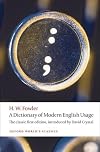
Back in the early 2000s, the software company I worked at had some unused books left over from a project, including a late printing of the first edition of H. W. Fowler’s *A Dictionary of Modern English Usage,* first published Great Britain in 1926. So I snagged it. As David Crystal says in his introduction to this new Oxford World’s Classics reprint, Fowler “writes with an attractive frankness, passion, and sincerity, so that even when we disagree with him we recognize that here is show more someone who has the best of intentions toward the wellbeing of the language. The impression he gives is of an endearingly eccentric, schoolmasterly character, driven at times to exasperation by the infelicities of his wayward pupils, but always wanting the best for them and hoping to provide the best guidance for them in a world where society and language are undergoing rapid change....We encounter entries which display a vivid and imaginative turn of phrase, especially to express his mock-suffering in the face of bad usage.” To a certain kind of reader, one who adores the English language and has a relationship with it akin to one’s relationship with a sibling, Fowler is a lot of fun. That many of the entries are out of date and may never have applied well to American usage at all only adds to the fascination. After over ninety years, you should consult this book to learn how to think about everyday language issues and not necessarily for guidance that you can apply. As an example of Fowler’s tone and approach, here is the opening of his article on *Pedantry:* “Pedantry may be defined…as the saying of things in language so learned or so demonstratively accurate as to imply a slur against the generality, who are not capable or not desirous of such displays. The term, then, is obviously a relative one; my pedantry is your scholarship, his reasonable accuracy, her irreducible minimum of education, and someone’s else’s ignorance. It is therefore not very profitable to dogmatize here on the subject; an essay would establish not what pedantry is, but only the place in the scale occupied by the author…”
The Oxford World’s Classic reprint (dirt cheap at £9.99 or US$17.95; I got it at half price during Oxford University Press’s annual holiday sale) features a fascimile of the entire book, plus the introduction by Crystal and an appendix of his notes on the entries, which are hit and miss: sometimes he notes how the language has since changed and sometimes he only wants to point a finger and call Fowler’s opinion strange or ridiculous. Overall, the notes are interesting enough to make this edition the one to get. show less
The Oxford World’s Classic reprint (dirt cheap at £9.99 or US$17.95; I got it at half price during Oxford University Press’s annual holiday sale) features a fascimile of the entire book, plus the introduction by Crystal and an appendix of his notes on the entries, which are hit and miss: sometimes he notes how the language has since changed and sometimes he only wants to point a finger and call Fowler’s opinion strange or ridiculous. Overall, the notes are interesting enough to make this edition the one to get. show less

I love this book whole-heartedly.
I won't pretend that with this one work you can leap from ignorance to expert knowledge, but if you already have a fair grasp of good usage, and are willing to have to look up the occasional technical term, this is an invaluable guide to the points you sometimes doubt, or know from practice but have never entirely understood.
The age of this edition is no hindrance in this. I find that on occasions when I need to be absolutely right, what I really need to do show more is to be acceptable to the irritable-retired-colonel type, and as he had his schooling before this edition was printed, it is entirely modern enough.
It is also well worth keeping to hand to browse when the mood takes you. In a way that seems uncommon in newer technical works the personality of the expert author shines through. He is passionate and knowledgeable and he wants to share, and to educate, and above all to help. He is sympathetic and helpful, never patronising or arrogant. He has warmth and charm, and a certain dry humour. Best and rarest of all, for a grammatical expert, he hates pedantry, accepts change, and explains in detail why you may split as many infinitives as you wish. show less
I won't pretend that with this one work you can leap from ignorance to expert knowledge, but if you already have a fair grasp of good usage, and are willing to have to look up the occasional technical term, this is an invaluable guide to the points you sometimes doubt, or know from practice but have never entirely understood.
The age of this edition is no hindrance in this. I find that on occasions when I need to be absolutely right, what I really need to do show more is to be acceptable to the irritable-retired-colonel type, and as he had his schooling before this edition was printed, it is entirely modern enough.
It is also well worth keeping to hand to browse when the mood takes you. In a way that seems uncommon in newer technical works the personality of the expert author shines through. He is passionate and knowledgeable and he wants to share, and to educate, and above all to help. He is sympathetic and helpful, never patronising or arrogant. He has warmth and charm, and a certain dry humour. Best and rarest of all, for a grammatical expert, he hates pedantry, accepts change, and explains in detail why you may split as many infinitives as you wish. show less

Those who urge you to throw away your old dictionary and stick with the most modern are mad, mad, mad! This is the best dictionary I have so far and I am so delighted with it. I need a dictionary to look up words I don't know, and to give subtle shadings of words I do know. This dictionary does that far better than my 1975 and 2002 dictionaries (which admittedly are shorter editions), and gives words that have fallen out of the newest in favour of "trackpants" and the like. Using the three show more together is an education in the evolution not only of words but of our view of them. Just a wonderful book. So pleased I found it. show less
Lists
Awards


You May Also Like


Associated Authors
Statistics
- Works
- 23
- Also by
- 13
- Members
- 6,978
- Popularity
- #3,503
- Rating
- 4.2
- Reviews
- 51
- ISBNs
- 112
- Languages
- 2