
K.R. Simms
Author of Parallel Realities: A Turing Fiction
Works by K.R. Simms
Tagged
Common Knowledge
There is no Common Knowledge data for this author yet. You can help.
Members
Reviews
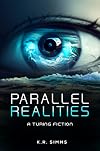
This is an interesting exploration of a future world where neural surgery, intended for healing, turns patients into objects for those who wield the power. The hero, Dawson, is recovering from a serious head injury and alternates between rehabilitation exercises with his father and painful 'recalibrations' by his neurosurgeon. His father cares for him as a person; his doctor denies the father exists and seems to treat Dawson as a human guinea pig who must progress according to expectations show more or face additional torment in the guise of healing. Dawson can’t figure out which world is real and which is fake, and tries to come to terms with that. The author says passages of this book were AI - generated and challenges the reader to find them. Aside from a few grammatical mistakes (run on sentences and errors like using “cue” for “queue”) I couldn’t tell the AI from the human sections. All in all, not a book I usually read - but that’s why I read books! show less
 This review was written for LibraryThing Early Reviewers.
This book is a fun experiment with AI supplying portions of the text, and openly inviting the reader to guess what has been produced by the author, and what has been produced by AI.
Approached in a light-hearted fashion, this is a playful way for us all to reflect on the implications and uses of this new technology, and the way we think about what is 'real'.
Approached in a light-hearted fashion, this is a playful way for us all to reflect on the implications and uses of this new technology, and the way we think about what is 'real'.
This review was written for LibraryThing Early Reviewers.This is a tricky book to review, because I'm both the ideal audience and the worst possible audience for a book that openly uses GPT to co-write the book. It's done in a clever way, trying to break the fourth wall by using AI as a wink to the reader and simultaneously as a plot device. Here's where it's tricky for me, though. I'm a professor of cognitive science who has worked in AI for nearly 30 years. So while I imagine many people love the creative device of using a chatbot in this way, show more for me it's not new and not productive in the way the author clearly intends it to be. There are already hundreds of books co-written with various iterations of GPT and I've been teaching my students the nuances of the technology for a long time. This means that unlike a naïve reader, I can actually detect some of the writing that isn't by a human author, and it really falls flat for me. So while this book did not hit for me at all, and I much would've preferred just a well-written creative piece of fiction from a human, I also don't want to dissuade others from engaging with the text because it might hit very different for someone not in my unique position. show less
This review was written for LibraryThing Early Reviewers.Well, first, let me say I completely failed at figuring out which parts were written by a human and which ones not. That said, it was an interesting story. I tried to figure out which reality was Dawson's real and which was computer fakery. I failed at that as well. All this failing means the book is a success as far as I'm concerned. I wonder if there'll be a breakdown in the final print edition? I did spot a few spelling/grammatical errors, but couldn't tell if they were the fault of the show more writing program or us good ol' fallible humans. Well done. show less
This review was written for LibraryThing Early Reviewers.Statistics
- Works
- 1
- Members
- 36
- Popularity
- #397,830
- Rating
- 3.0
- Reviews
- 29
- ISBNs
- 1

